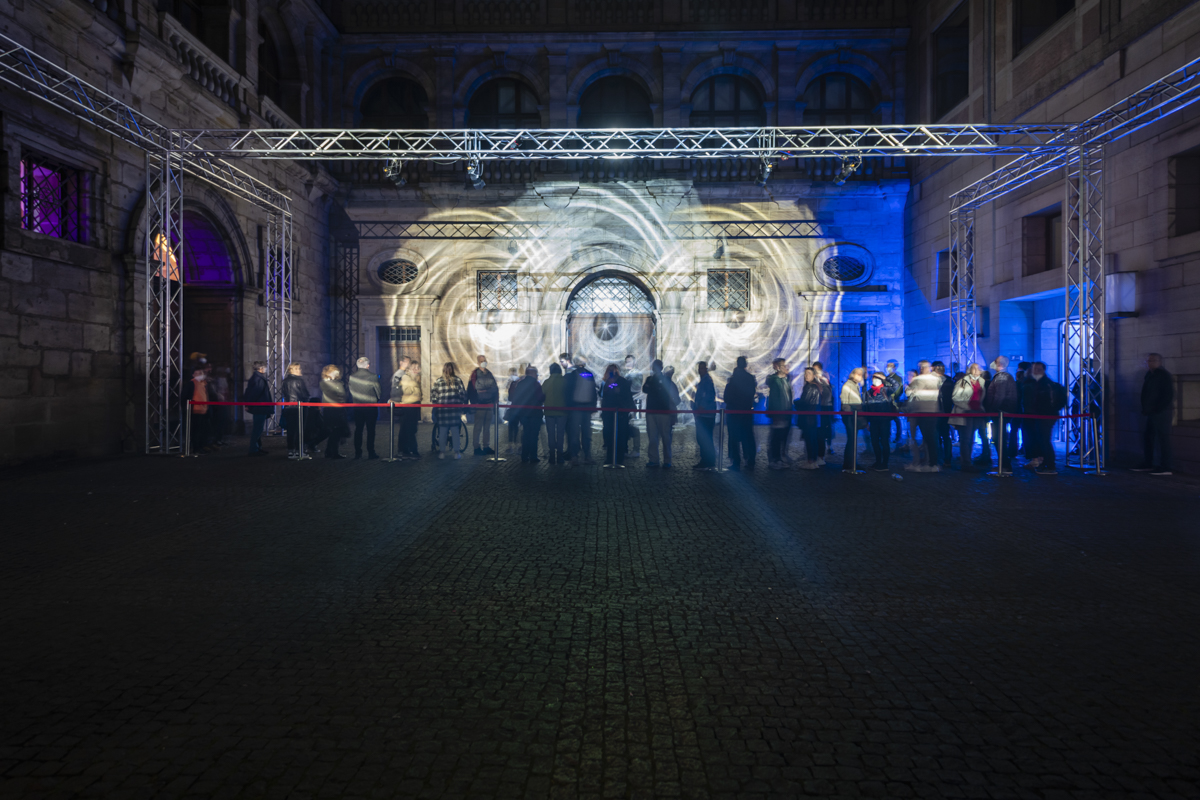
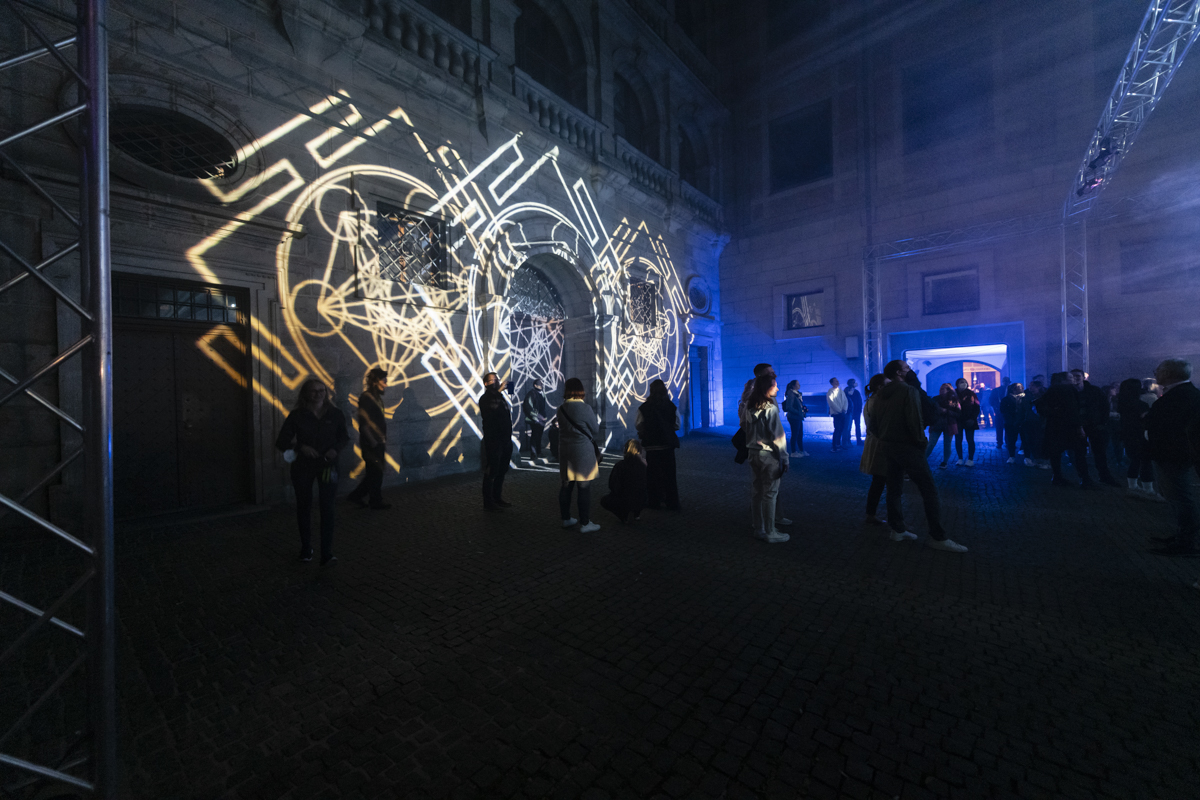
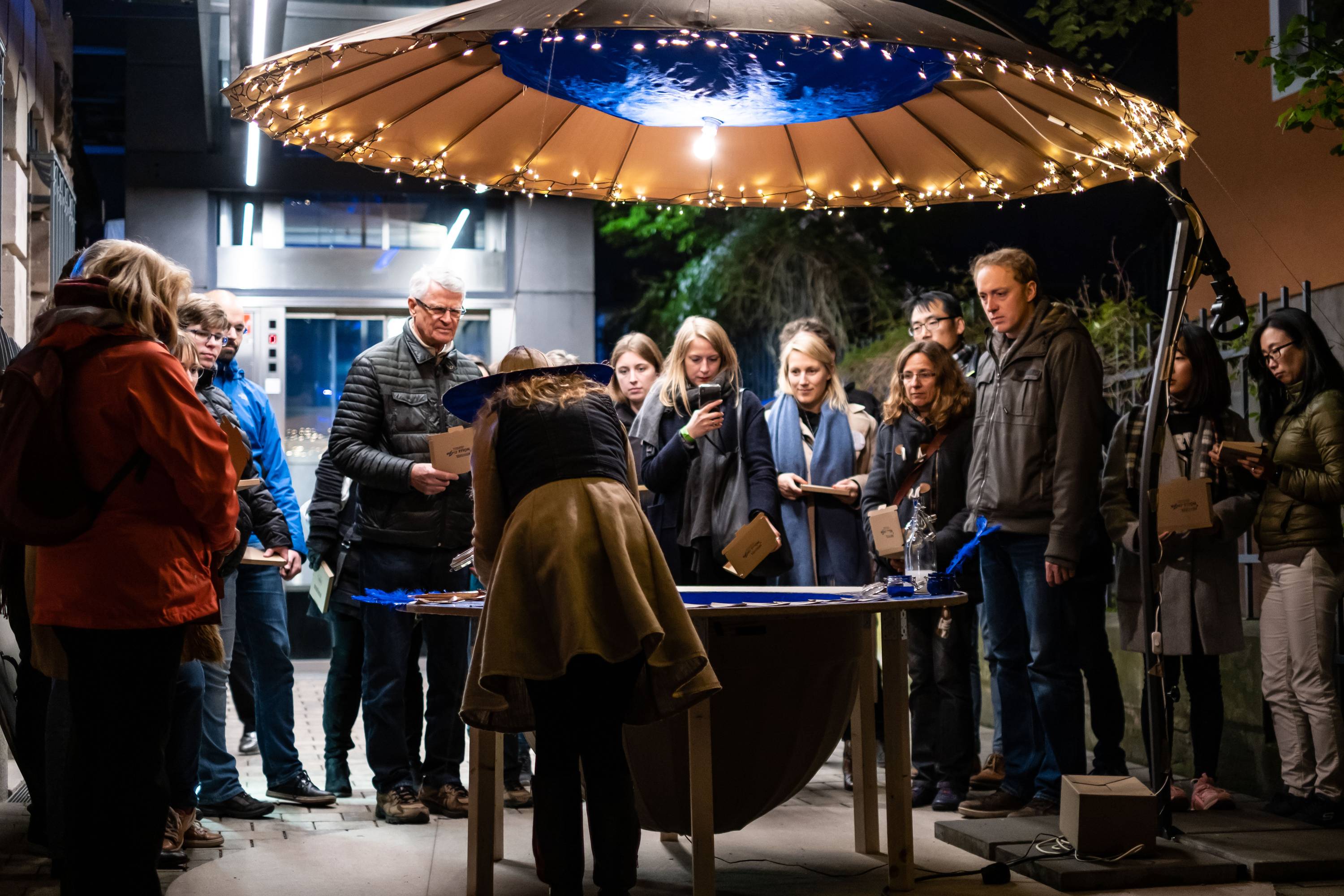
Since 2000, Die Blaue Nacht | The Blue Night has transformed Nuremberg’s Old Town into a stage for art, culture, and encounters for one night—attracting around 110,000 visitors, featuring more than 200 programme items, and involving over 50 participating institutions.
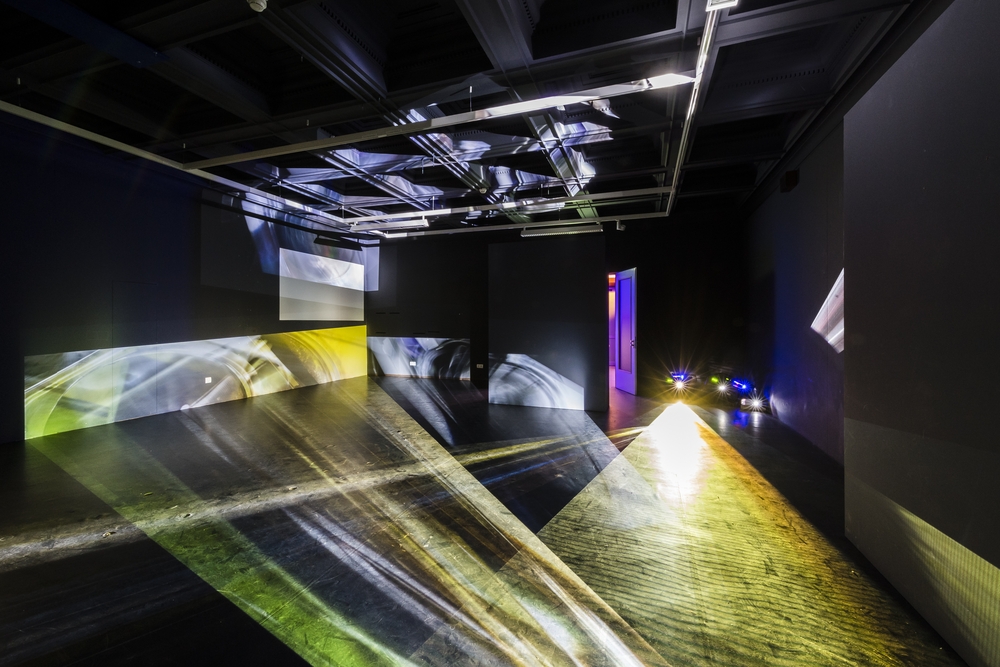
The Die Blaue Nacht | The Blue Night Art Competition has been inviting artists since 2005 to develop site-specific projects in courtyards, indoor locations and squares in Nuremberg’s Old Town. For this competition, we are looking for art that inhabits spaces, engages audiences, and holds its own across two nights. Applications are open to individuals and collectives working across all artistic disciplines, including installations, light art, performance, media art, as well as interactive and participatory projects.
Applications for Die Blaue Nacht | The Blue Night 2027 are closed. The next edition is expected to take place in 2029.
Die Blaue Nacht | The Blue Night 2027:
Fri, 23 April 2027, 8–12 pm: preview of the Art Competition
Sat, 24 April 2027, 7–12 pm: Die Blaue Nacht | The Blue Night
Residency grant from the zumikon Cultural Foundation
For the first time, a selected artist from the International Blue Night Art Competition will have the opportunity to work in Nuremberg for four weeks. The grant comprises 2,000 euros and the use of the foundation’s residency studio.
Icarus dares to fly—and falls. The myth speaks of hubris, longing, overconfidence, and the price of departure. For 2027, we invite artists to connect this ancient story with contemporary questions: Where are we currently flying too close to the sun? Which utopias carry us—and which ones send us plummeting?
The story of Icarus and his father Daedalus, who escape their imprisonment with wings made of wax, gains new relevance in our era of scientific and technological innovation. Technological progress emerges from the interplay between problem and innovation, a dynamic that has continuously intensified in both scale and speed since the Industrial Revolution. Never has humanity reached for the sun more fervently, and warnings against the hubris of “higher, faster, further” are getting louder.
In times of radical acceleration in technological development, multiple crises, and painful societal transformations, Icarus can serve both as a cautionary figure and as a shining example and projection surface. His myth invites us to surpass ourselves, while also reminding us not to go too far. We may hope for success, but there is also an undeniable beauty in failure.
The fields of association for this call are intentionally broad—from Greek mythology to Romanticism to space exploration, from dramatic downfall to collective departure. Climate change, demographics, artificial intelligence, political polarization, personal limits: Icarus is everywhere.
Die Blaue Nacht | The Blue Night 2027 opens the space between utopia and hubris wide.
Please take the following specifics of the event into careful consideration:
Visitor flow: We expect around 10,000 visitors with tickets across 8 to 10 art venues – your project must function during a rush
Duration: The project must be continuously accessible for 4 to 5 hours on Friday and Saturday. Performances may need to be repeated.
Presence: Artists are required to be present at their project on both Friday and Saturday during the event.
Darkness: Sunset on 23/24 April falls around 8:30pm; full darkness only sets in around 9pm. Light-based works must account for this conceptually or address it spatially (e.g. through blackout).
Formats: Works presented in the manner of a white cube exhibition like paintings and sculptures cannot be considered.
Artist's Fee
Selected artists and collectives will receive a flat fee of €1,500 (plus VAT where applicable). The fee covers concept development, preparation, install, deinstall, and attendance at the exhibition venue during the Preview and Die Blaue Nacht | The Blue Night. It is not increased based on the number of participants.
Material Expenses
In addition to the fee, expenses of up to €4,500 (incl. VAT) will be reimbursed upon submission of receipts. This sum covers all project-related expenditure: technical equipment, transport, accommodation, travel, install and de-install staff, barriers, performance rights, and similar costs.
Not eligible for reimbursement:
• Equipment for long-term use (projectors, laptops, etc.) exceeding €300 net. Hire costs may be claimed.
• Meals
• Documentation expenses
Planning should take sustainability (reusability of materials) and cost efficiency (hiring rather than purchasing, where possible) into account.
An advance of up to €750 is available upon request.
Accounting
Within two months of the project’s completion, a full financial statement including all receipts and the budget plan must be submitted. Original receipts must be retained for five years.
Budget Calculation
The cost breakdown is an integral part of the application. Following confirmation by the jury, it may be adjusted for the specific venue. The agreed budget is then binding. Additional sponsorship secured by the artist can be added to the art project’s budget after consultation with the organizers.
Details are specified by the artist contract which is binding.
Documents to Submit
• Brief project concept (2 pages max.)
• Detailed cost breakdown (materials, personnel, technical euqipment, transport, accomodation, performance rights where applicable)
• Information on install and de-install
• CV (1 page max.) and website/social media accounts
• Full contact details (email, mobile number, address)
Applications must be submitted digitally only, by 31 July 2026, to:
blaue.nacht@stadt.nuernberg.de
All applications will be acknowledged by email.
Applicants may indicate one or more preferred exhibition venues (see up-to-date venue list below). Final placement decision rests with the jury.
Tours of the venues will take place mid-May 2026. Please let us know in advance if you are interested.
In autumn 2026, a jury will select up to ten projects for realisation and presentation as part of Die Blaue Nacht | The Blue Night on 23 and 24 April 2027 in Nuremberg.
The competition results will be communicated to all participants in writing by email by the end of November 2026.
Legal recourse is excluded. The jury’s decisions are final and will not be substantiated.
The selected artworks are and remain the property of the artists.
They grant the commissioning party the right to take photographs and videos of the artwork themselves or through photographers commissioned by them. These images will be used in the City of Nuremberg’s public relations work to promote Die Blaue Nacht | The Blue Night (including after the event) and the organiser, and will also be retained for documentation purposes.
A contract will be concluded with all artists selected by the jury regarding the presentation of their artwork at Die Blaue Nacht | The Blue Night 2027. This contract regulates further key financial, legal, copyright-related, and organisational matters between the City of Nuremberg and the selected artists.
Project Leads Die Blaue Nacht | The Blue Night:
Stephanie Milling
E-Mail: stephanie.milling(at)stadt.nuernberg.de
Barbara Schwesig
E-Mail: barbara.schwesig(at)stadt.nuernberg.de
The event organiser proposes specific locations for the realisation of the competition entries (squares, courtyards and other spaces in Nuremberg’s Old Town, 90402 and 90403 Nuremberg; see below). It is not strictly necessary to apply for one of the locations listed and described below; however, a description of the ‘ideal’ conditions for your art project (light conditions, size of the space, enclosed or open space, etc.) is required.
The event organiser reserves the right to assign selected projects to a location different from the one requested.
At most locations, drilling into walls and floors is not possible! At most of the locations, power supply is available with higher connected load than specified. However, costs for this are substantially higher than for standard power connections and have to be included in the calculation and settled via the project budget.
If required, we are offering an on-site visit from mid-May 2026 for all interested parties. Please let us know early if you would like to participate.
The following sites are available for the art competition 2027:
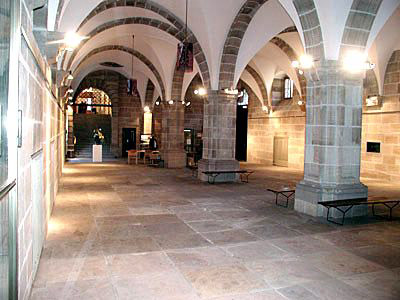
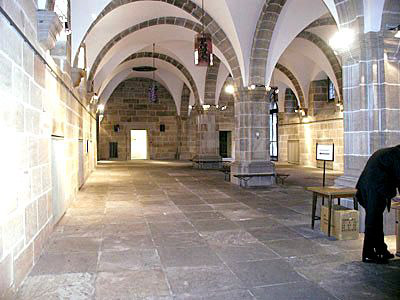
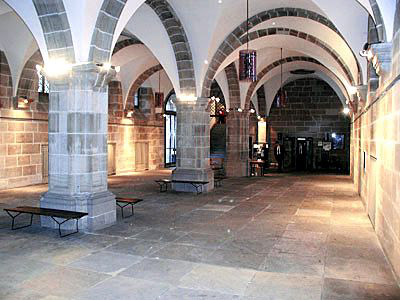
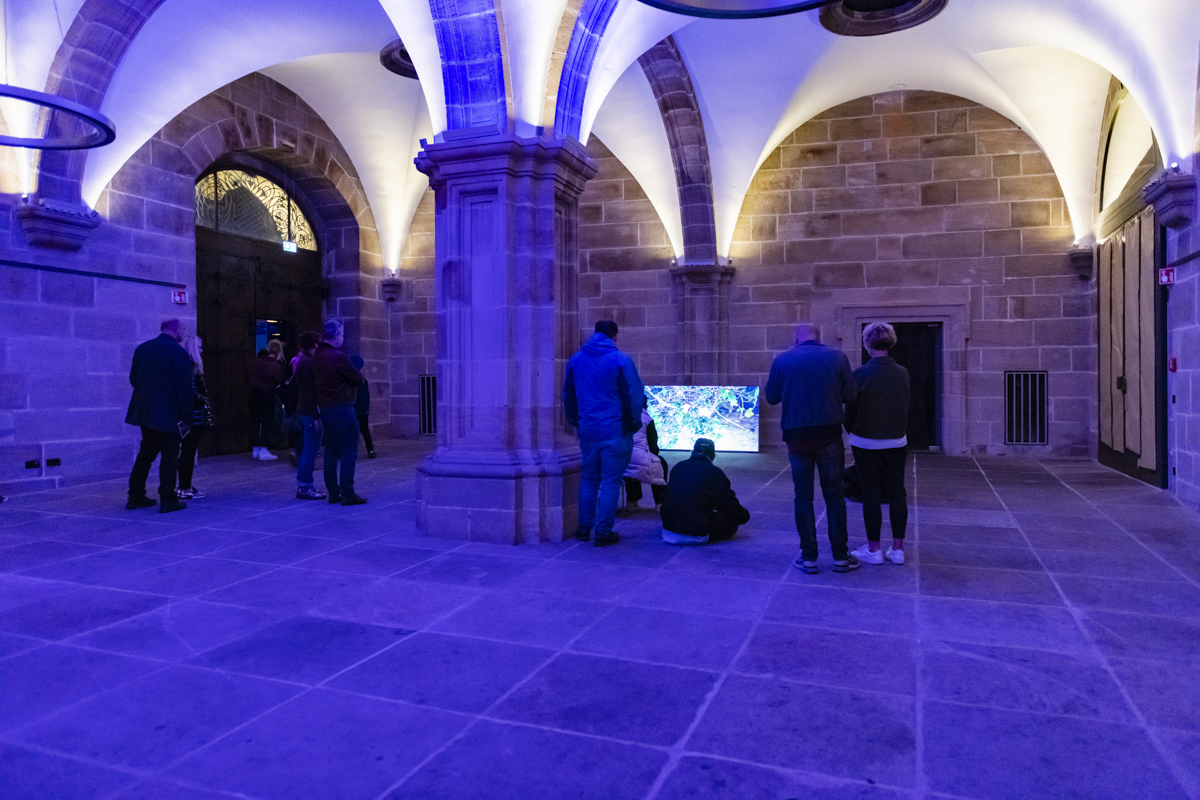
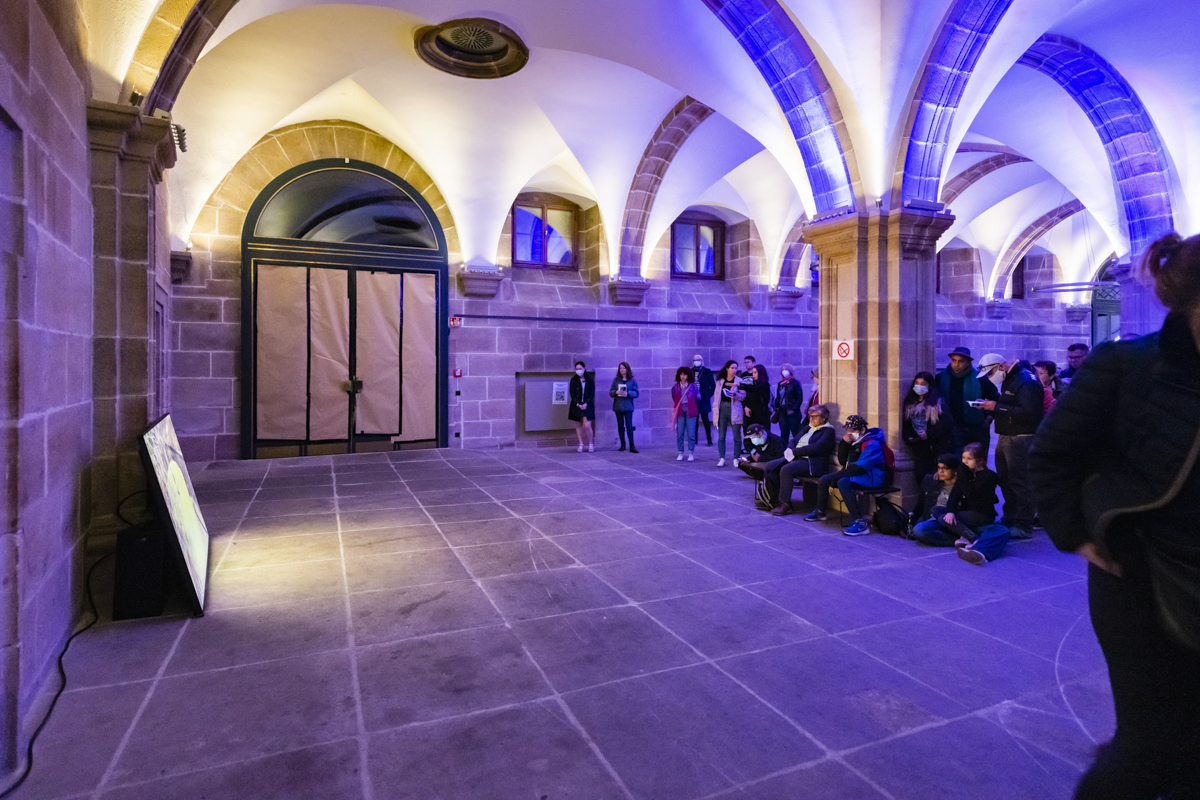
Altes Rathaus Wolff‘scher Bau, Ehrenhalle | Old Town Hall ‘Wolff’scher Bau’, Hall of honour
Altes Rathaus Wolff‘scher Bau, Ehrenhalle | Old Town Hall ‘Wolff’scher Bau’, Hall of Honour
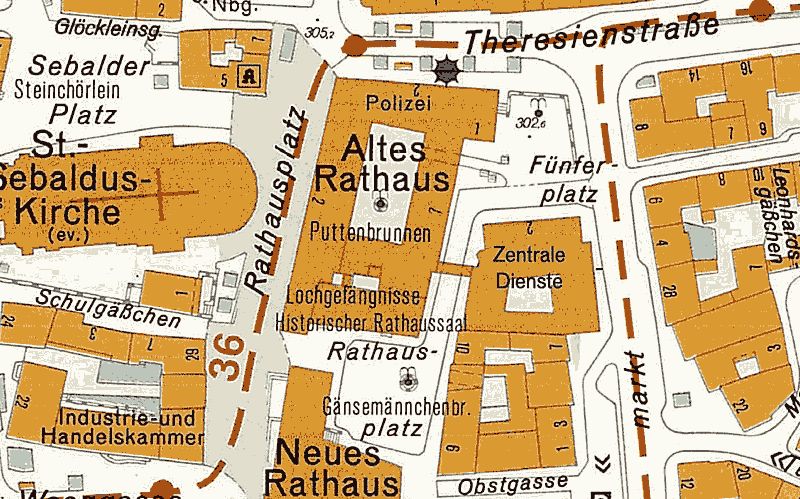
Rathausplatz 2
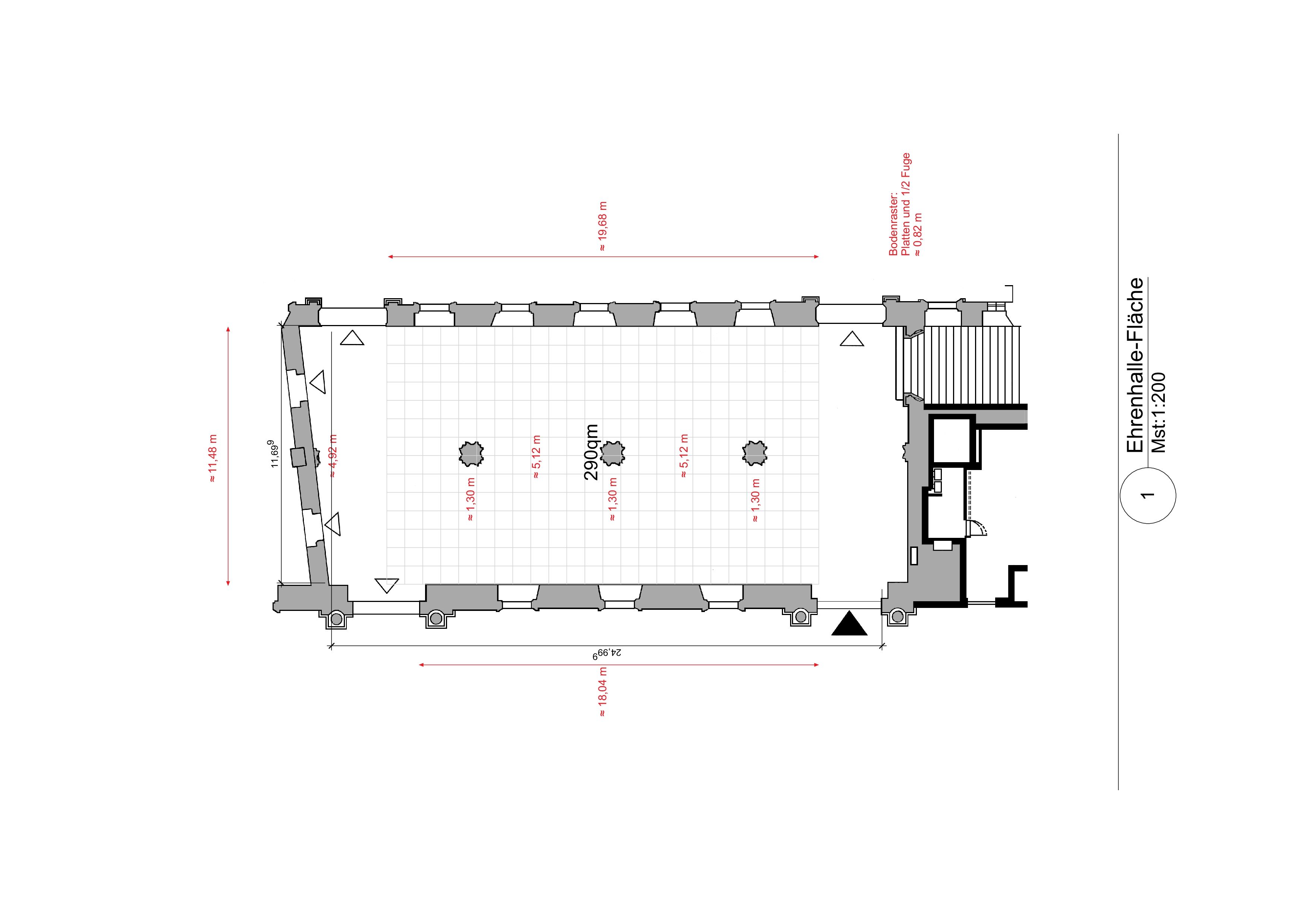
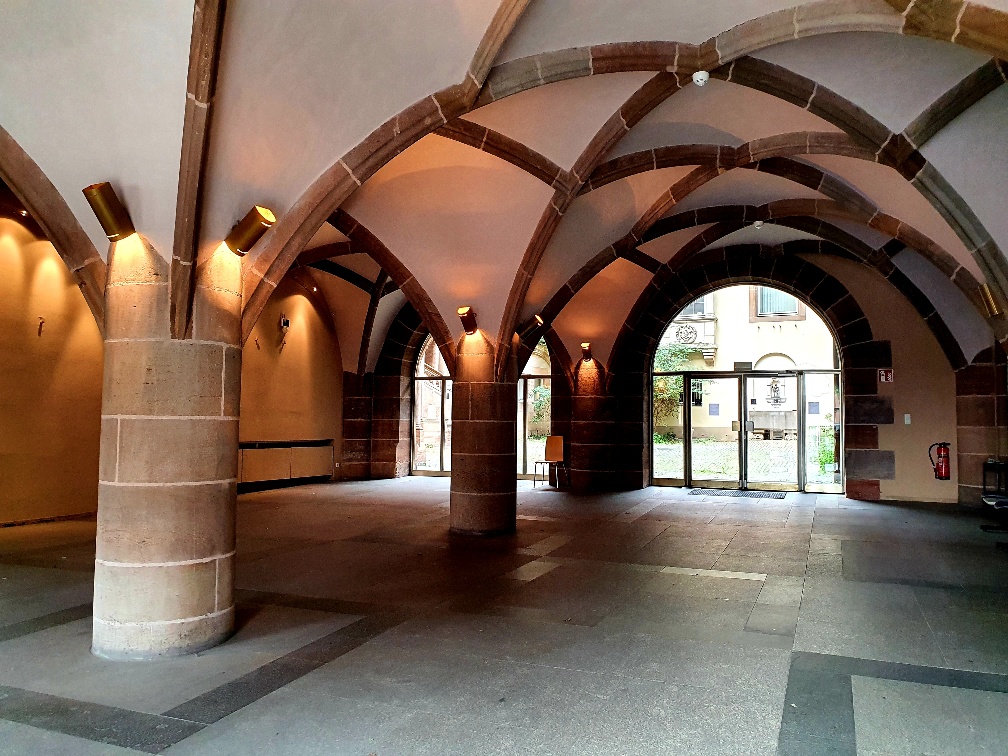
Two-aisled, neo-Gothic colonnaded hall featuring three large sandstone columns, constructed by Jakob Wolff the Elder between 1617 and 1622. Destroyed during the Second World War and subsequently rebuilt. The columns, floor and walls are made of sandstone. Drilling, anchoring, and the use of adhesives is not permitted. Approx. 28 metres long, 12 metres wide, 6 metres high. Approx. 30 smaller lamps and four modern pendant lamps (suspended from the ceiling), each with approx. 20 individual bulbs. The colours of these can be adjusted partially, but their position cannot be altered. The sandstone floor rises slightly towards the north (height difference approx. 30 cm).
When handling liquids, the floor must be protected. Transport using pallet trucks or similar equipment is only permitted to a limited extent and subject to prior consultation with the Mayor’s Office. The floor must be protected as necessary, e.g. by using suitable underlay.
The use of fog, smoke, and fire is not permitted.
Installation may commence from Thursday, 22 April 2027.
Power supply: 32 A CEE connection and Schuko outlet.
Access during Die Blaue Nacht | The Blue Night: via two wooden doors from Rathausplatz and two large glass doors connecting to the inner courtyard.
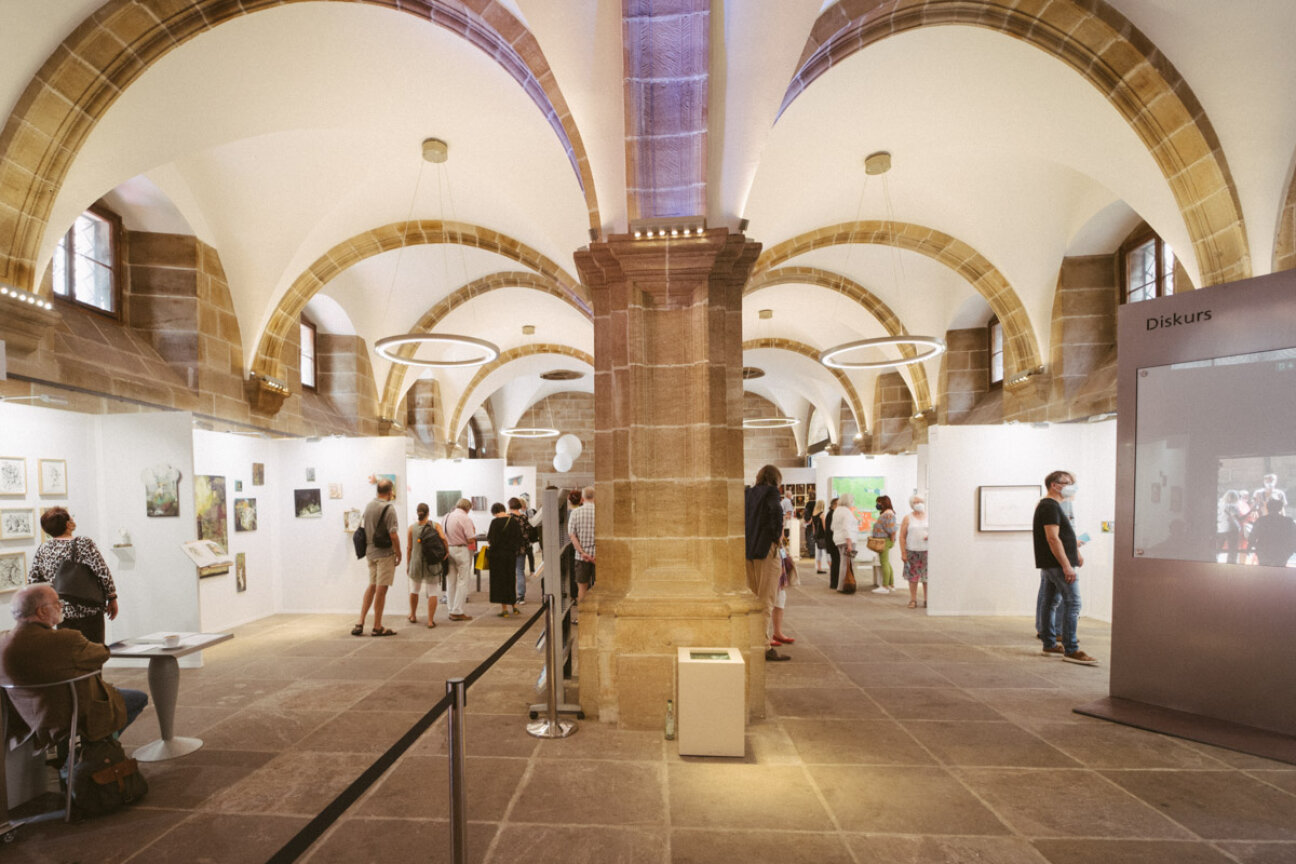
Rathaus - Ehrenhalle | Old Town Hall, Hall of Honour
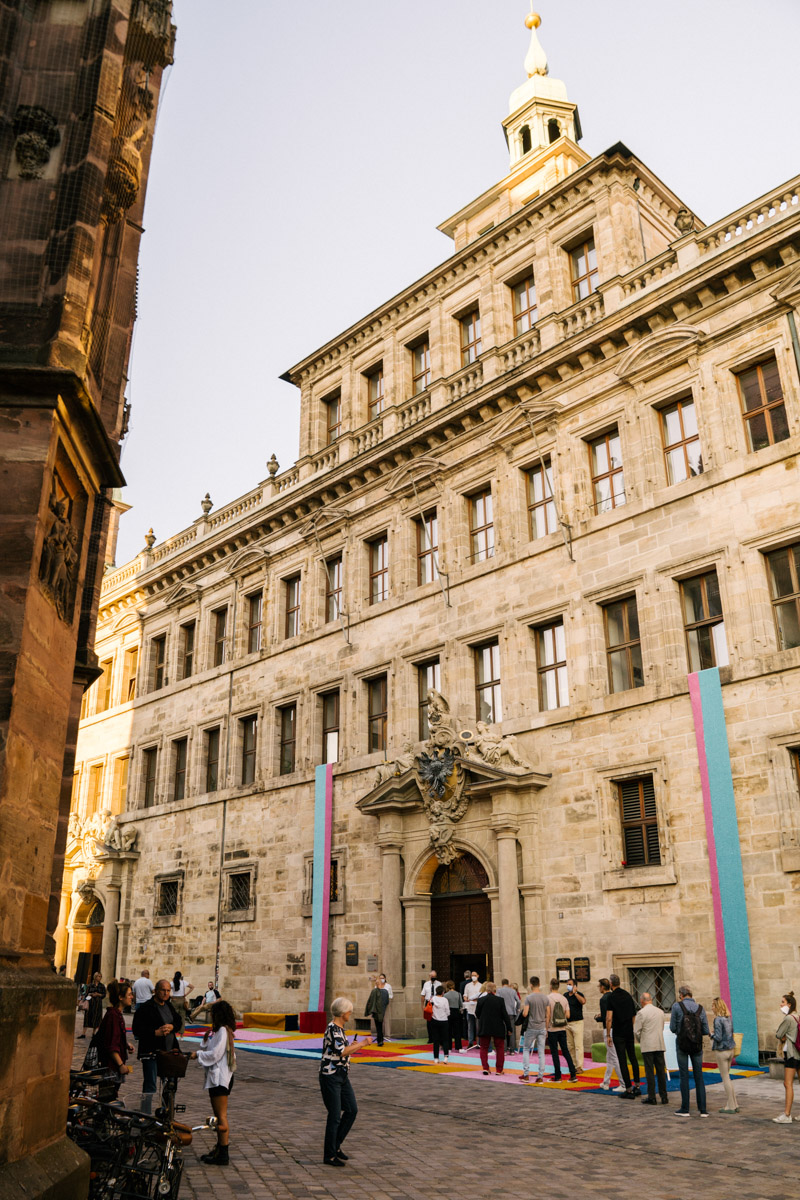
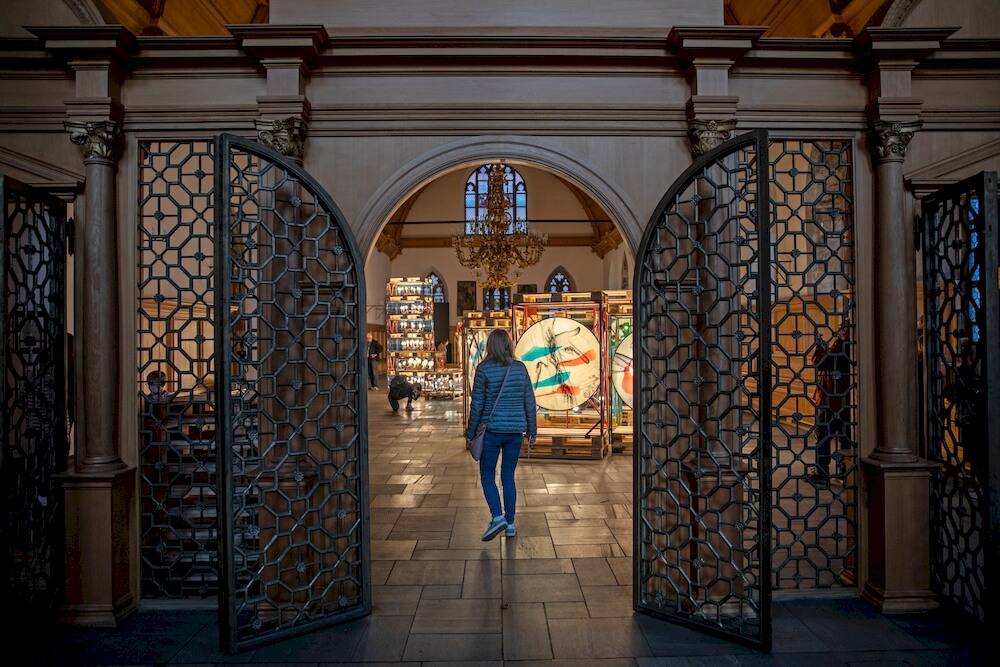
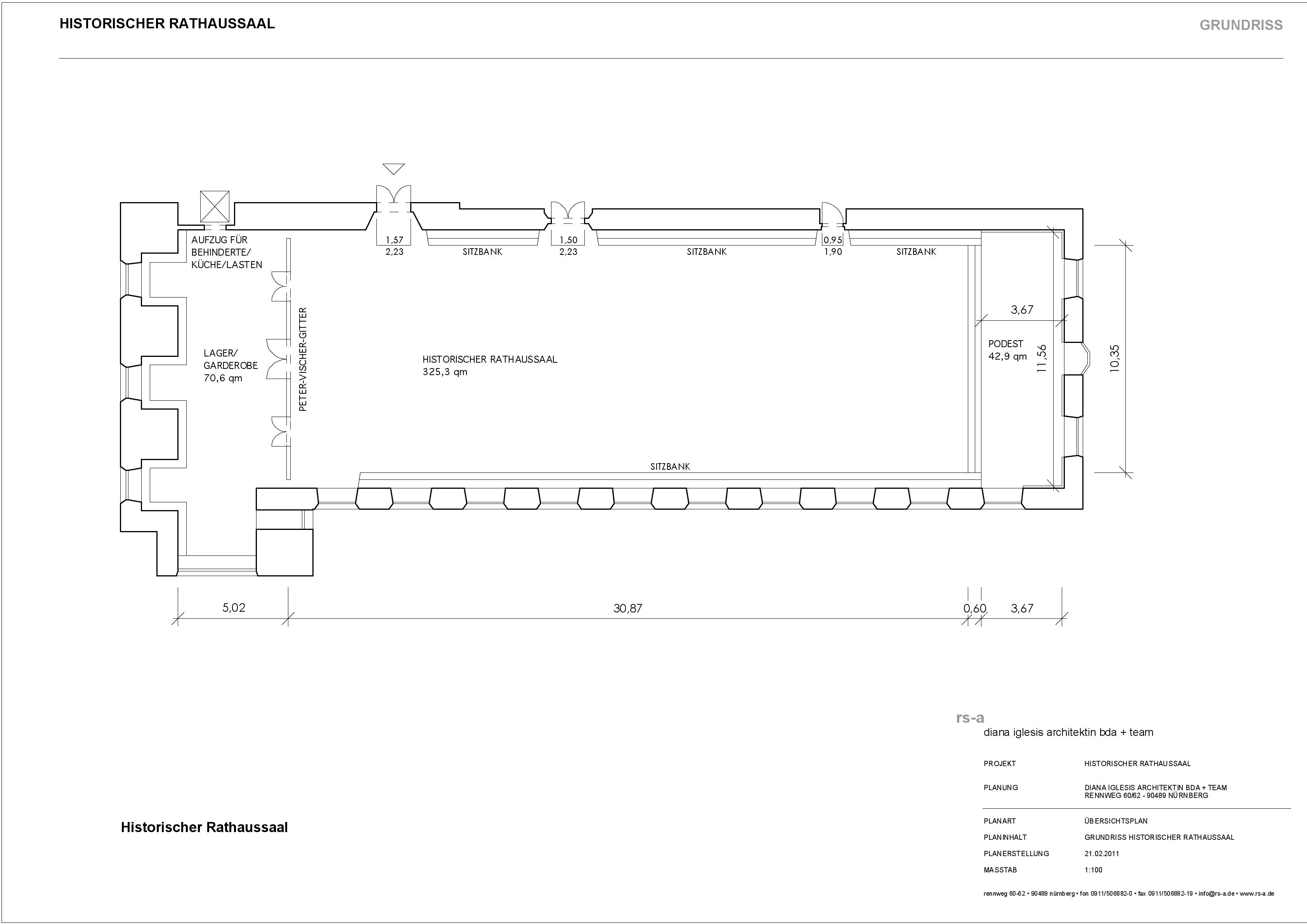
Altes Rathaus Wolff‘scher Bau, Historischer Rathaussaal | Historic City Hall ‘Wolff’scher Bau’, Historic City Council Chamber
Altes Rathaus Wolff‘scher Bau, Historischer Rathaussaal | Historic City Hall ‘Wolff’scher Bau’, Historic City Council Chamber
Rathausplatz 2
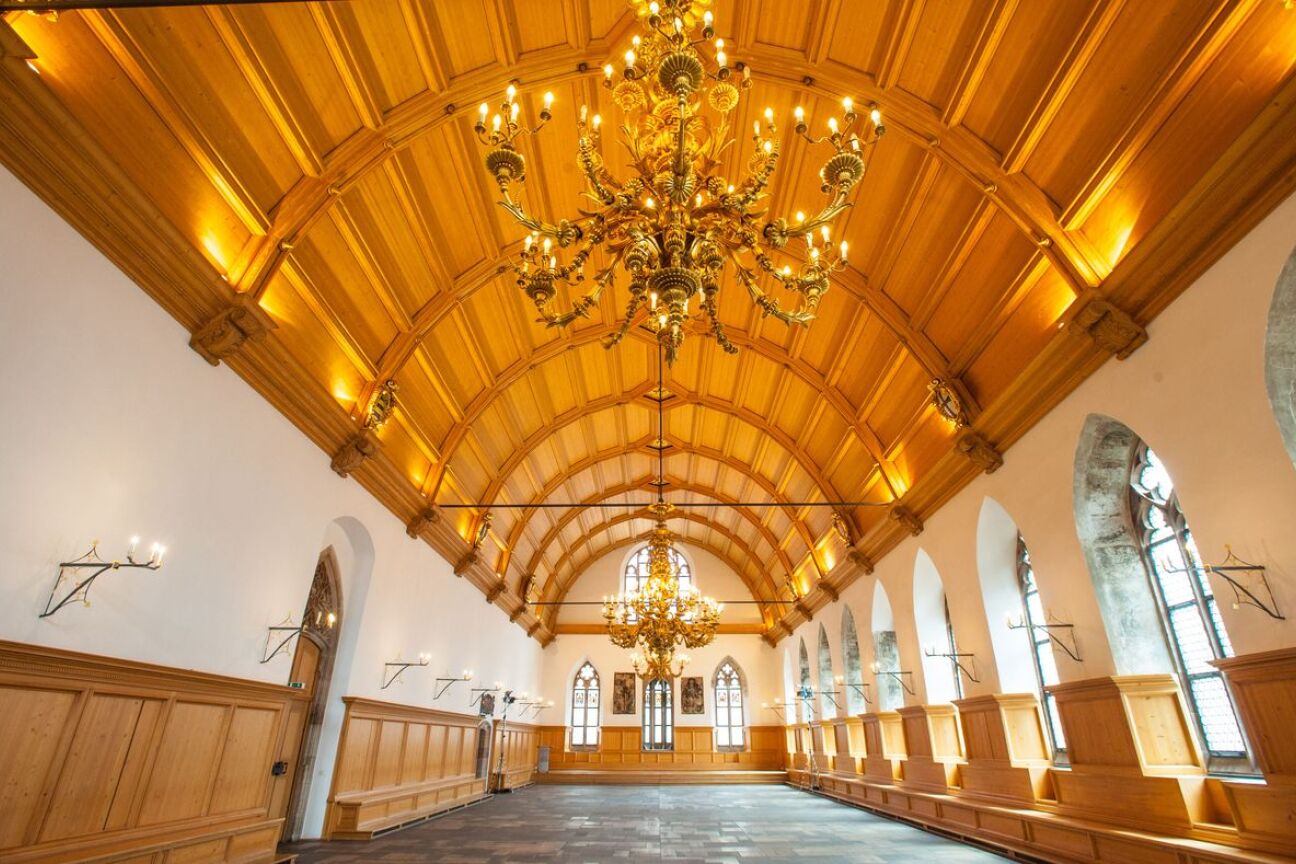
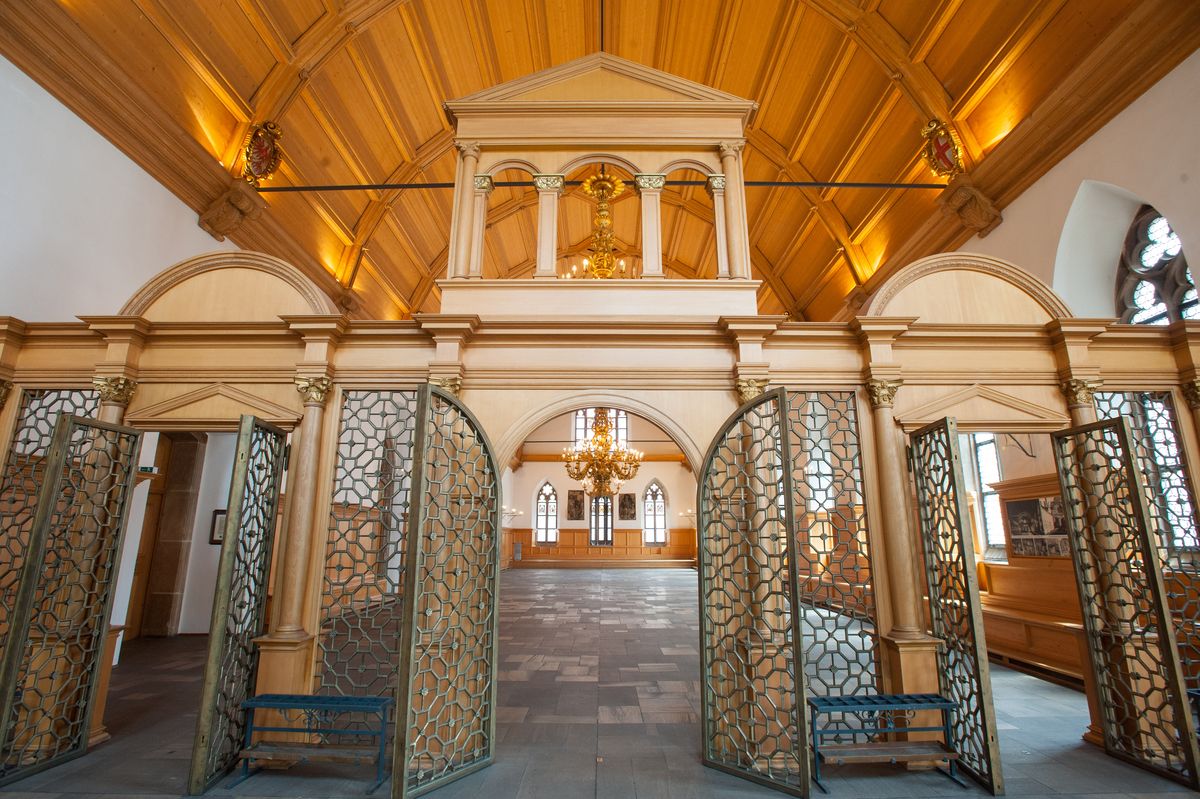
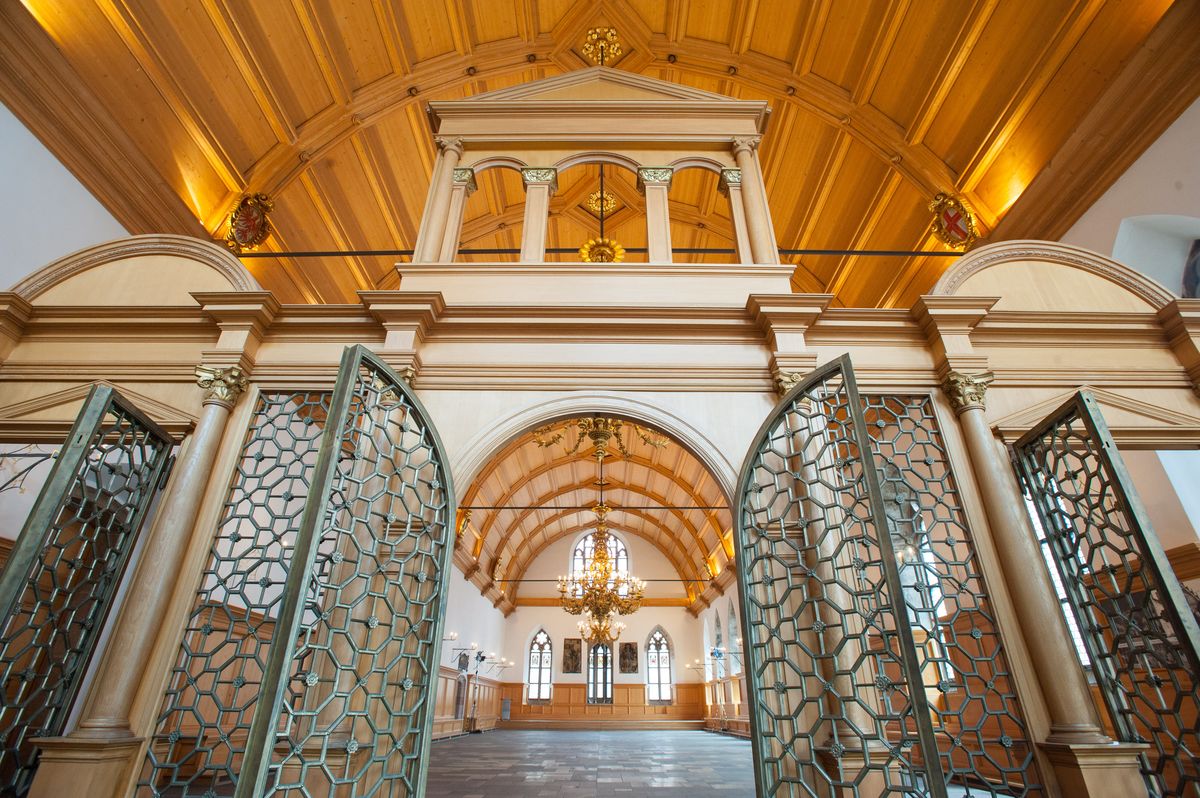
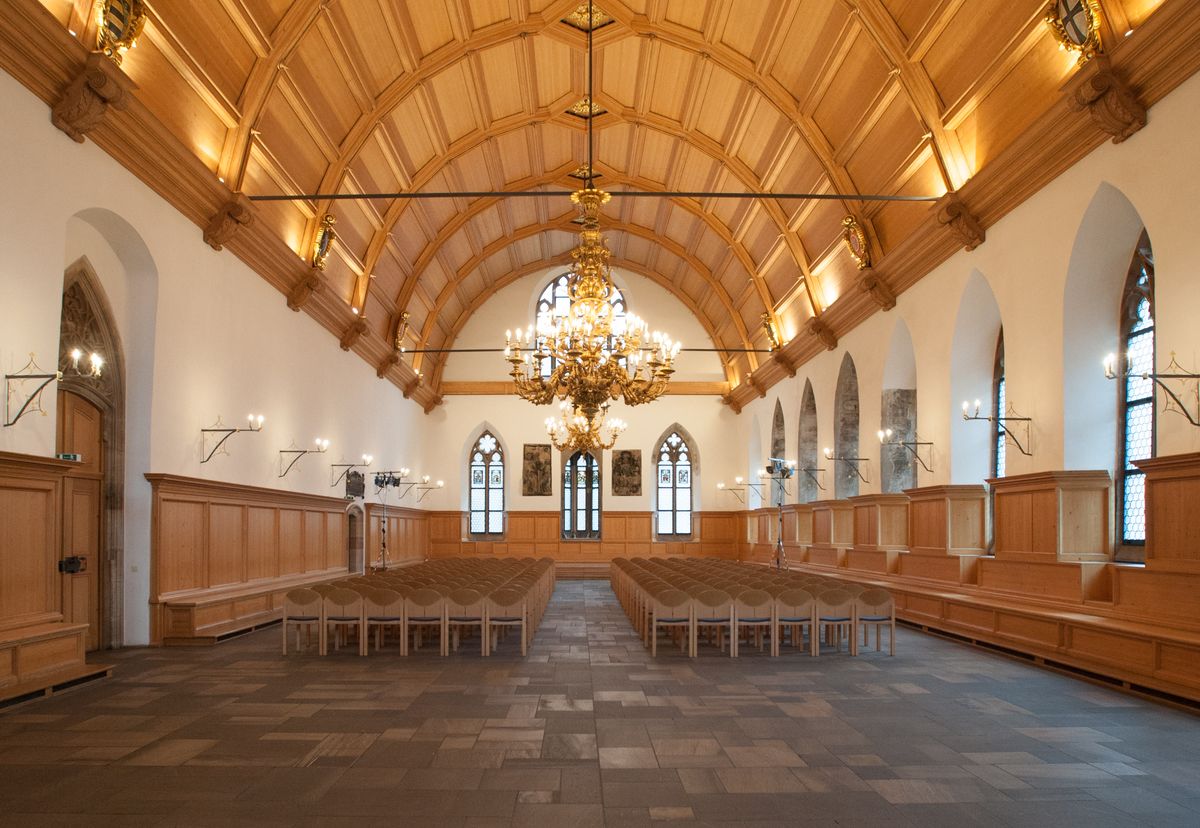
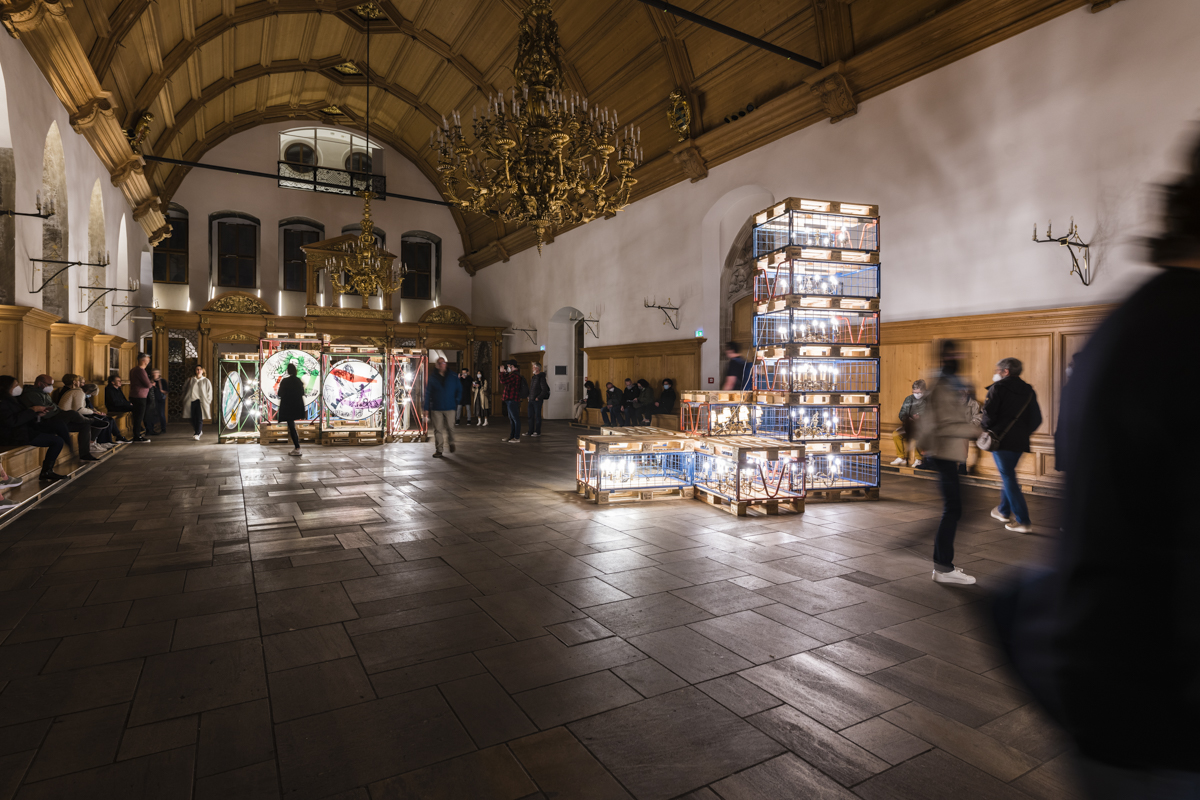
Constructed between 1332 and 1340, the Historic City Hall was, at 40 metres in length and 12 metres in height at its highest point, the largest secular building north of the Alps at the time of its construction. Under Dürer’s direction, , a Renaissance Gesamtkunstwerk was created from 1521 onwards, comprising wall paintings, stained glass, wood panelling, a barrel-vaulted wooden ceiling, and wall-mounted light fixtures. In 1649, the Peace Banquet was held in the City hall, marking the end of the Thirty Years’ War. Dürer’s paintings were revised several times and were finally destroyed during the Second World War.
In 1945, the Hall burned down to its walls. Between 1956 and 1958, the exterior was rebuilt; from 1980 onwards, the interior was restored, including the reconstruction of the wooden barrel vault, the wood panelling, and the stone floor.
The existing cross-bracing cannot be used. There are no other suspension points available either. Nothing may be glued – not even to the wooden panelling.
The use of fog, smoke, or fire is not permitted.
When handling liquids, the sandstone floor must be protected. Transport using pallet trucks or similar equipment is only permitted to a limited extent and subject to prior consultation with the Mayor’s Office. The floor must be protected as necessary, e.g. by using suitable underlay. The same applies to structures that could damage the floor, e.g. scaffolding. In the case of heavy structures, weight restrictions on the stage and in the hall must be checked or enquired about. Blackout curtains are not available.
Installation may commence from Thursday, 22 April 2027.
Power supply: 32 A CEE connection, 16 A CEE connection and Schuko outlet.
Access during Die Blaue Nacht | The Blue Night: via the Hall of Honour at Rathausplatz 2 and a staircase to the mezzanine. Lifts are available (separate lifts for the public and goods).
Rathaus - Historischer Rathaussaal | Old City Hall, Historic City Council Chamber

Altes Rathaus Wolff‘scher Bau, Innenhof | Historic City Hall ‘Wolff’scher Bau’, Inner Courtyard
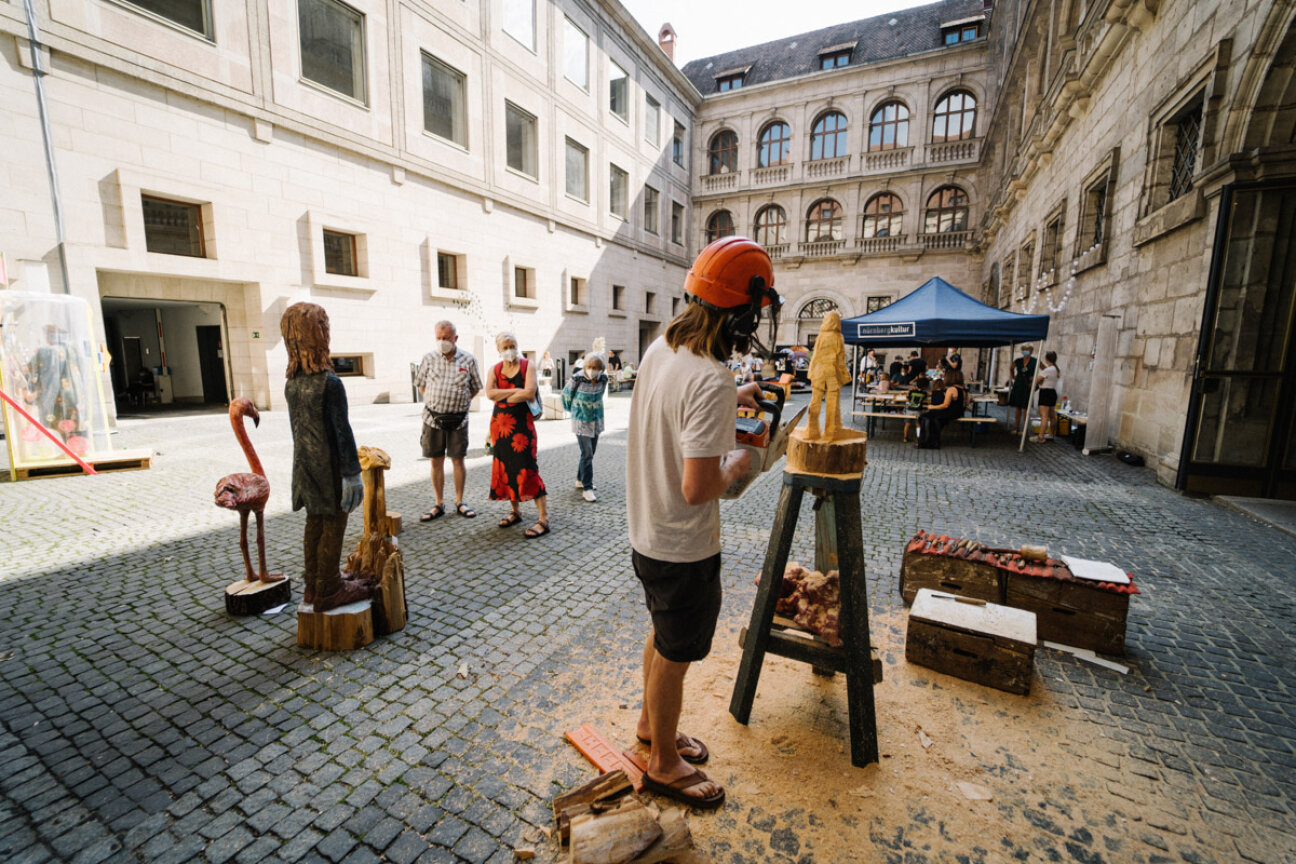
Altes Rathaus Wolff‘scher Bau, Innenhof | Historic City Hall ‘Wolff’scher Bau’, inner courtyard
Rathausplatz 2 or Fünferplatz 7
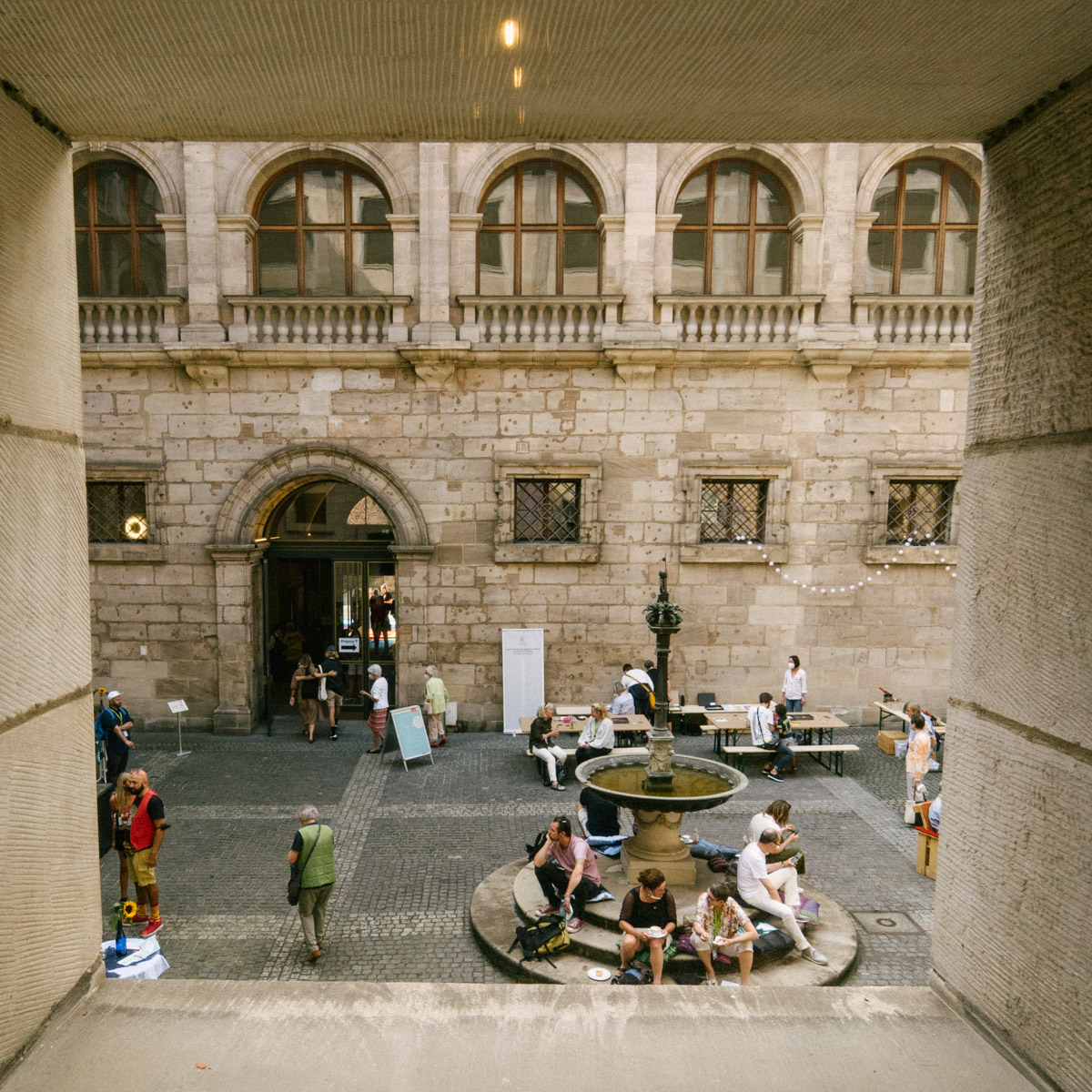
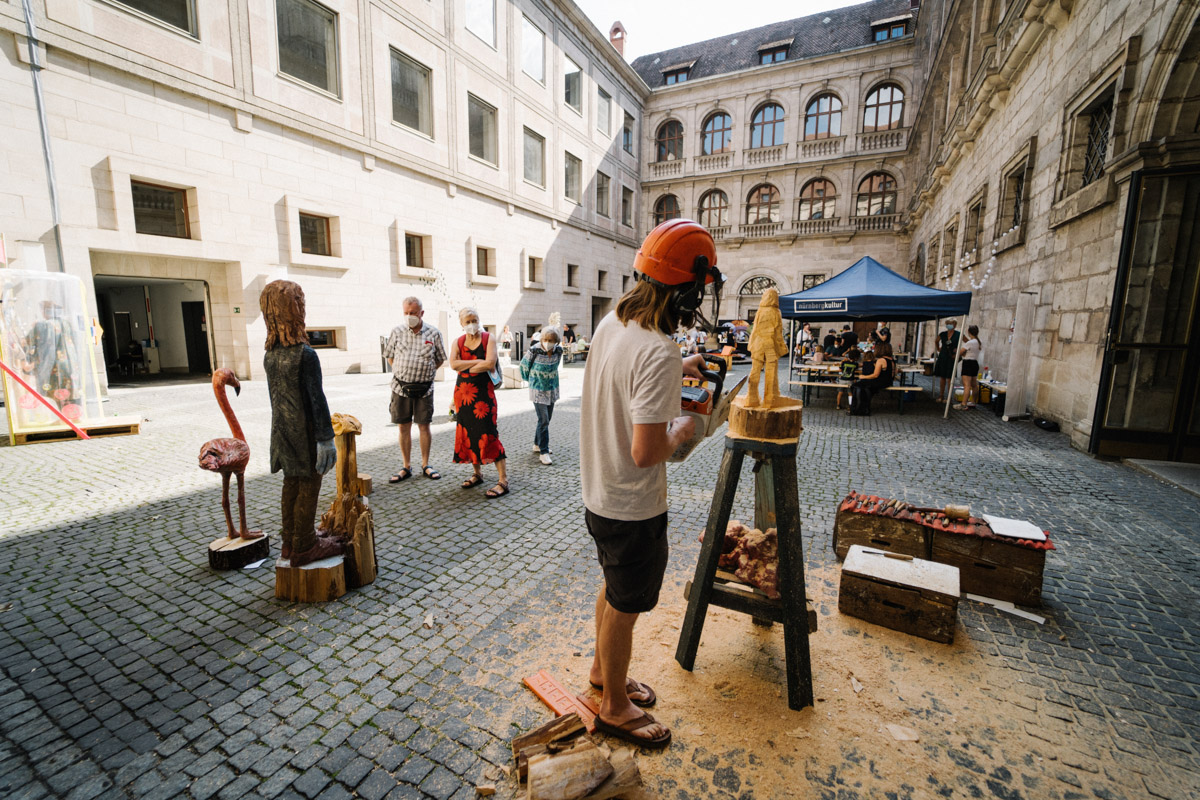
On weekdays, the courtyard is used as a parking area for the Lord Mayor, Mayor, and city councillors. On three sides, it is enclosed by three- and four-storey Renaissance façades with a total of 41 round arches (25 to 30 metres high). On the eastern side, there is a building dating from 1962/63. The numerous windows of the four wings can be used for illumination.
Located at the centre is a putti fountain by Pankraz Labenwolf (1549-57). The courtyard is open to the sky and measures approximately 28 × 17 metres. The surface consists of medium-sized cobblestones laid in a straight pattern and slopes gently towards the north. The walls are made of sandstone. The windows of corridors and offices overlook the courtyard. In the north-east corner (entrance/exit), there are two large lamps.
When using fog, care has to be taken to ensure that it does not enter the Hall of Honour or drift into the mezzanine via the windows.
Please note: Installation may only commence from Friday, 23 April 2027.
Power supply: 3x 32 A CEE connection and Schuko outlet.
Access during Die Blaue Nacht | The Blue Night: via the City Hall’s Hall of Honour and through a gateway from Fünferplatz.
Rathaus - Innenhof | City Hall - Inner Courtyard

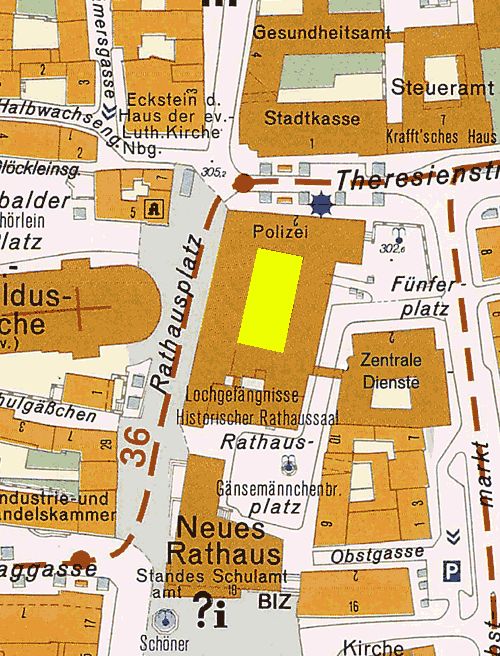
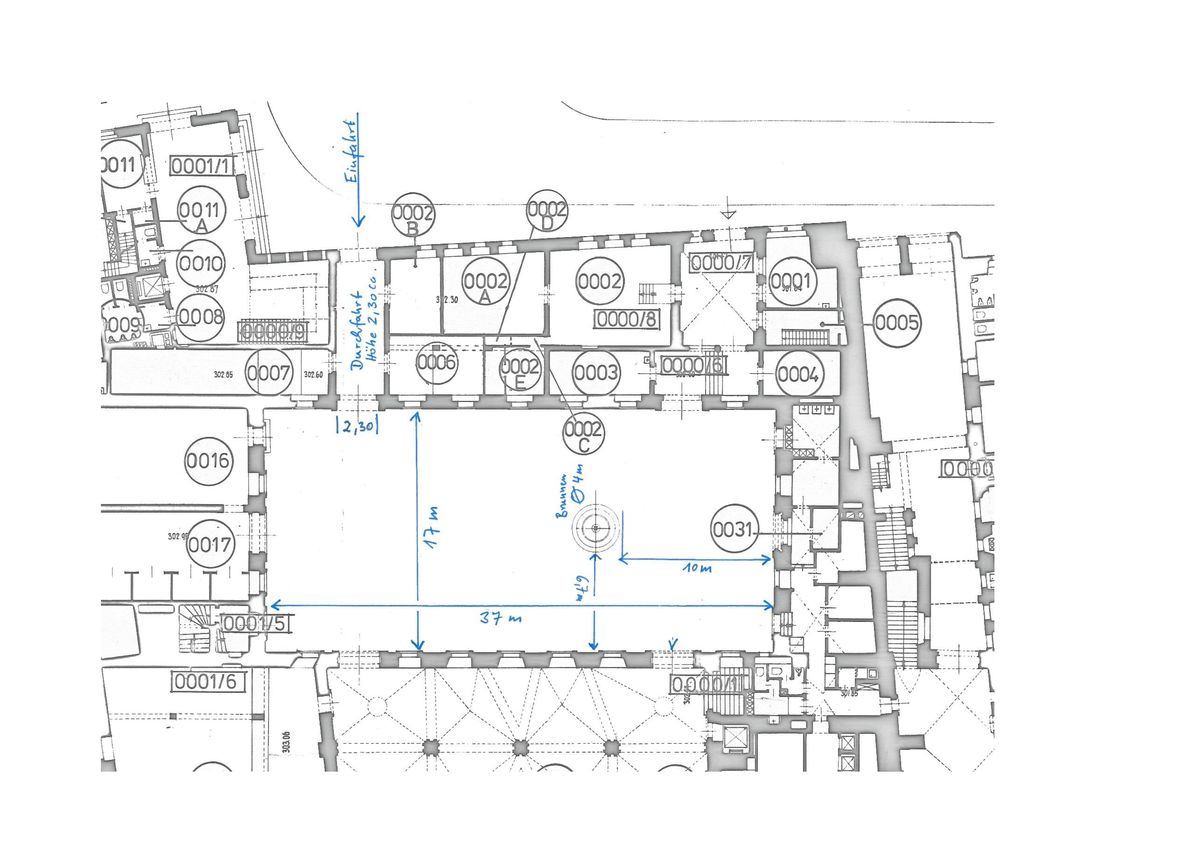
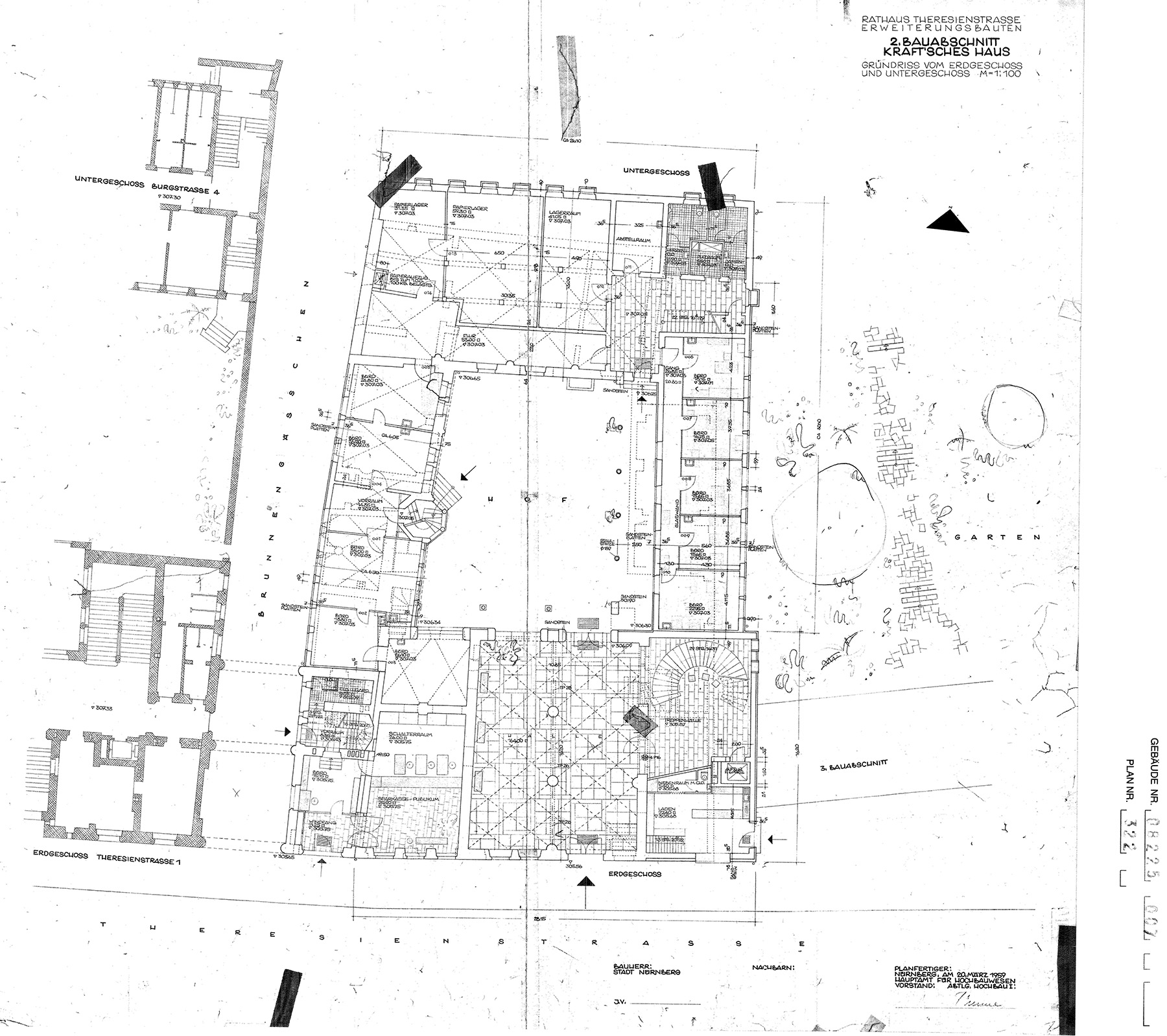
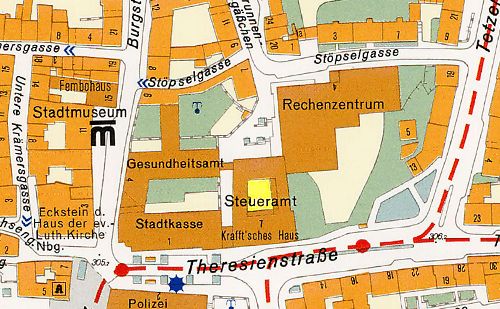
Krafft‘scher Hof und Eingangsbereich Krafft‘sches Haus | Krafft‘scher Hof and Entrance Area of Krafft‘sches Haus
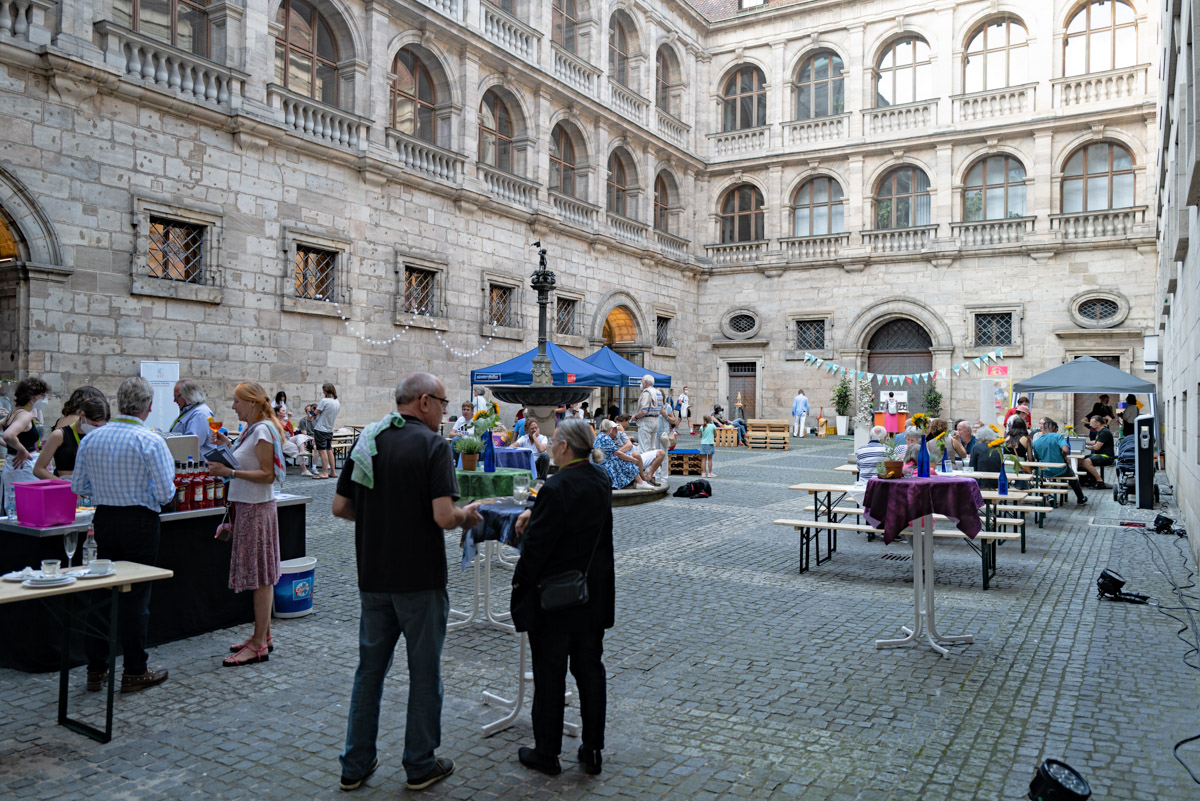
Krafft‘scher Hof und Eingangsbereich Krafft‘sches Haus | Krafft‘scher Hof and entrance area of Krafft‘sches Haus
Theresienstraße 7
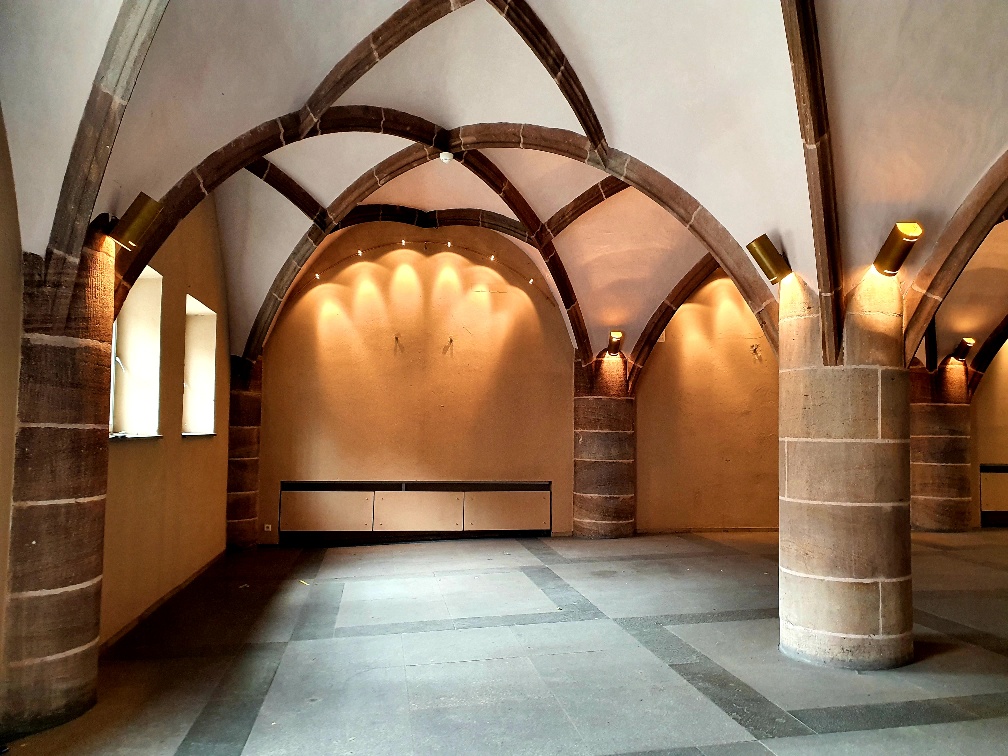
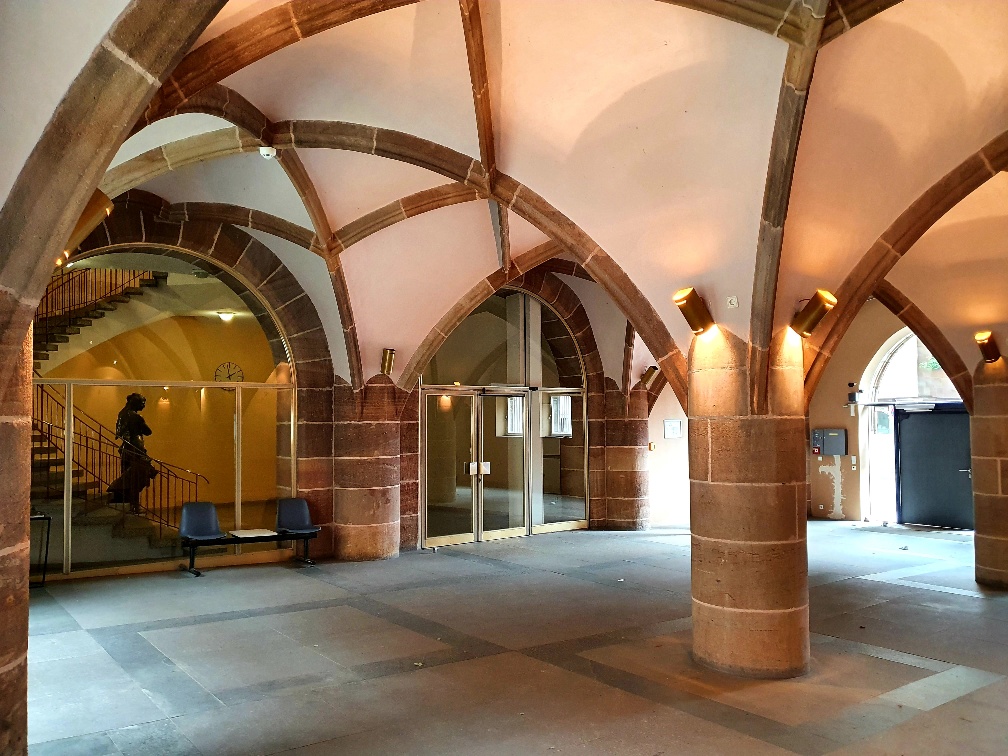
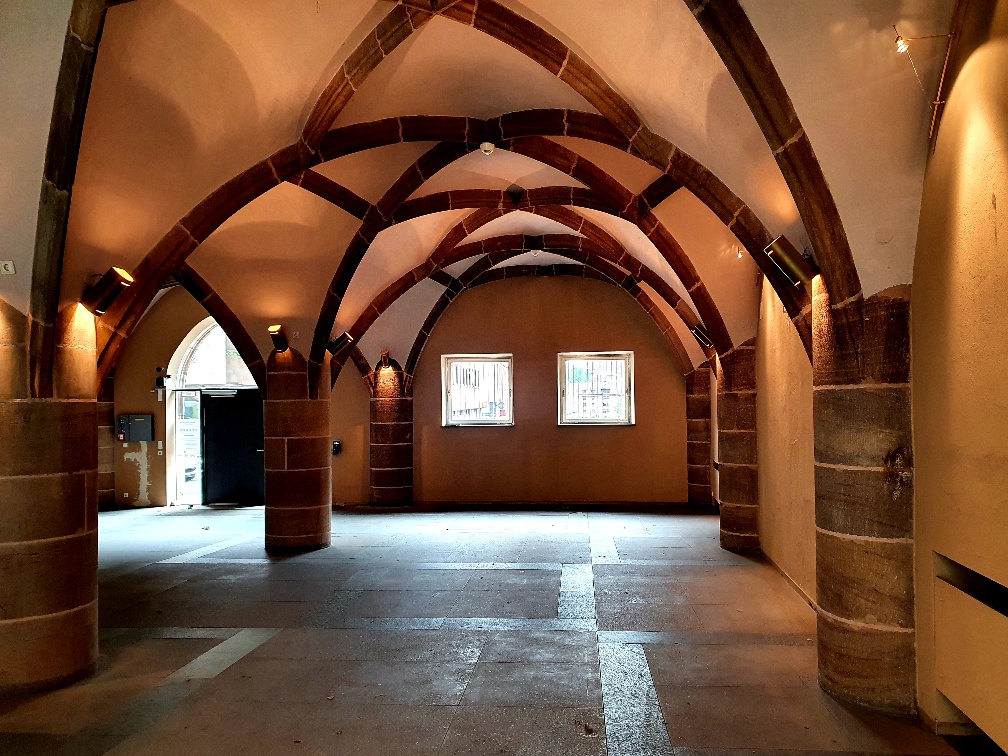
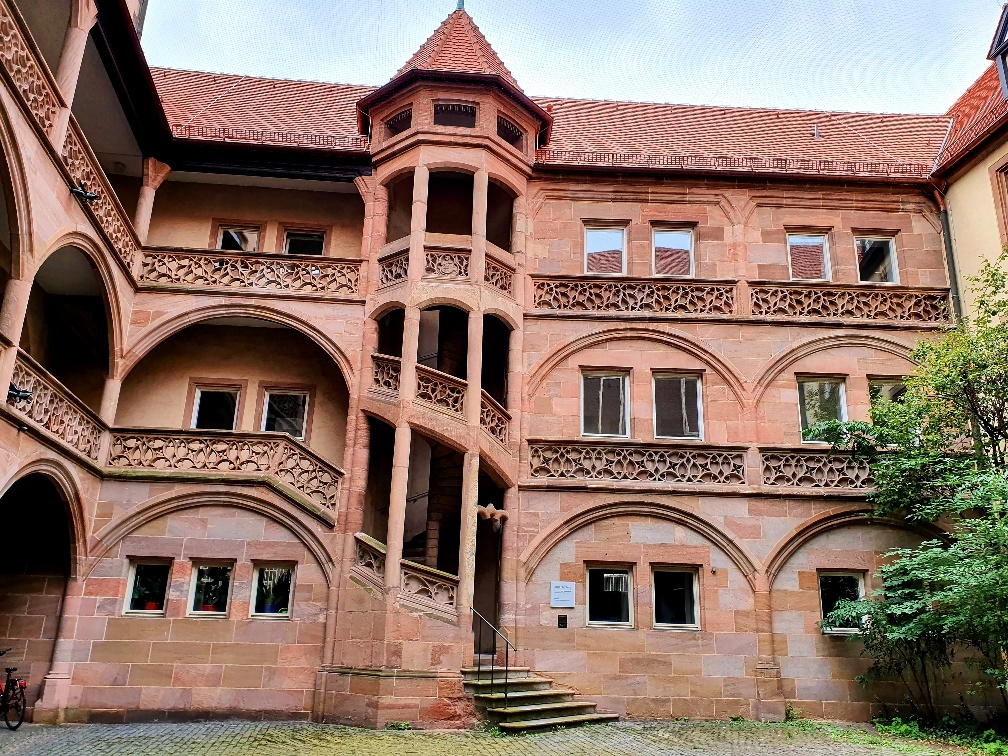
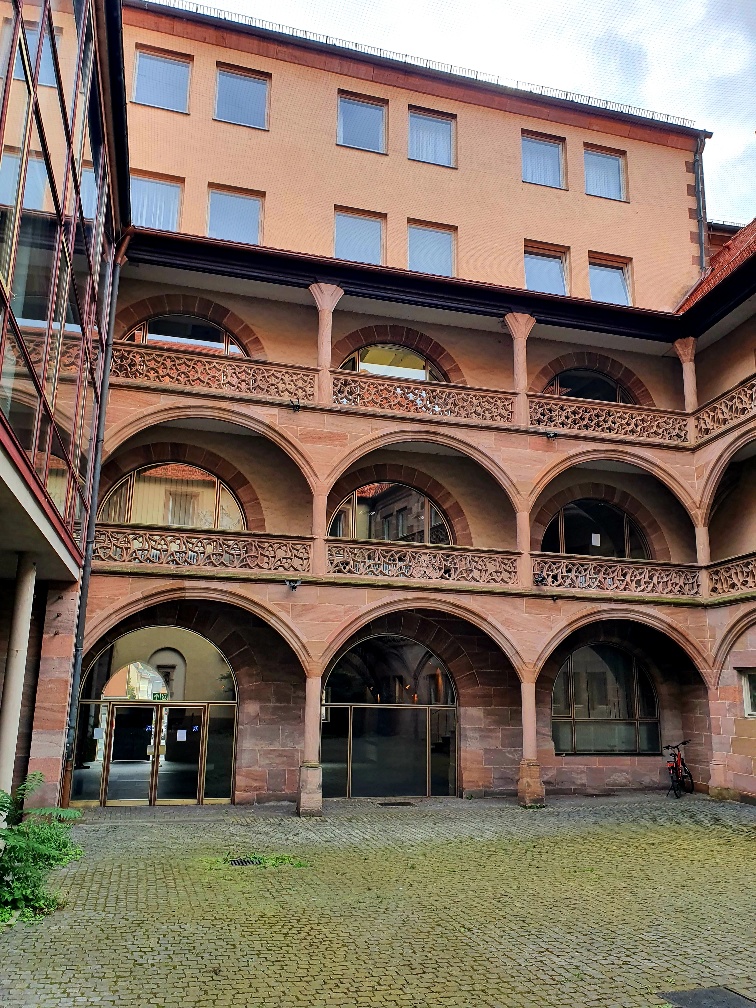
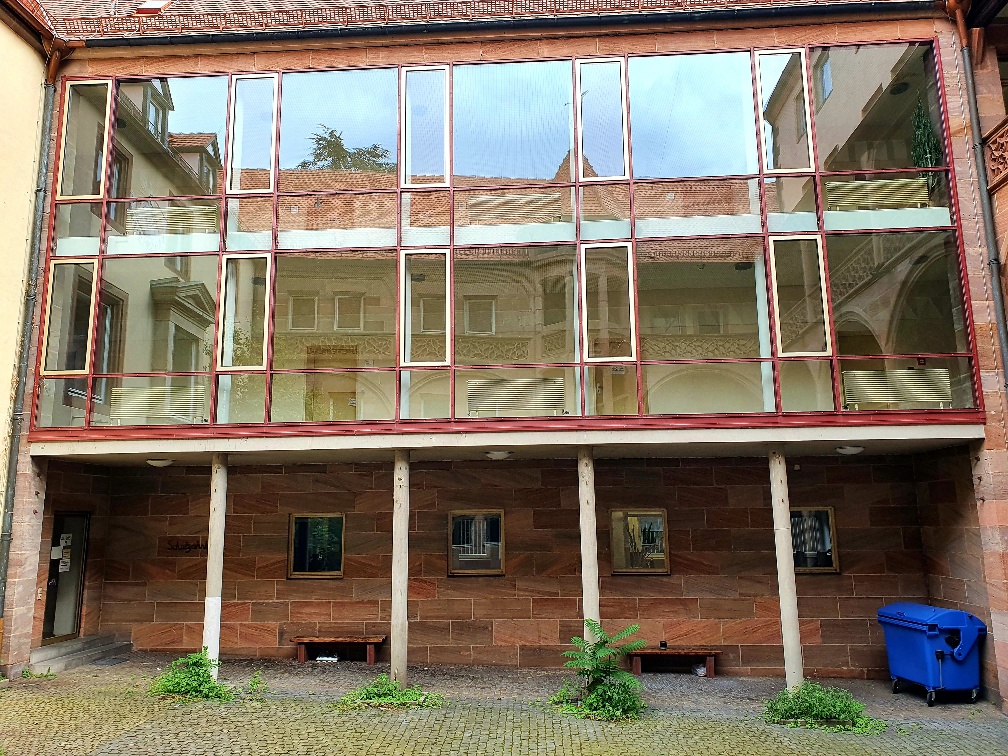
In summer, the courtyard serves as a venue for cultural events. Originally called ‘Welserhof’, dating from the first half of the 16th century, it was later known as Krafft’s House after its last owner. Almost completely destroyed during the war, it has been rebuilt between 1961 and 1963. From the street, one first enters the entrance area, an apparently reconstructed vestibule with a neo-Gothic vaulted ceiling (15 metres long, 11 metres wide). At the centre of the vestibule stand two substantial sandstone columns. The hall has very good and differentiated lighting and is occasionally used as an exhibition space. Viewed from the entrance, a glass wall on the right separates the entrance area from a stairwell leading to the offices.
Separated from the entrance area by two large glass doors, the courtyard adjoins beyond. It is one of the few remaining courtyards of the historic Old Town and slopes gently towards the north. On te entrance side, the first and second floors feature sandstone arcades with tracery balustrades.
On the left side, there is a three-storey, openwork, finely articulated sandstone stair tower with wide-spanning arches on slender columns at ground-floor level, providing access to the arcades on the first and second floor. The sandstone stair tower is approx. 18 metres high and is topped with a metal weather vane.
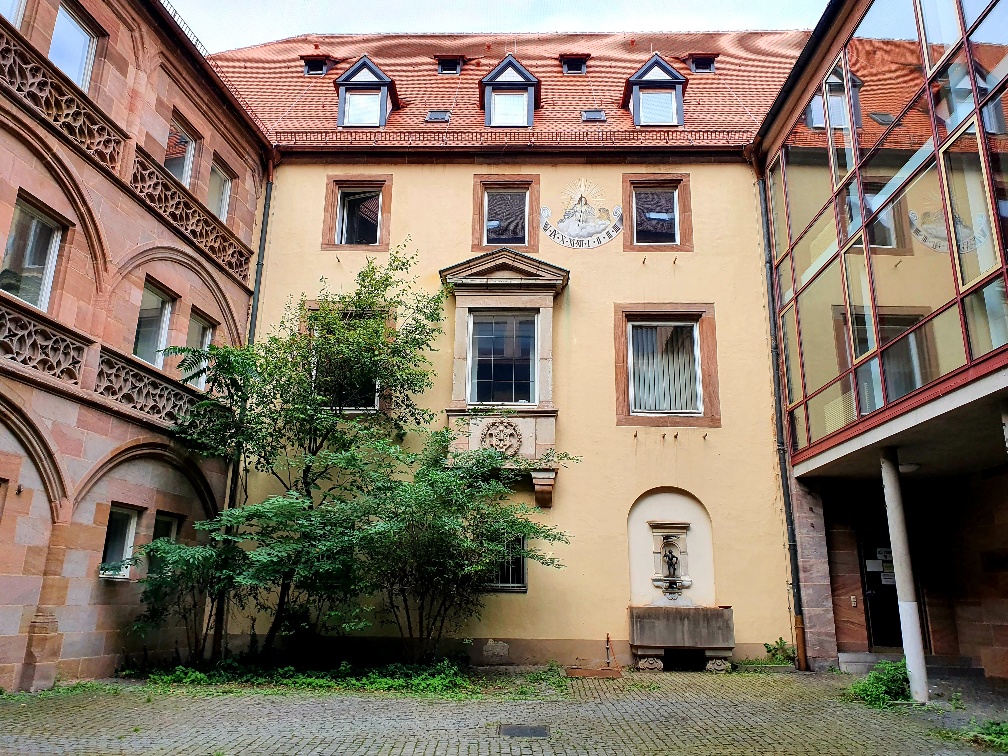
At the far end (appearing new but in fact an old rendered façade) are located a small Baroque wall fountain (‘Mauritius Fountain’), a Renaissance oriel (c. 1550), and a small enclosed planted area with a tree and a shrub.
The courtyard measures 18 metres in length and 13 metres in width. It is not covered, except for a section along the right-hand side (18 metres long, 2.5 metres wide). Four modern concrete columns with vegetation separate this covered section from the courtyard.
The floor is covered with medium-sized granite paving stones, laid in a random pattern, and the walls are made of sandstone. There is no lighting.
Power supply: Schuko outlet.
Access during Die Blaue Nacht | The Blue Night: via Theresienstraße 7
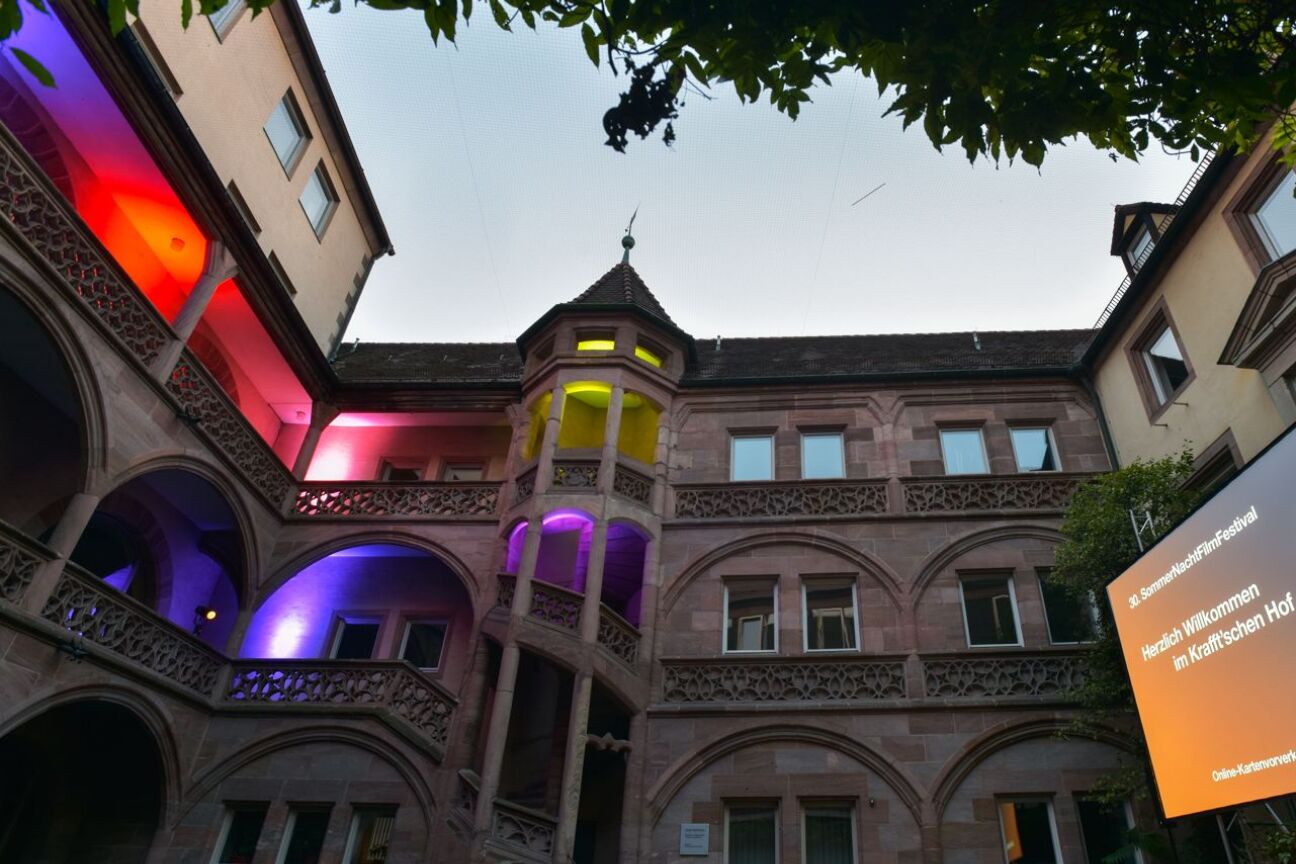
Krafft‘scher Hof und Eingangsbereich Krafft‘sches Haus | Krafft‘scher Hof and Entrance Area of Krafft‘sches Haus
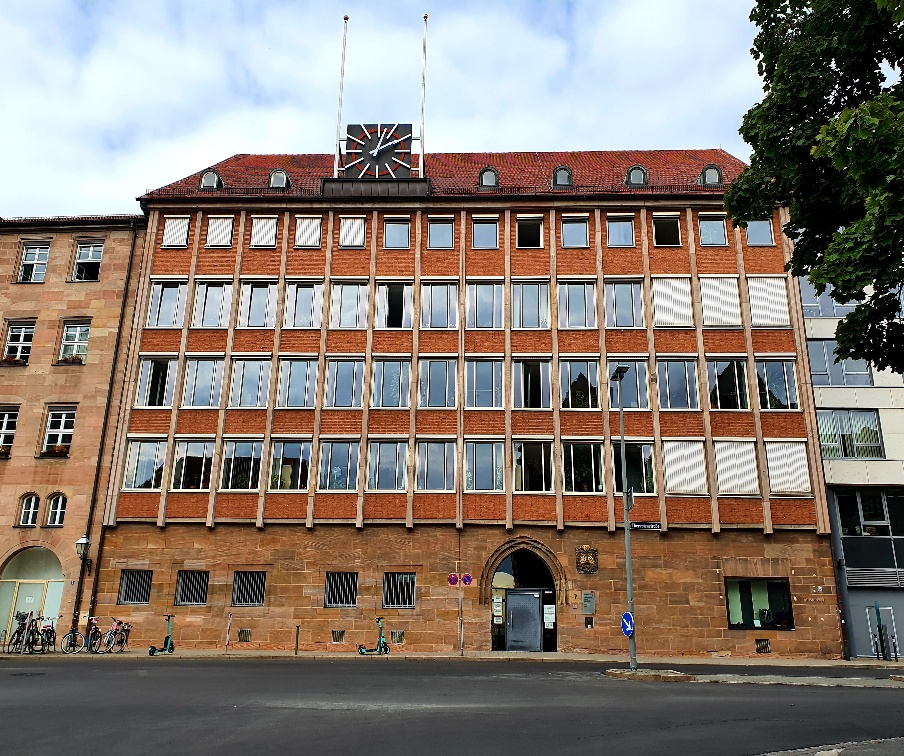
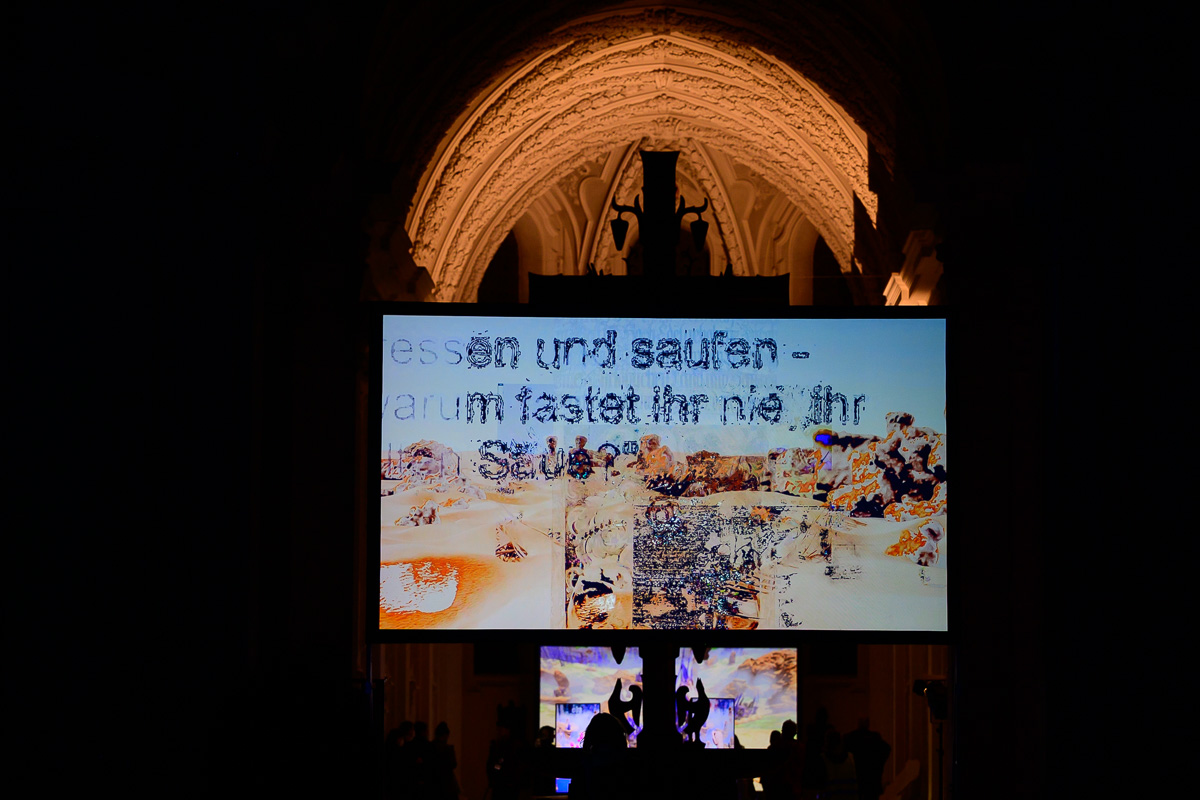
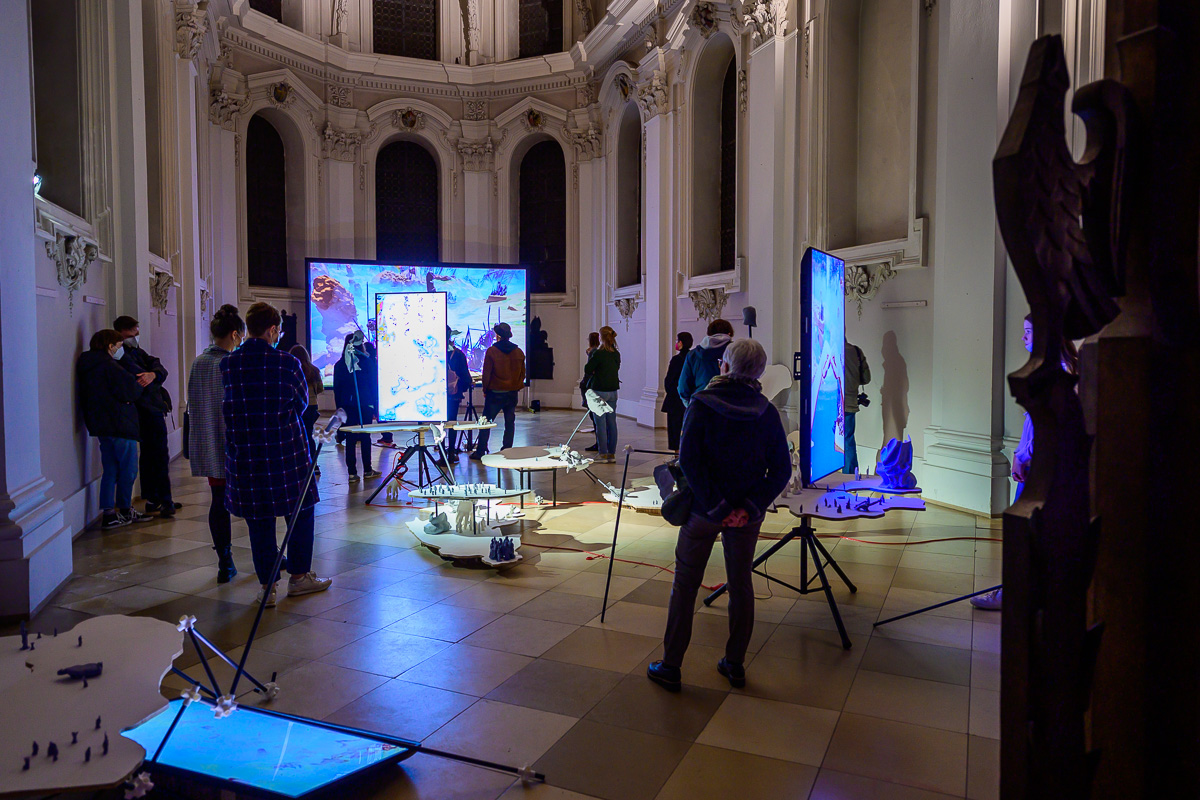
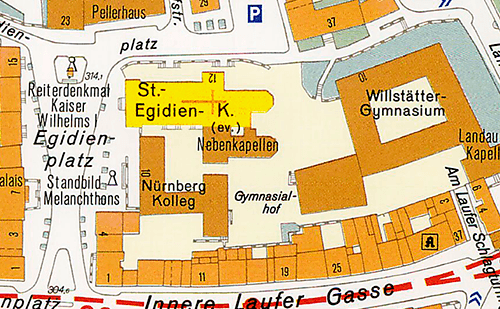
St. Egidien
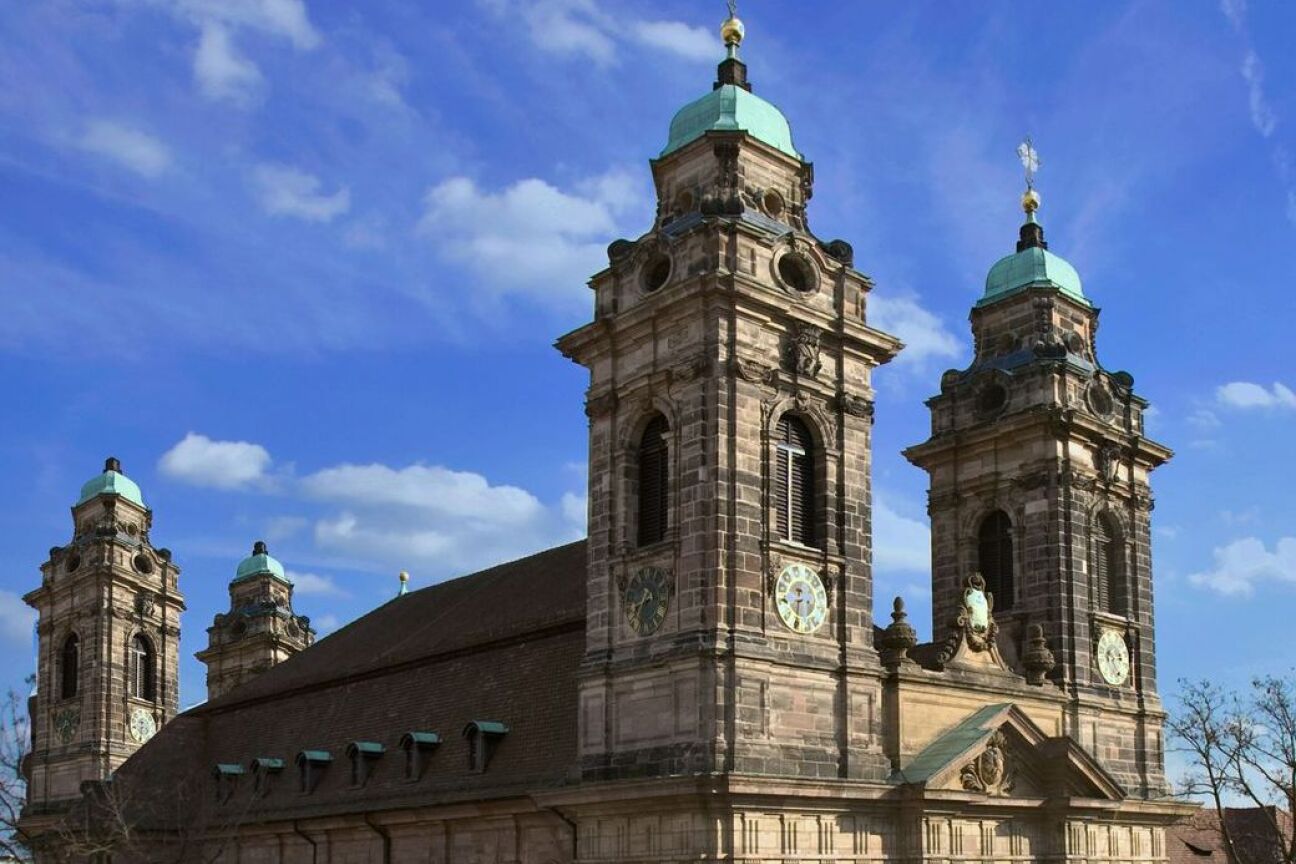
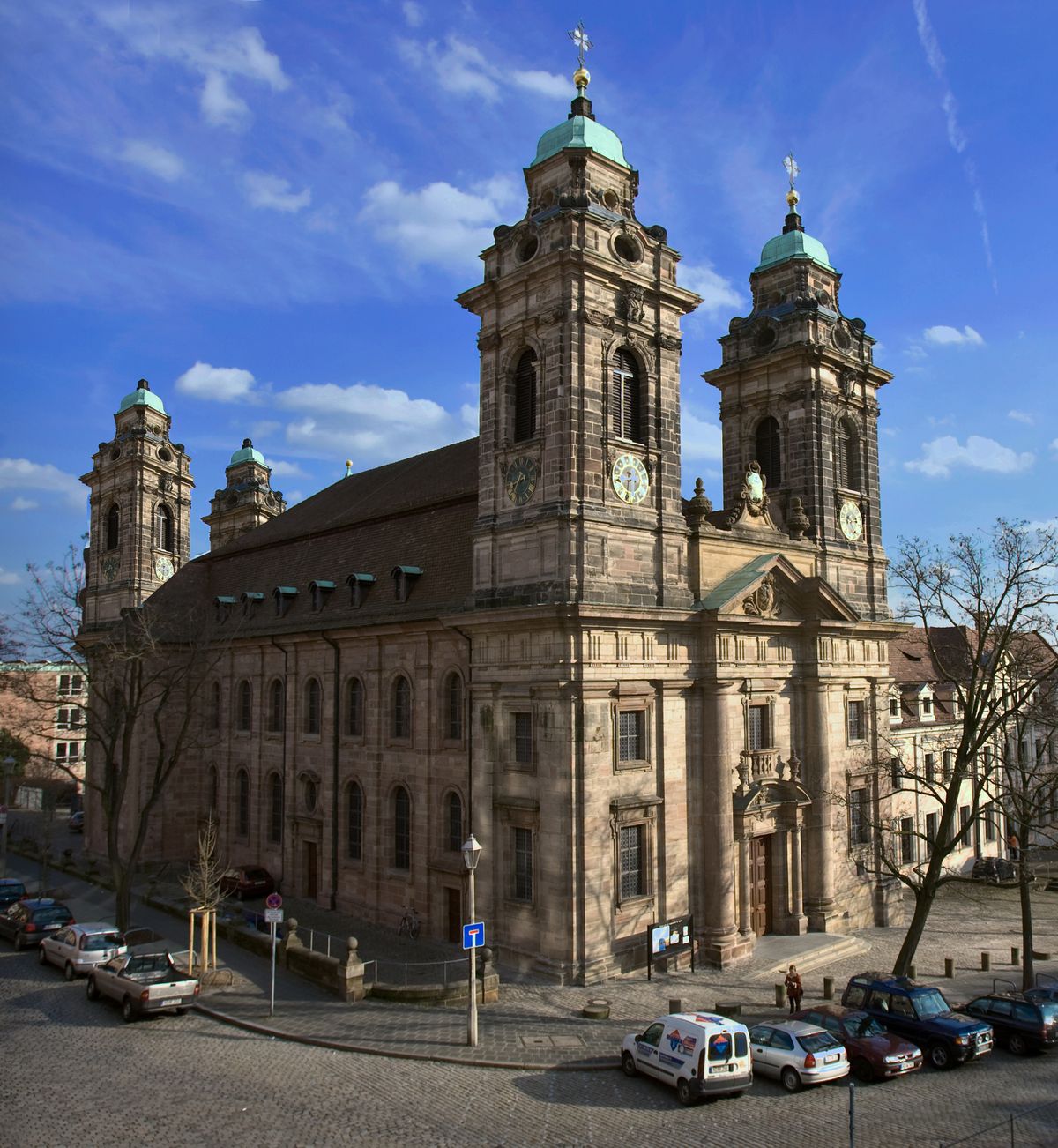
St. Egidien
Egidienplatz 37
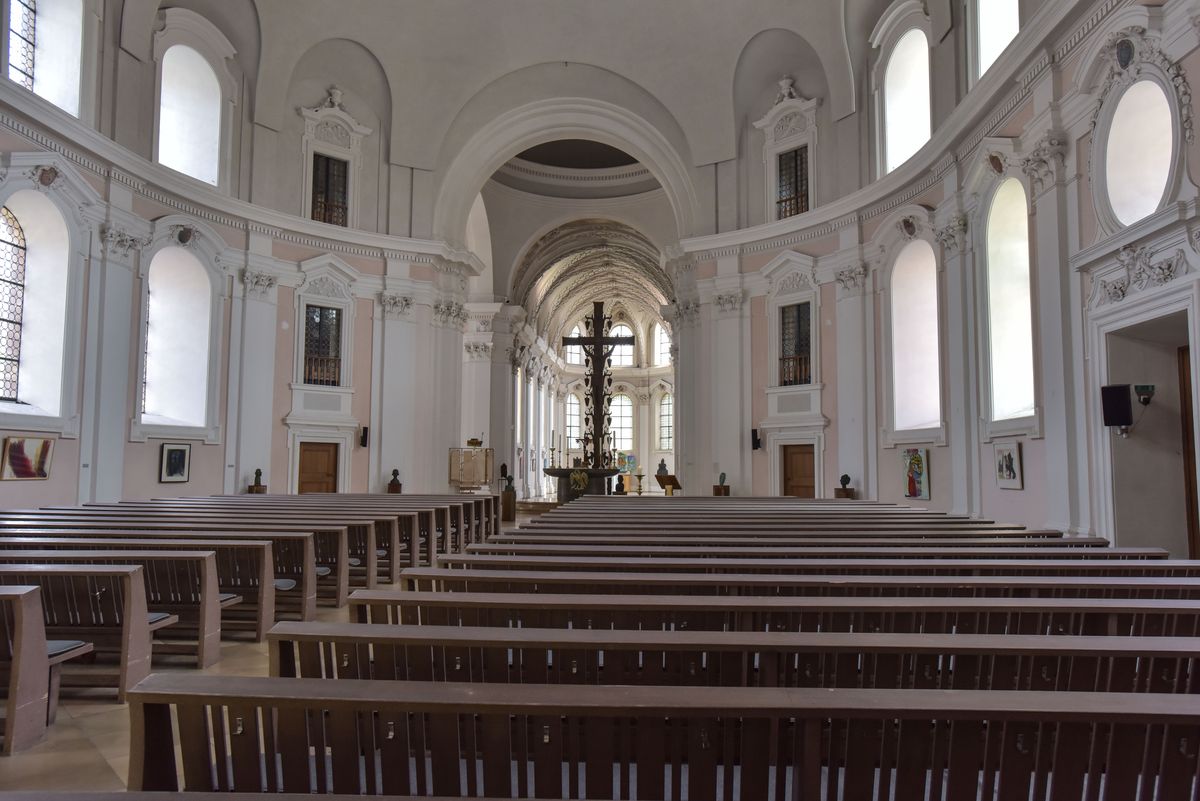
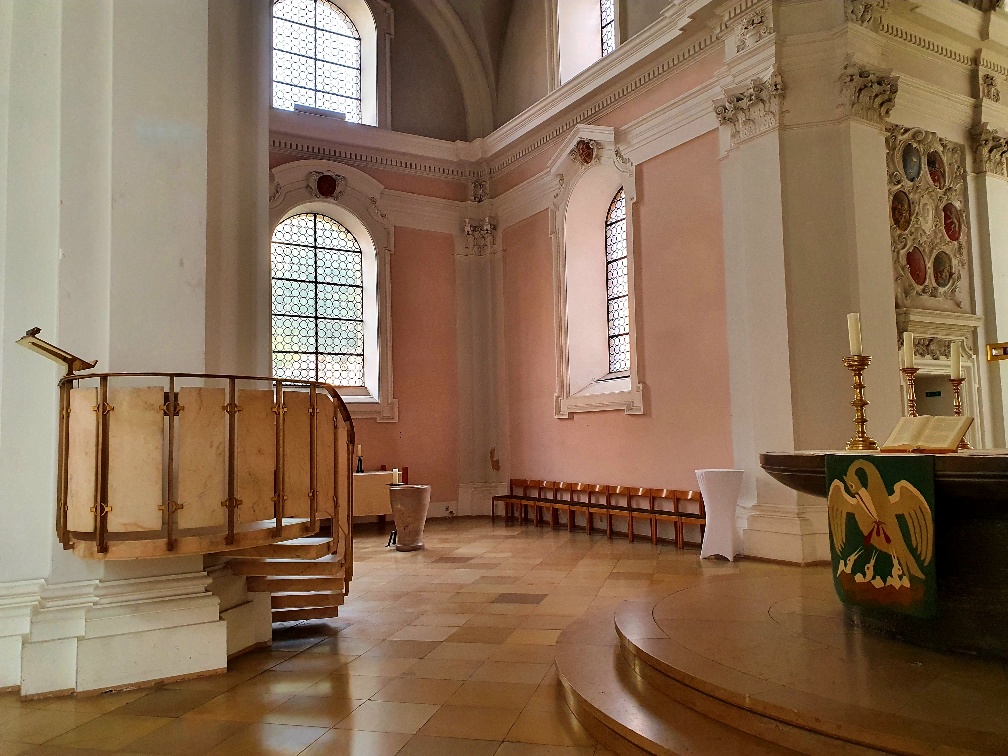
As Cultural Church of the Nuremberg deanery, the Evangelical Lutheran Egidienkirche has been involved in the city's cultural life in the field of the visual arts for many years.
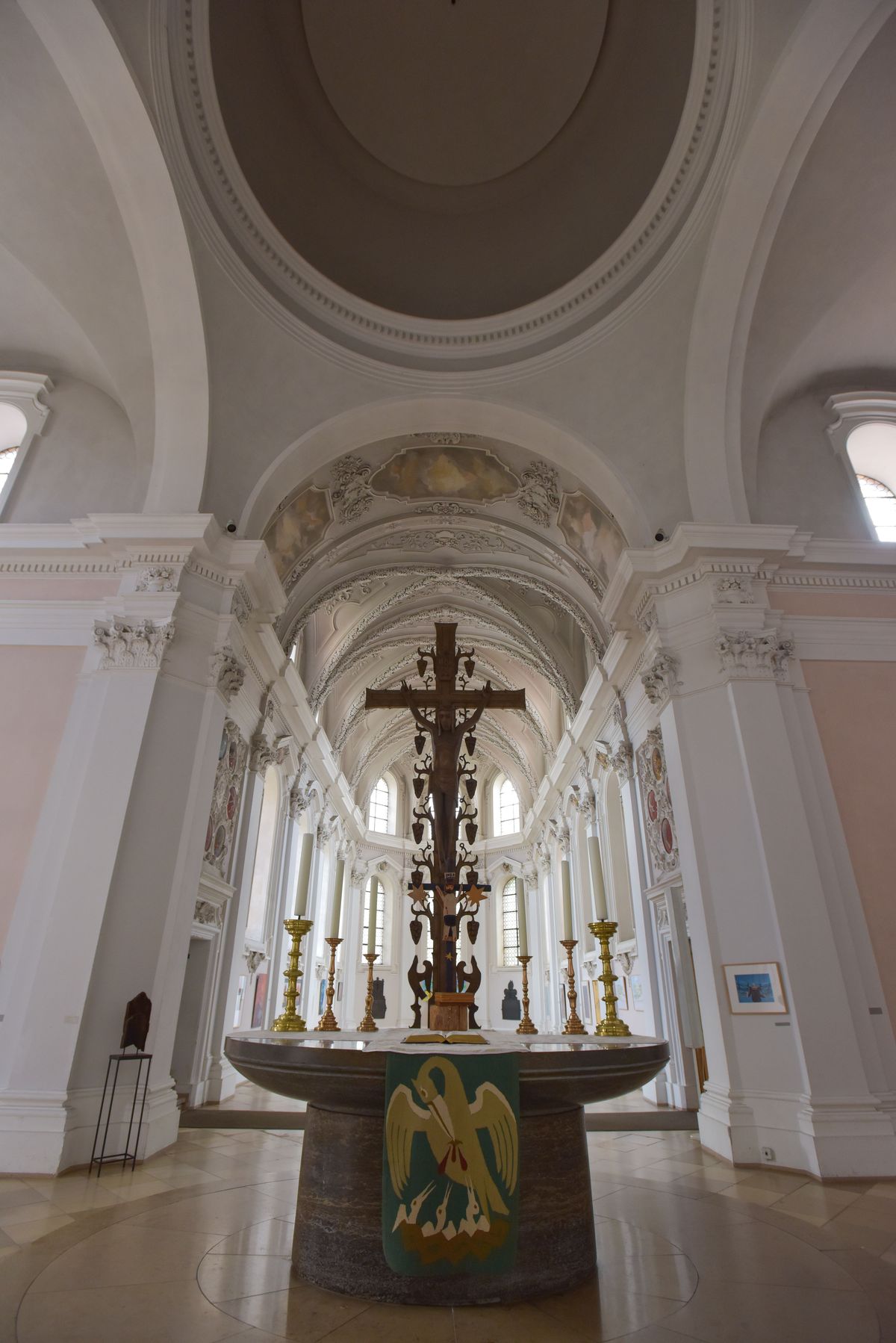
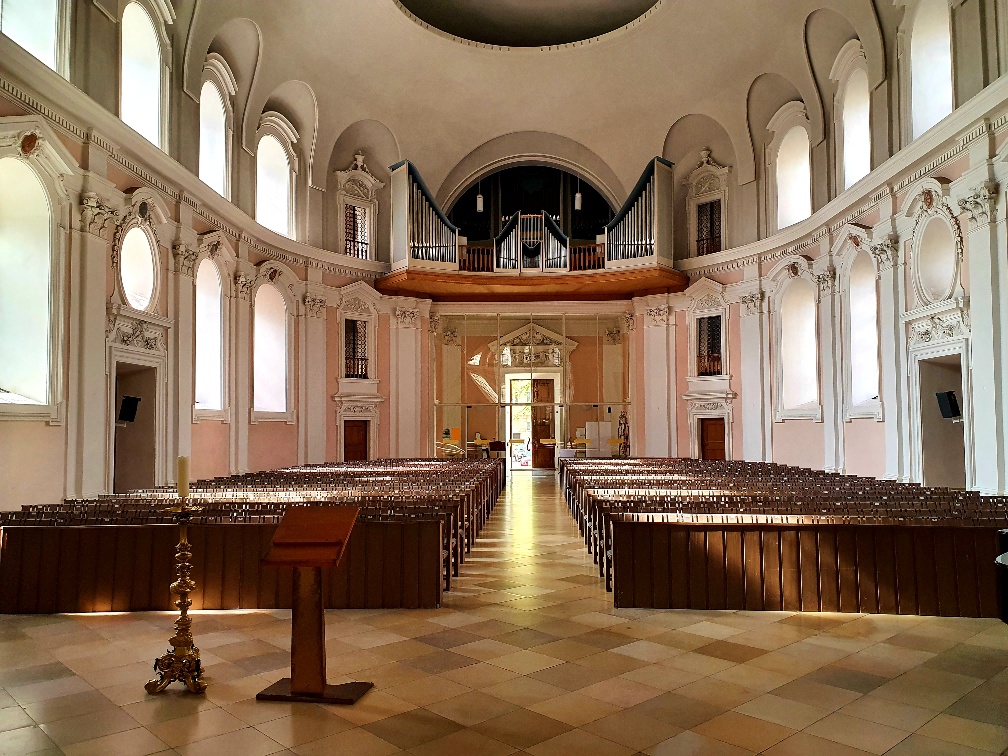
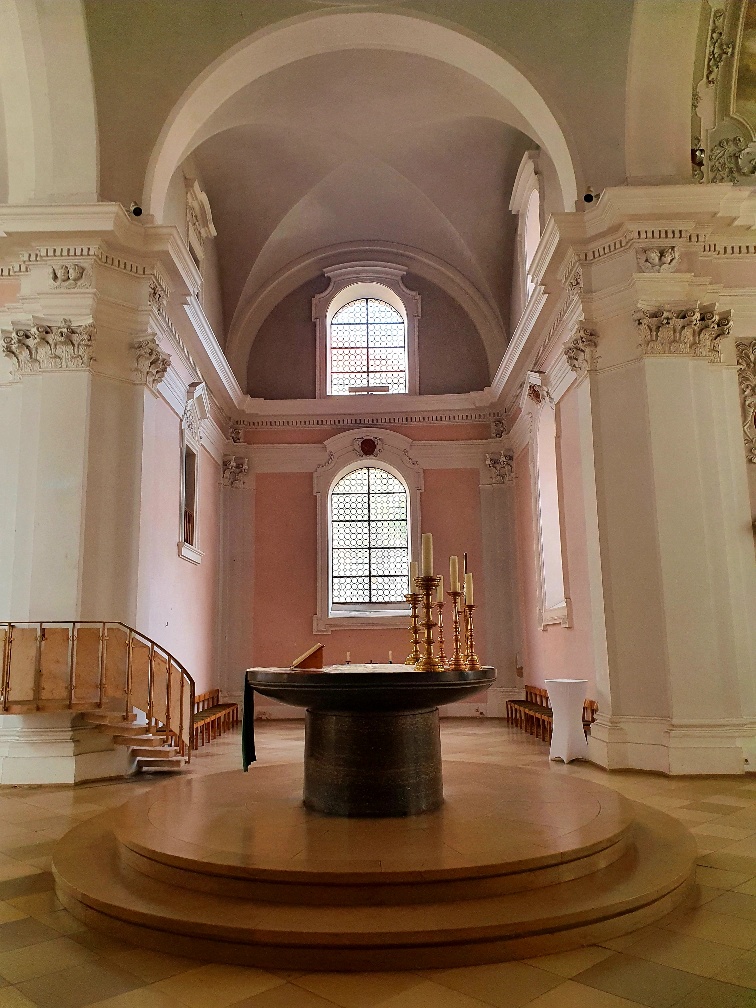
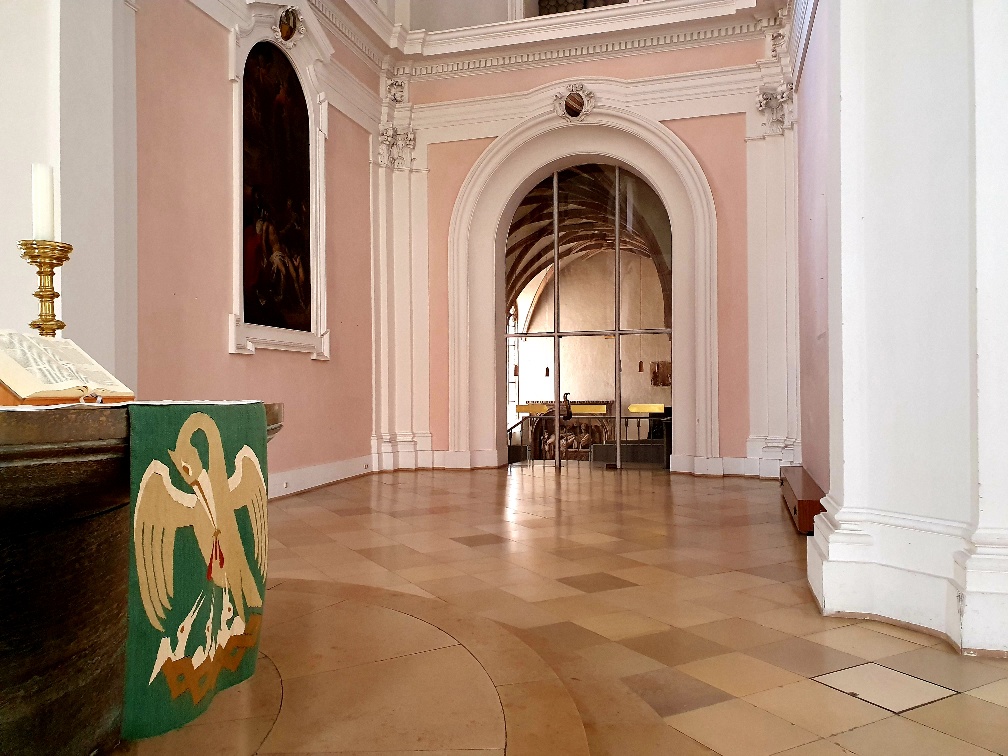
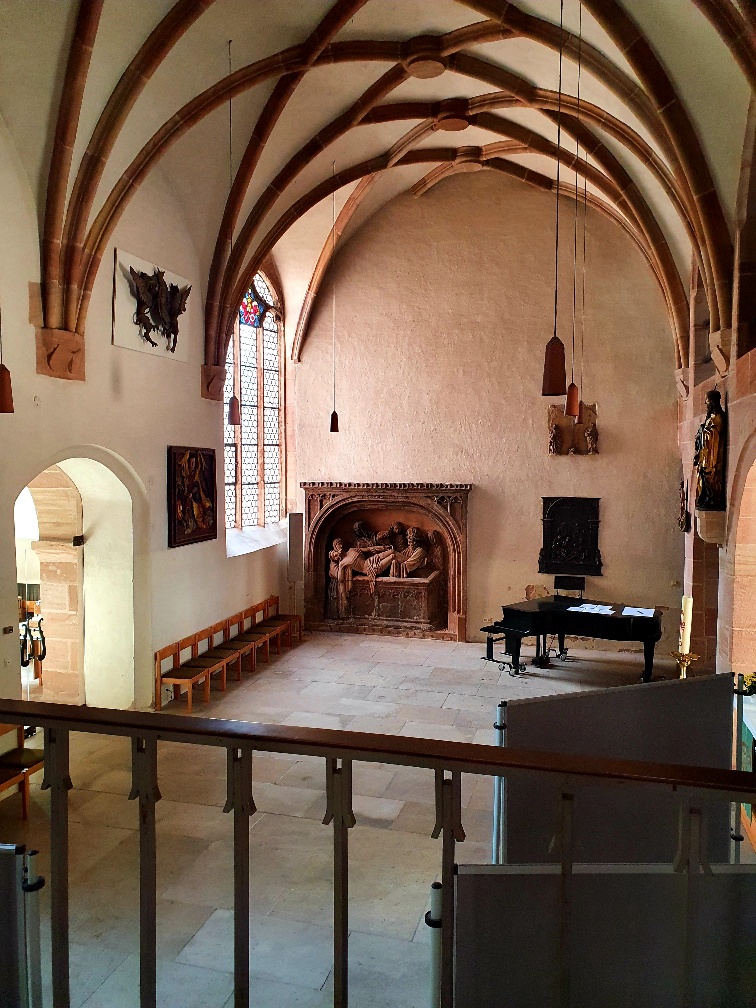
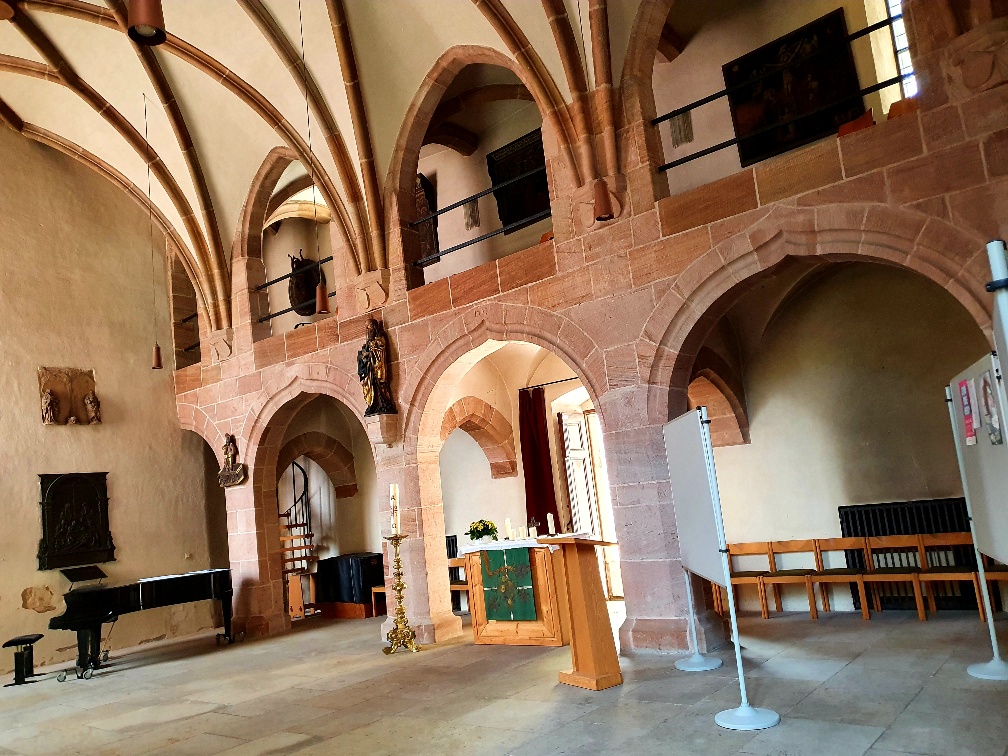
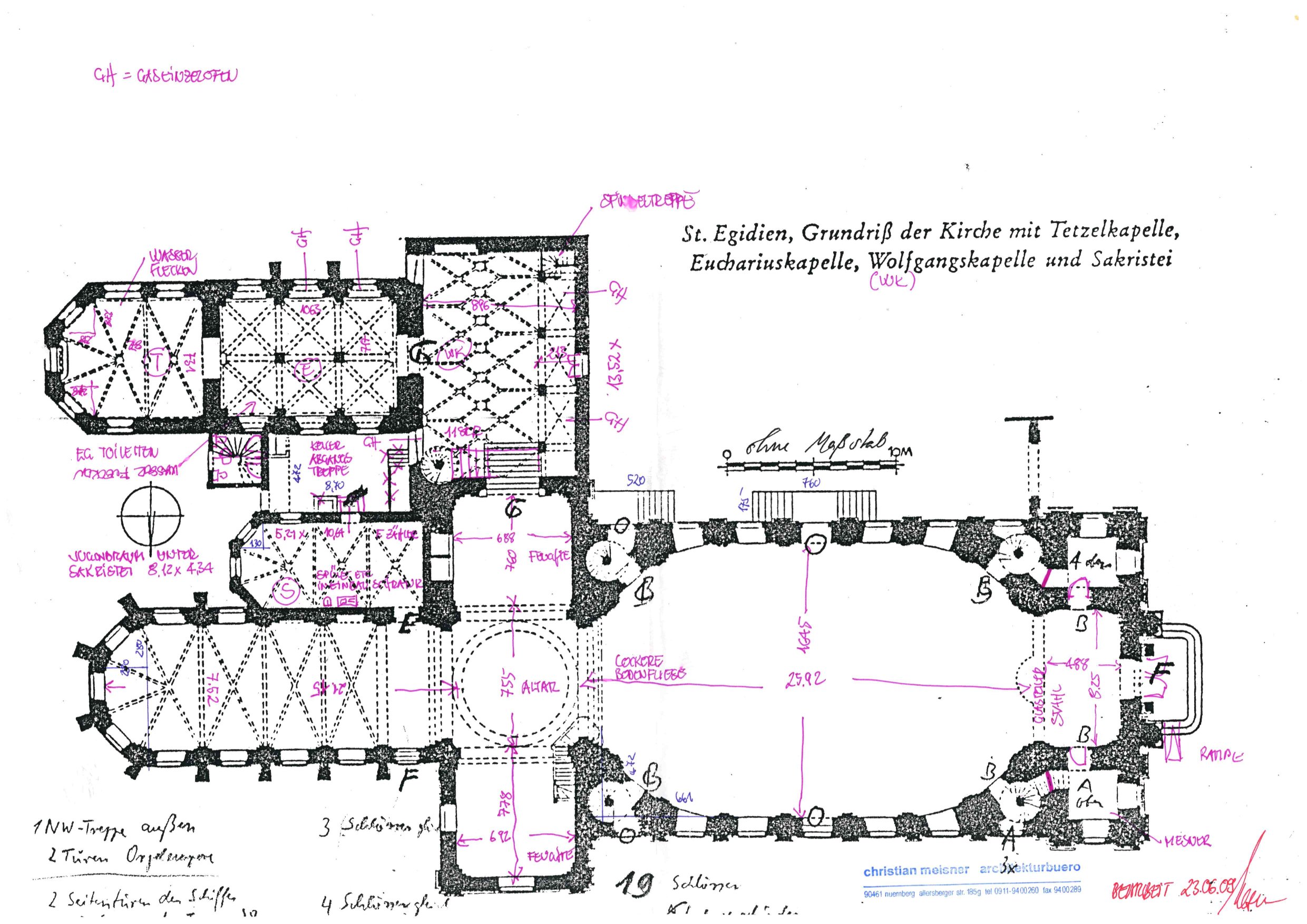
Defining spatial elements include the oval nave with approximately 430 seats and the Rieger organ; the freestanding circular altar beneath the crossing dome; unobstructed transepts to the north and south; and a spacious, open eastern choir, which in the time of the Benedictine monastery served for the monks’ Liturgy of the Hours. Adjoining the southern transept are three well-preserved medieval chapels with a rich array of epitaphs and other sculptural works.
The building’s history brings together multiple stylistic layers and spatial characters: originally a Romanesque monastic basilica (c. 1150), inhabited by Hiberno-Scottish monks until 1418, it was converted during the Reformation in 1525 into a Protestant preaching church, with a model grammar school established in the monastery buildings. A major fire in 1696 necessitated rebuilding on the original footprint in a Baroque–early Neoclassical style including rich stuccowork by Donato Polli, unique in this form in Nuremberg. However, much of the Baroque interior was lost in the bombing of the Second World War, and the subsequent reconstruction realised a synthesis of reduced Baroque elements with the restrained lightness of 1950s architecture. The simple vaulted ceiling with lunettes in the navewith its recessed lighting cove provides a popular surface for projections. Today, a large dark bronze cross from 1963, in the form of a Tree of Life with the blessing Christ, dominates the visual axis from the nave towards the east choir, which has been (partly) restored with stuccowork.
The spacious, column-free church, decorated in light colours, offers plenty of scope for artistic interventions, including free-hanging installations. Thanks to its long reverberation time, the acoustics are particularly well suited to vocal music or small ensembles and encourage experimentation with visual art in the context of sound-based performance.
Height: max. 16 m
The door dimensions are:
Main entrance: height 4.00 m; width 1.75 m
Inner door (glass partition): height 2.65 m; width 2.25 m
Power supply: several Schuko sockets, high-voltage power supply
Instruments: main organ, portable chest organ, two grand pianos
Access during Die Blaue Nacht | The Blue Night: via Egidienplatz 37
Egidienkirche | St. Egidien

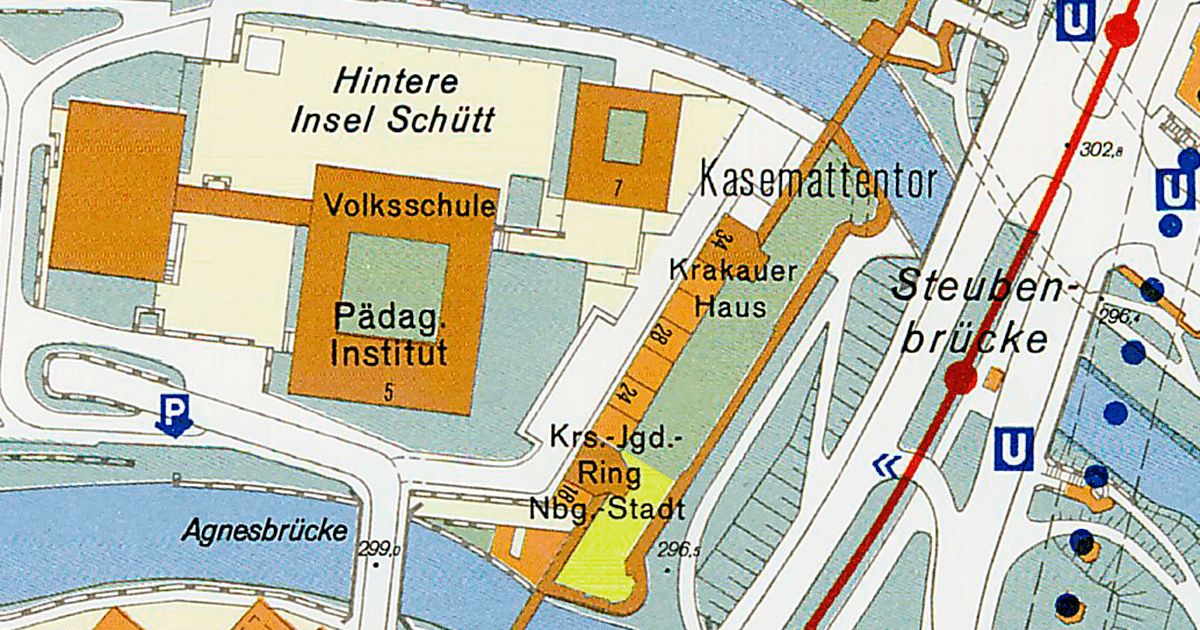
Tratzenzwinger
Tratzenzwinger
Hintere Insel Schütt 20
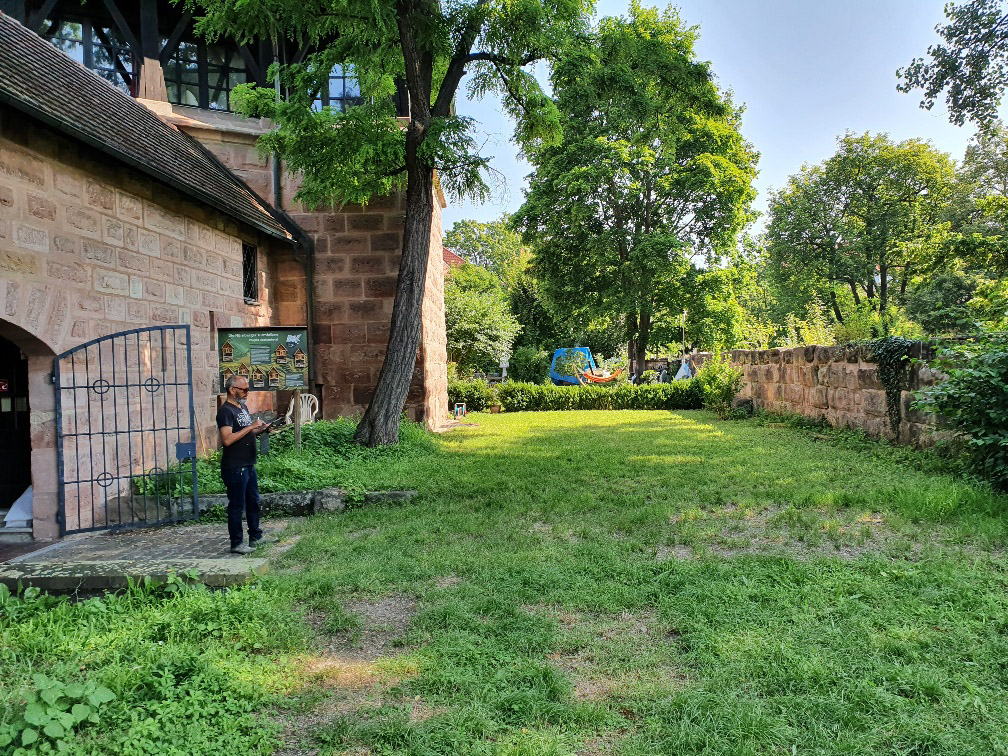
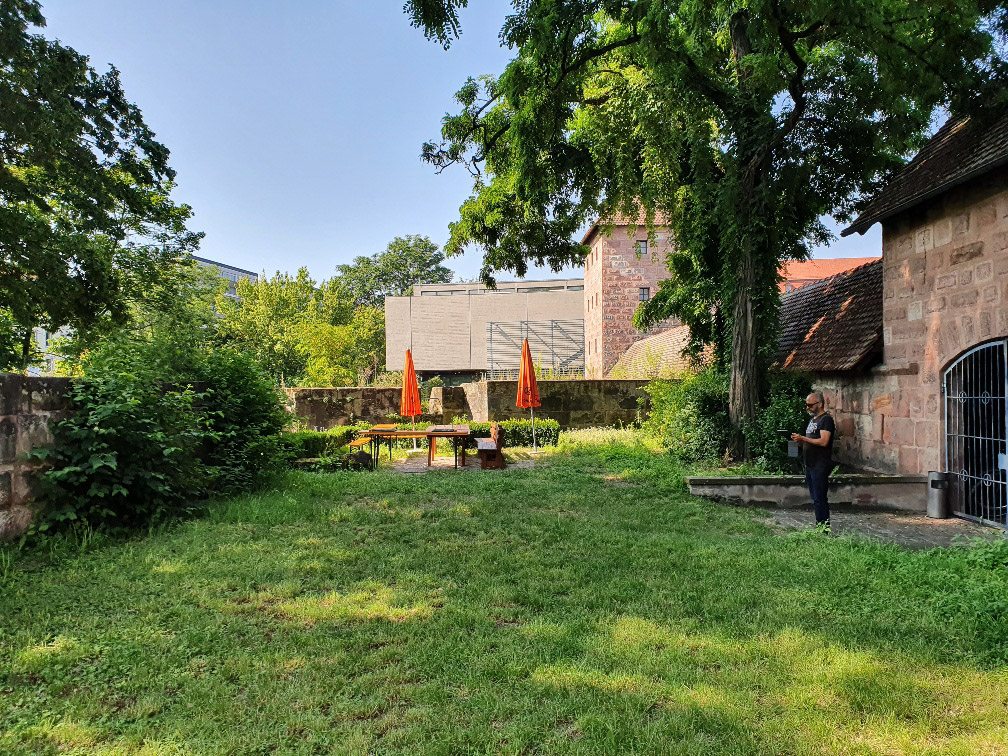
The zwinger between the two branches of the Pegnitz was built on foundations of the 15th century up until 1547. The towers behind it were converted into cannon towers. The towers of Nuremberg’s last city fortifications were designated by colours and letters depending on their section. The defensive tower at Hintere Insel Schütt 20 is known as “Blue A”. Both towers were heavily damaged during the Second World War. In 1977, restoration began on the remaining stump of the “Blue A” tower, which since 1980—together with parts of the bastion—has been used by the Kreisjugendring as an office and event venue, now known as “Stadtturm Tratzenzwinger”. The name derives from Johann Matthias Dratz (Tratz), the former tenant of the zwinger tavern once located there.
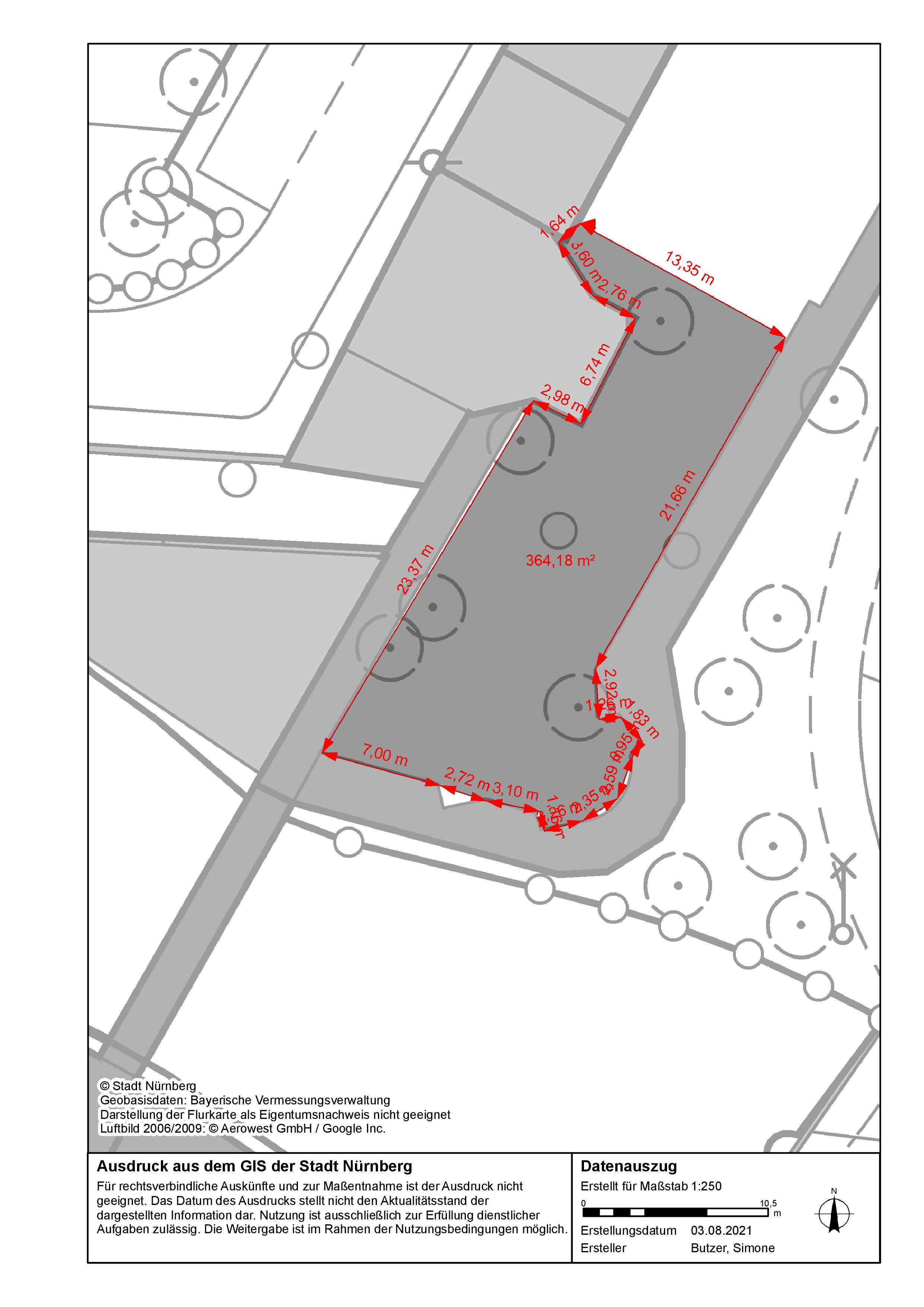
The outer zwinger area can be used in accordance with the site plans. Access is via a ramp near Agnesbrücke. The ramp must not be used by cars.
Power supply: Schuko sockets
Access: via the ramp after Agnesbrücke
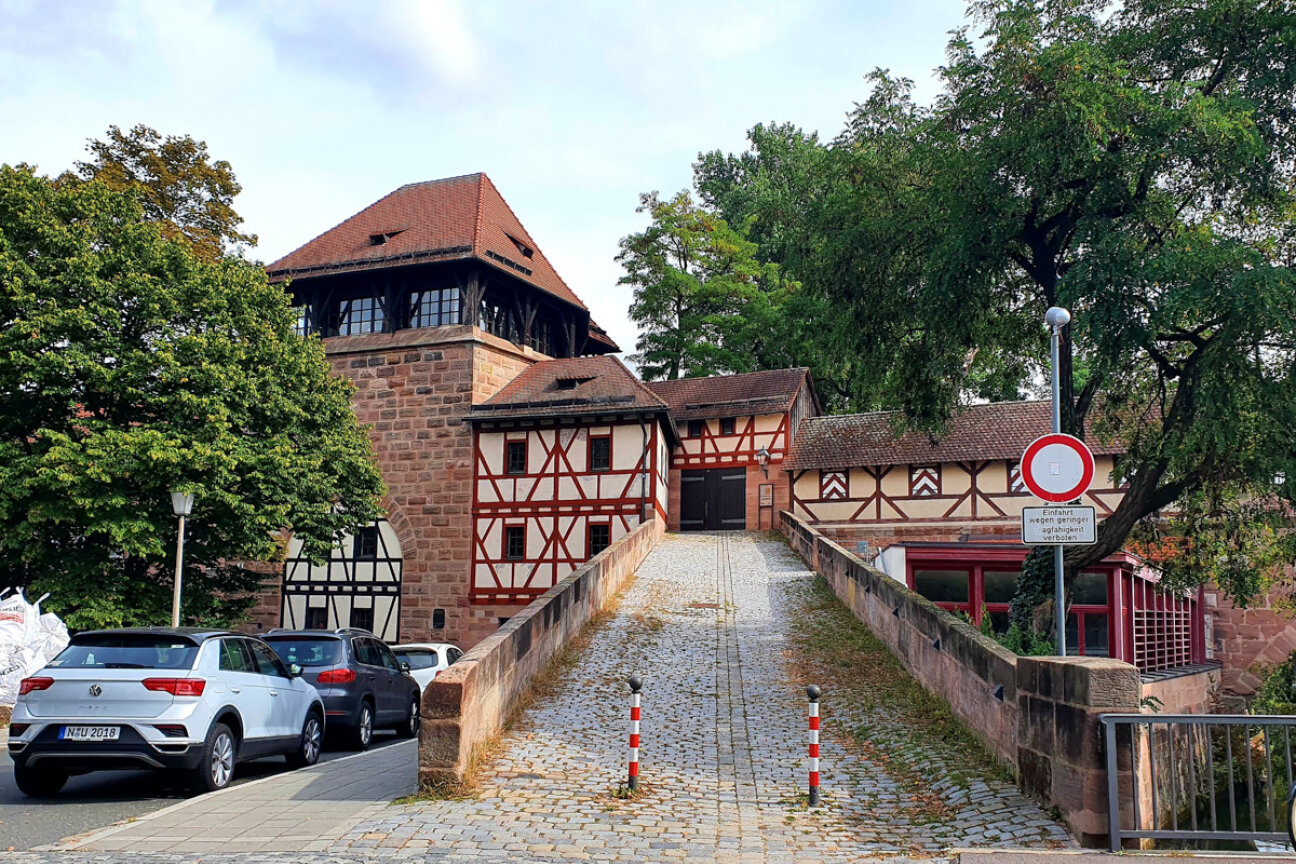
Tratzenzwinger
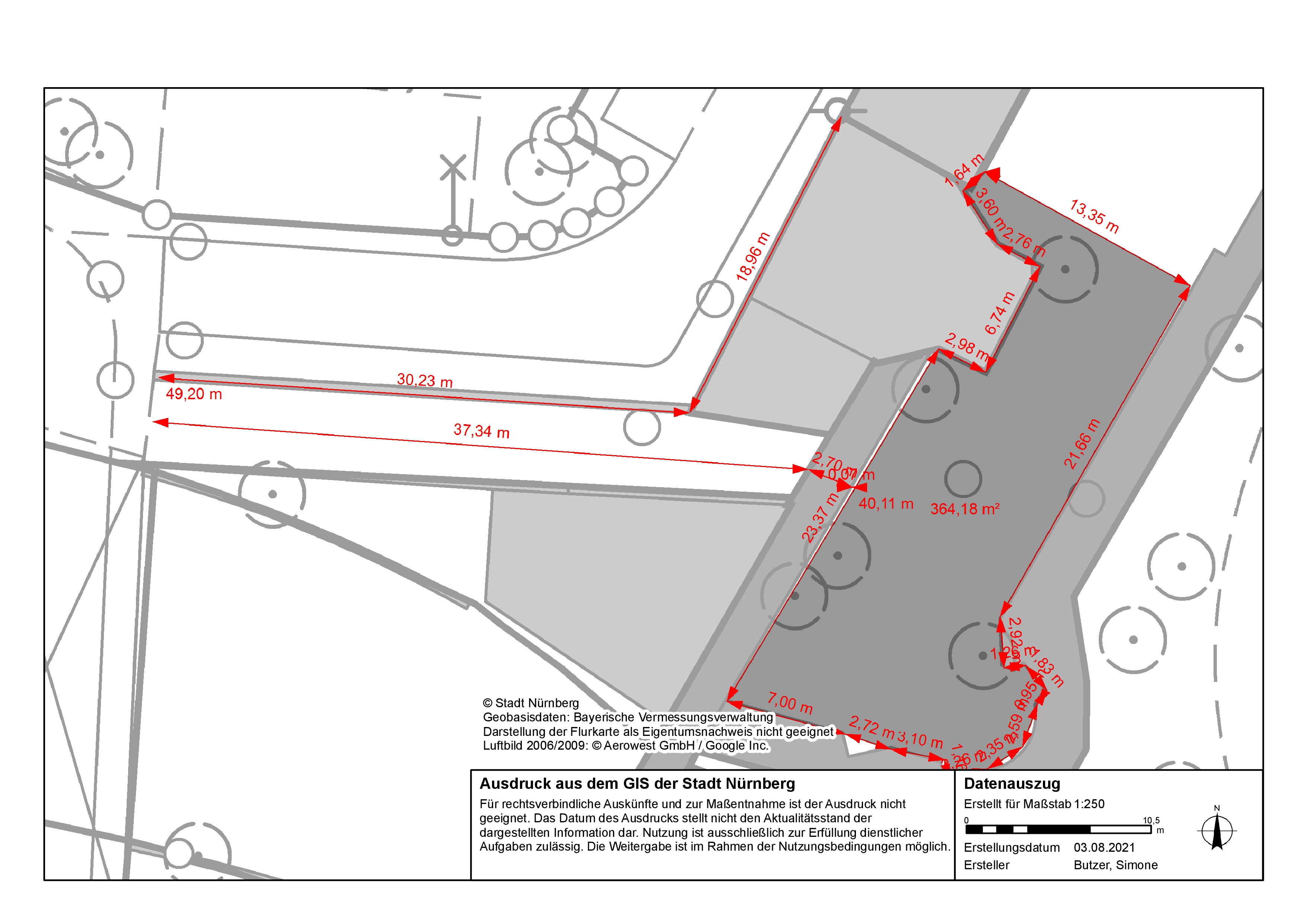
Katharinenruine im KunstKulturQuartier | St Catherine's Ruins in KunstKulturQuartier
Katharinenruine im KunstKulturQuartier | St Catherine's Ruins in KunstKulturQuartier
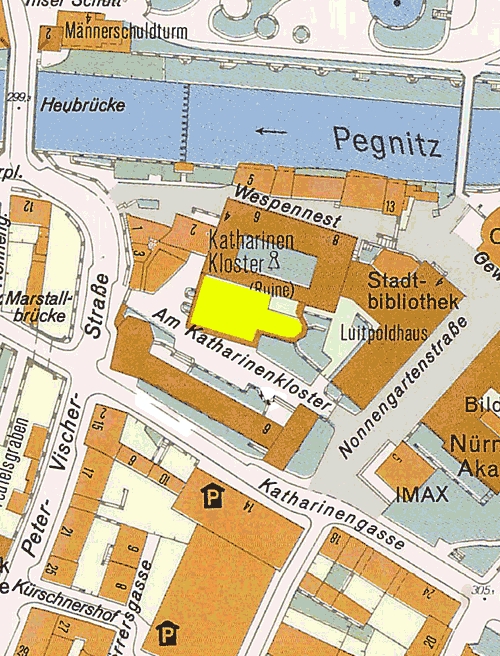
Am Katharinenkloster 6A
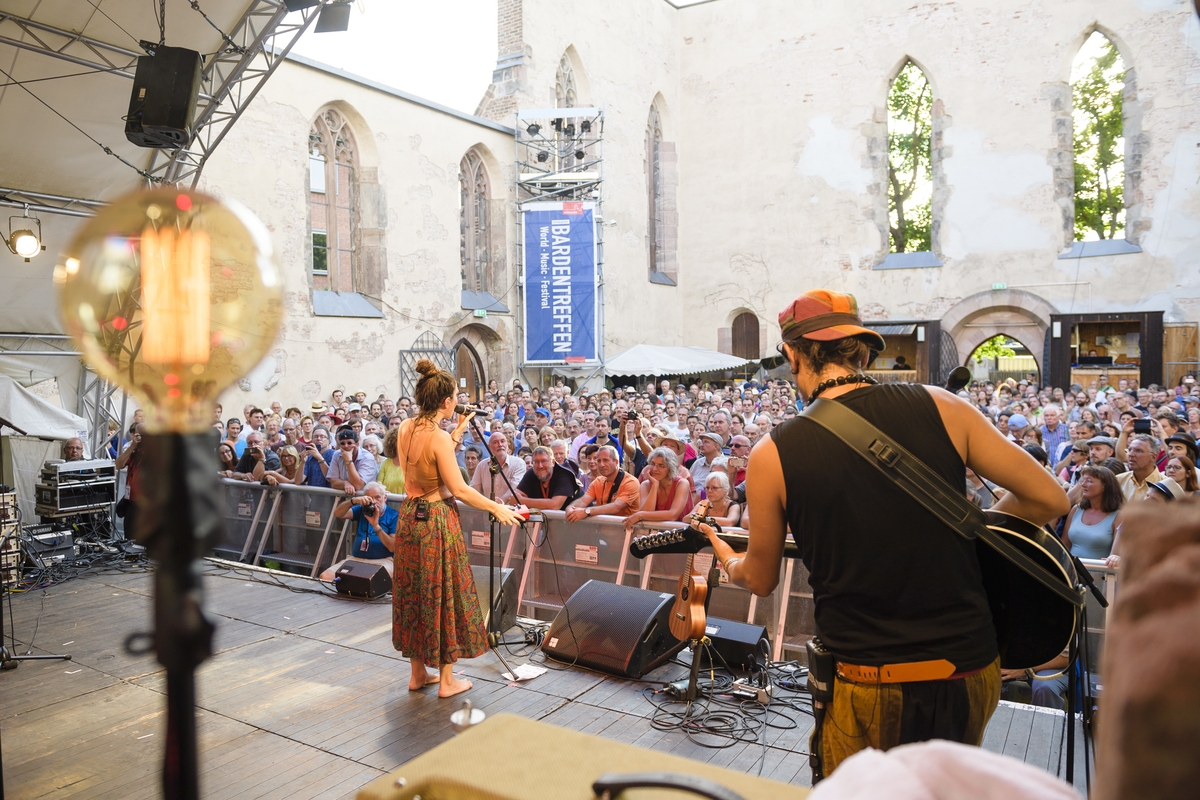
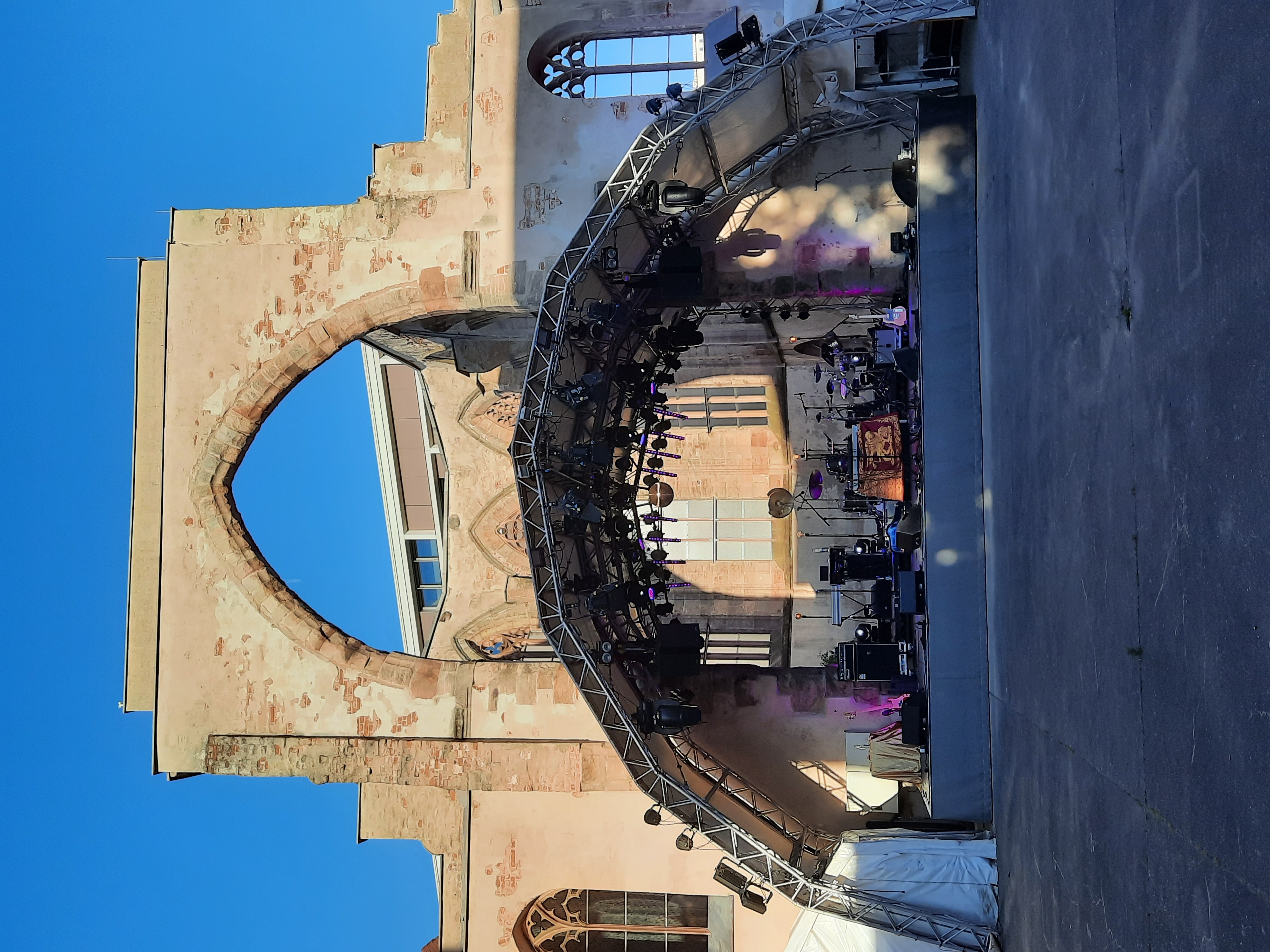
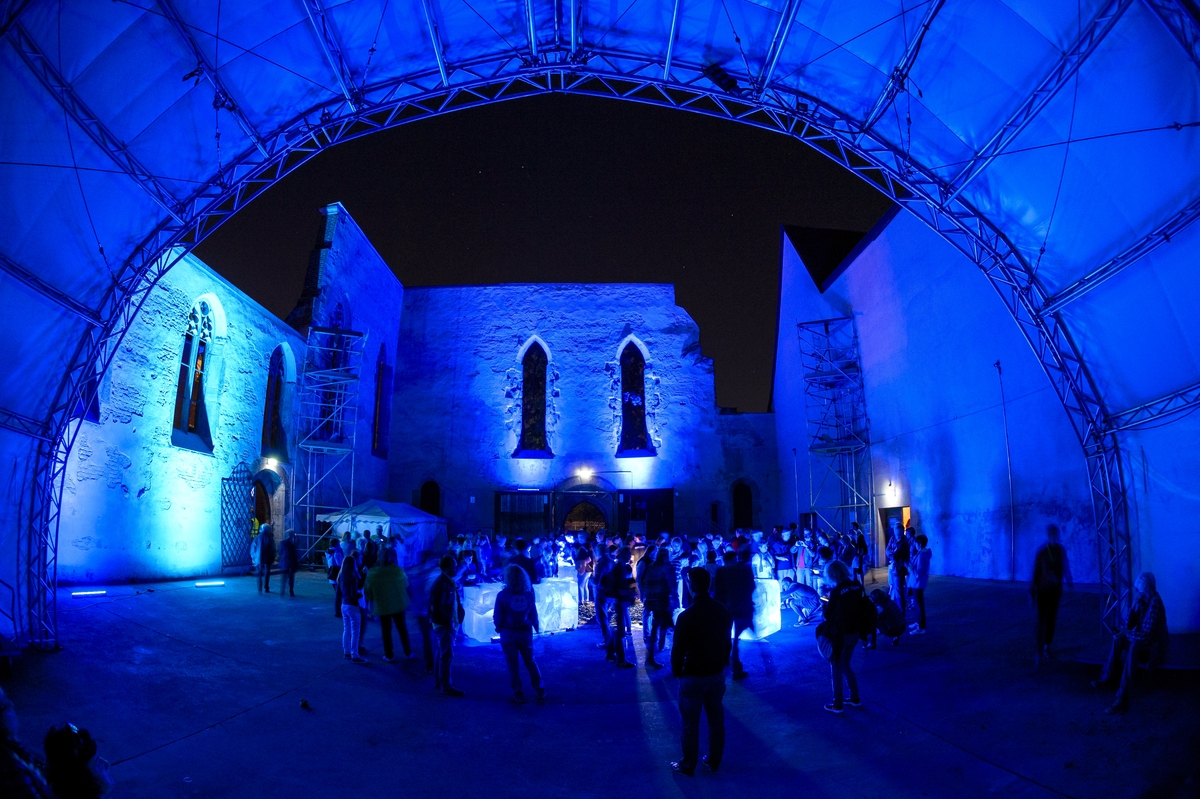
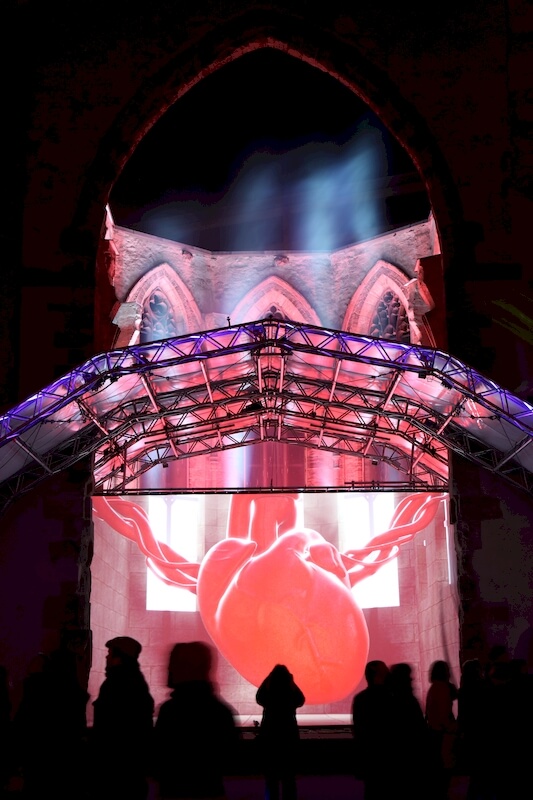
For decades, it has been one of the stages of the annual Bardentreffen festival and for many years has served as the main venue of the St. Katharina Open Air. The monastery was built in 1293, and St. Catherine’s Church in 1297. Both monastery and church were completely destroyed by an air raid during the Second World War. The enclosing walls of the church were stabilised in the 1960s and 1970s, but the church was never rebuilt and remains roofless.
A stage is installed. Lighting and sound equipment must be taken into account in the calculation.
Dimensions: approx. 19 m wide x 25 m long (excluding the choir)
Power supply: 4 x CEE 32 A, Schuko socket
Access during Die Blaue Nacht | The Blue Night: via Peter-Vischer-Straße/Am Katharinenkloster
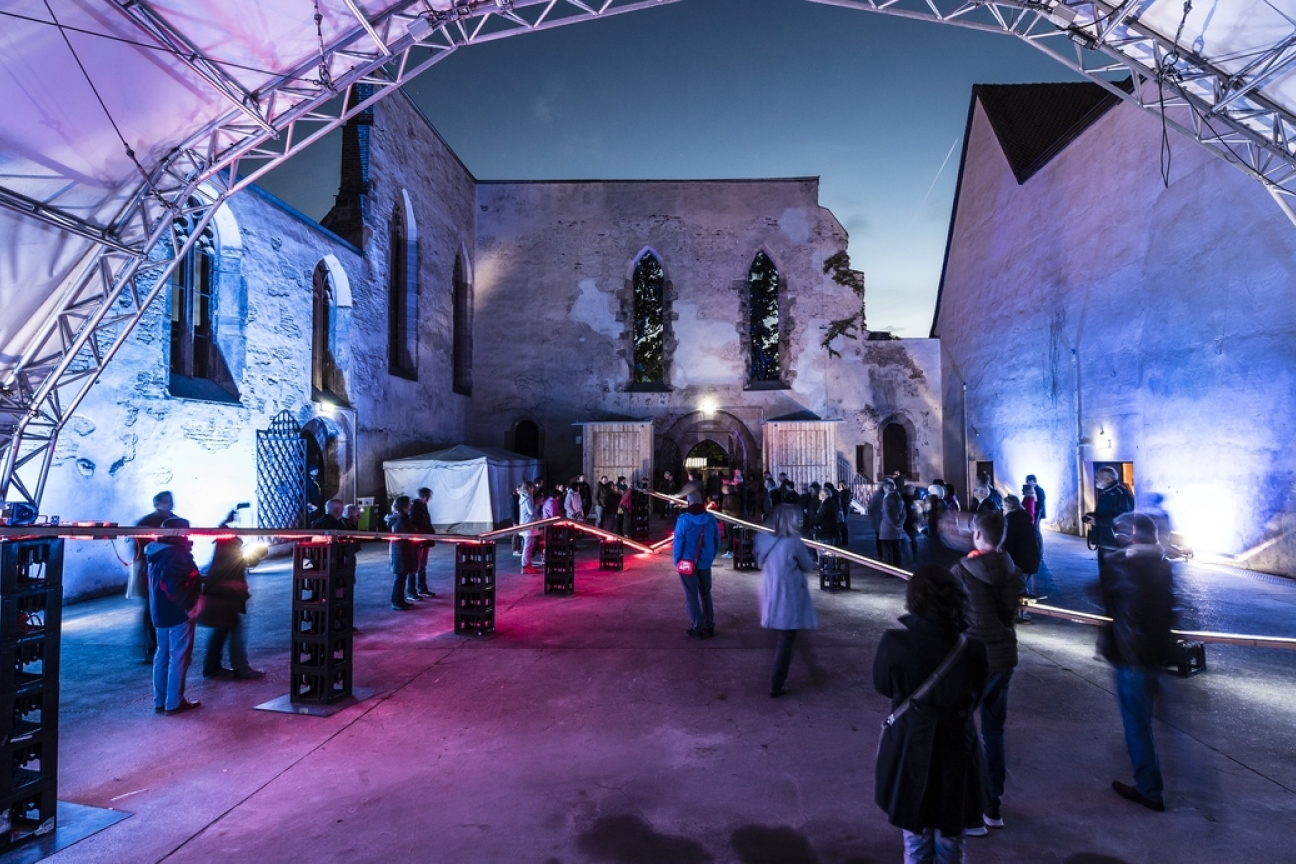
Katharinenruine | St Catherine's Ruins

Garten Marstallbrücke | Marstallbrücke Garden
Garten Marstallbrücke | Marstallbrücke Garden
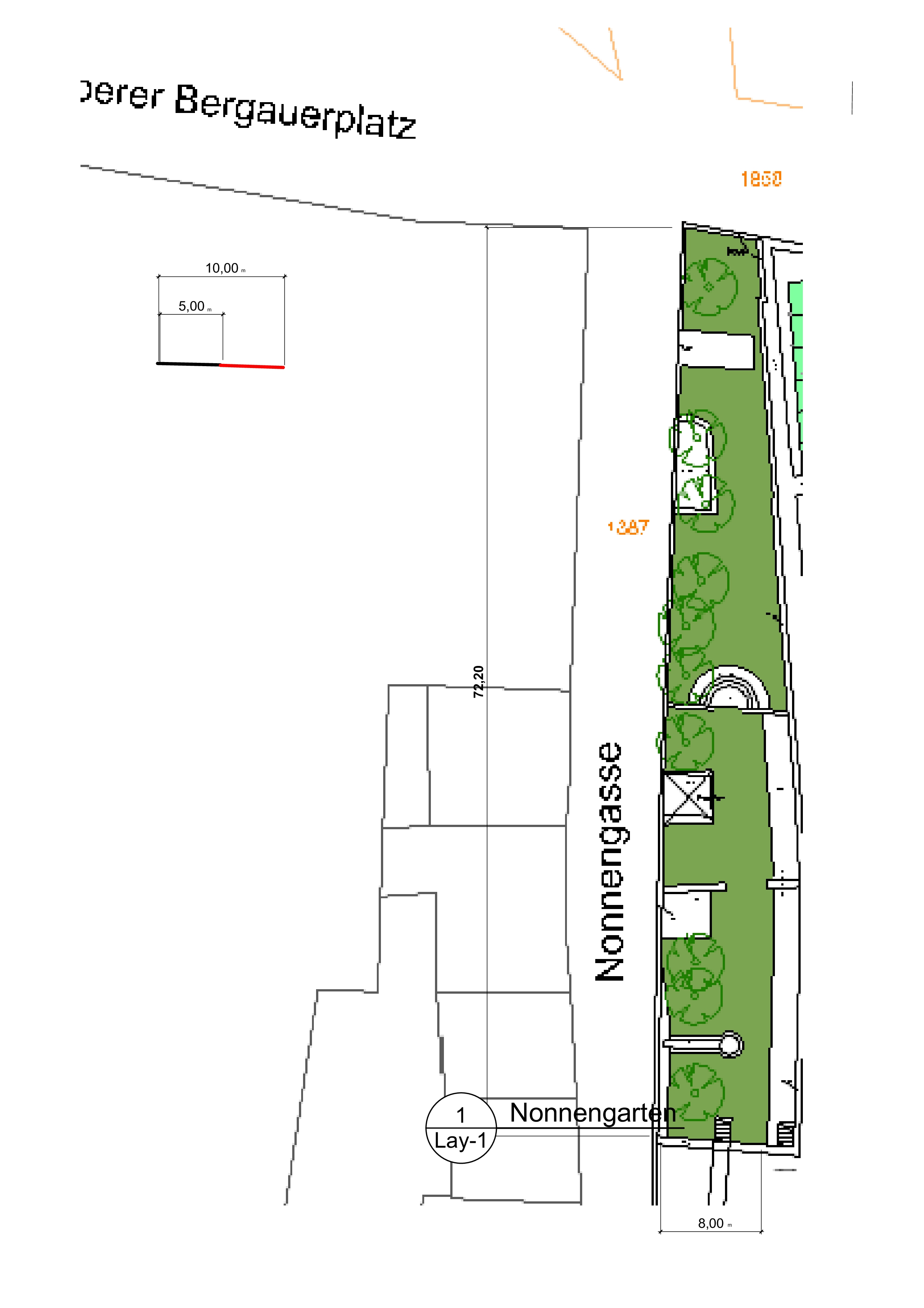
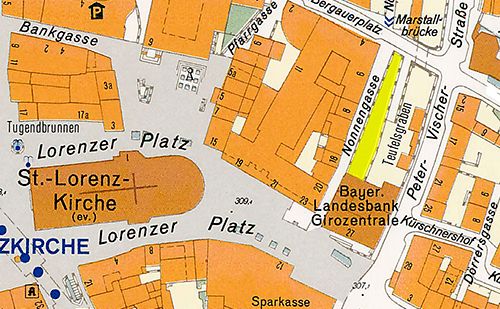
opposite Nonnengasse 2
On this section of the penultimate city moat, located in the area of the former Katharinenkloster, Hans Beheim the Elder built the Marstall (royal stables) in 1510. In addition to horse stables, the complex included residential quarters for the stable master and a bakery. Following later conversions and expansions around 1800, it also comprised an indoor riding arena with a riding track. The so-called Fechtboden (fencing floor) above the arena was used, among other things, as a venue for performances by English comedians and puppeteers.
From the early 18th century until its demolition in 1845, the armoury of the Franconian Imperial Circle was located in the southern part of Nonnengasse. The name “Nonnengasse,” documented as early as 1378, derives from a former estate of the Seligenpforten convent near Neumarkt in der Oberpfalz. In 1812, the gatehouse at Unterer Bergauerplatz 12 was demolished, and in 1945 the Marstall was destroyed.
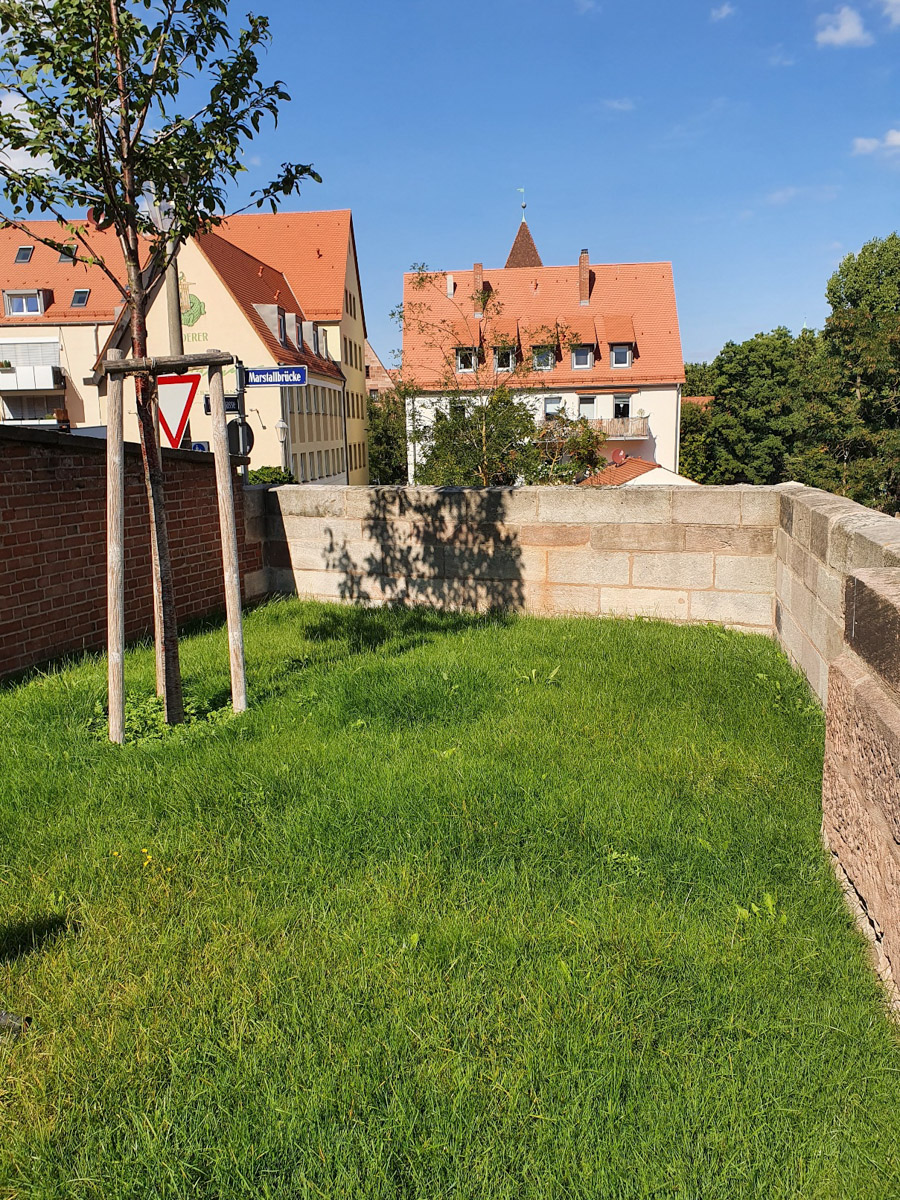
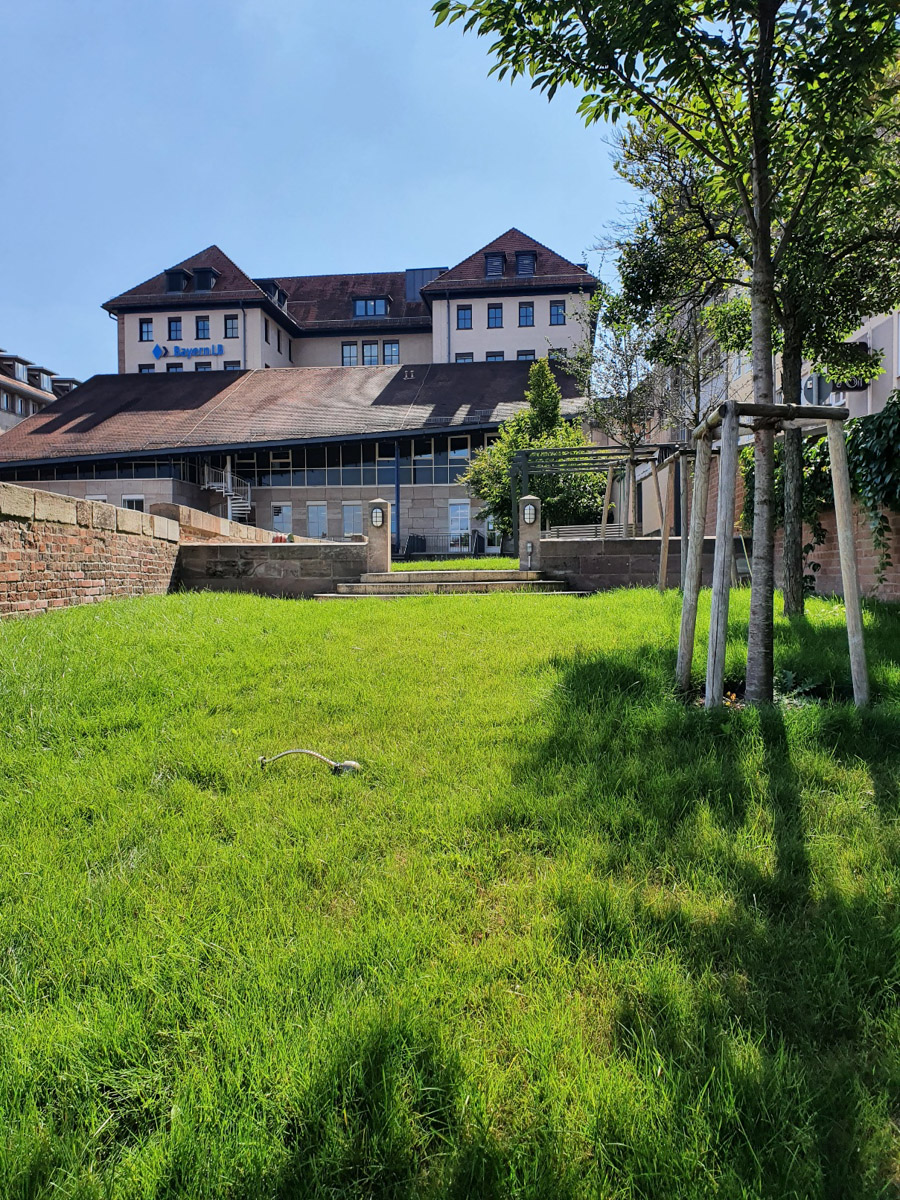
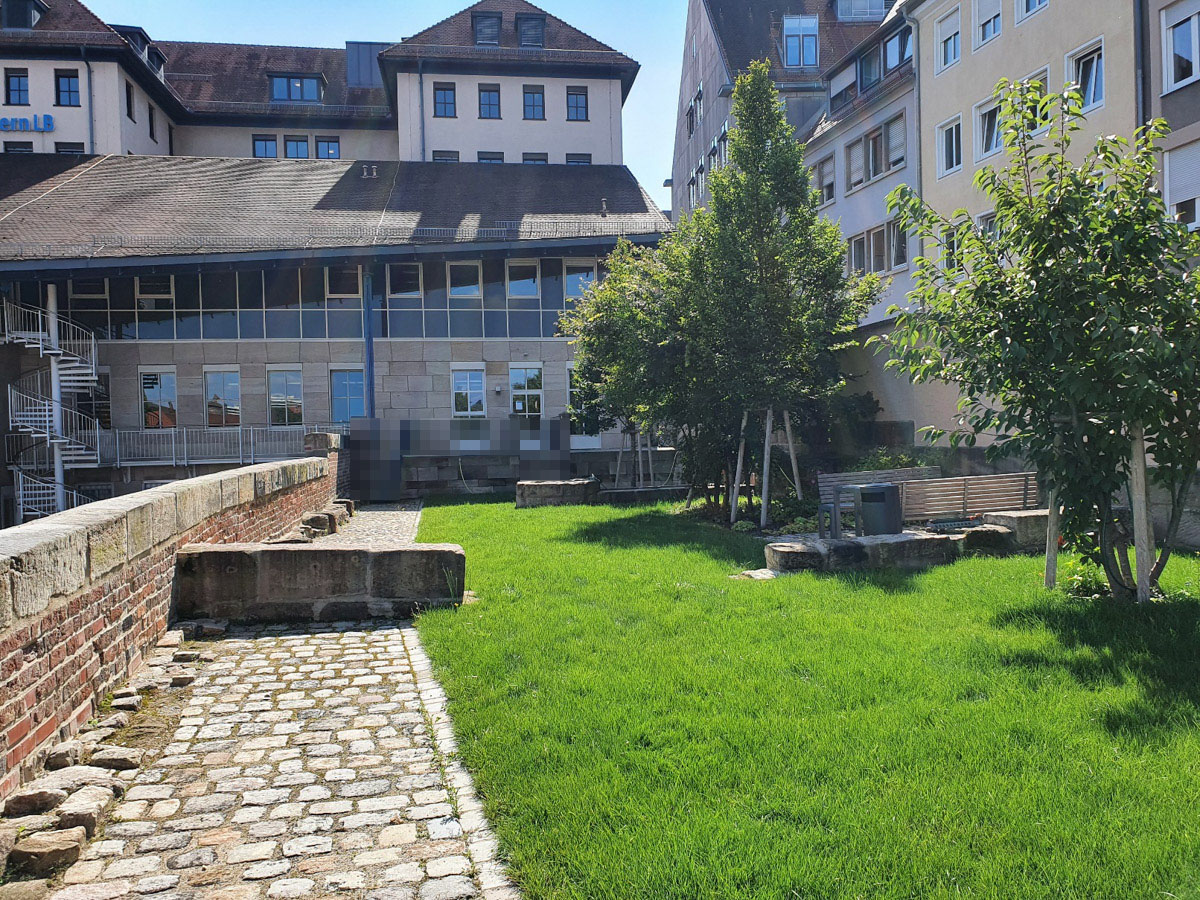
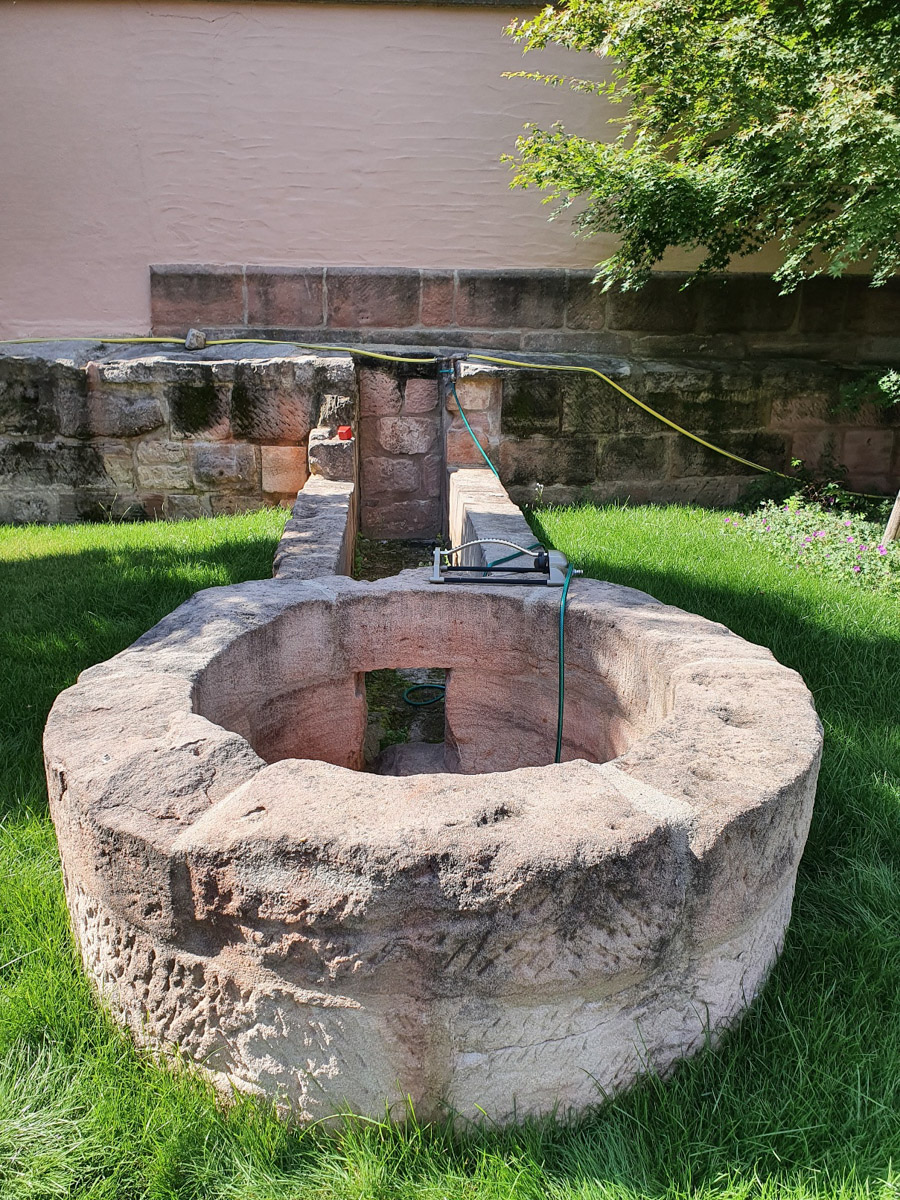
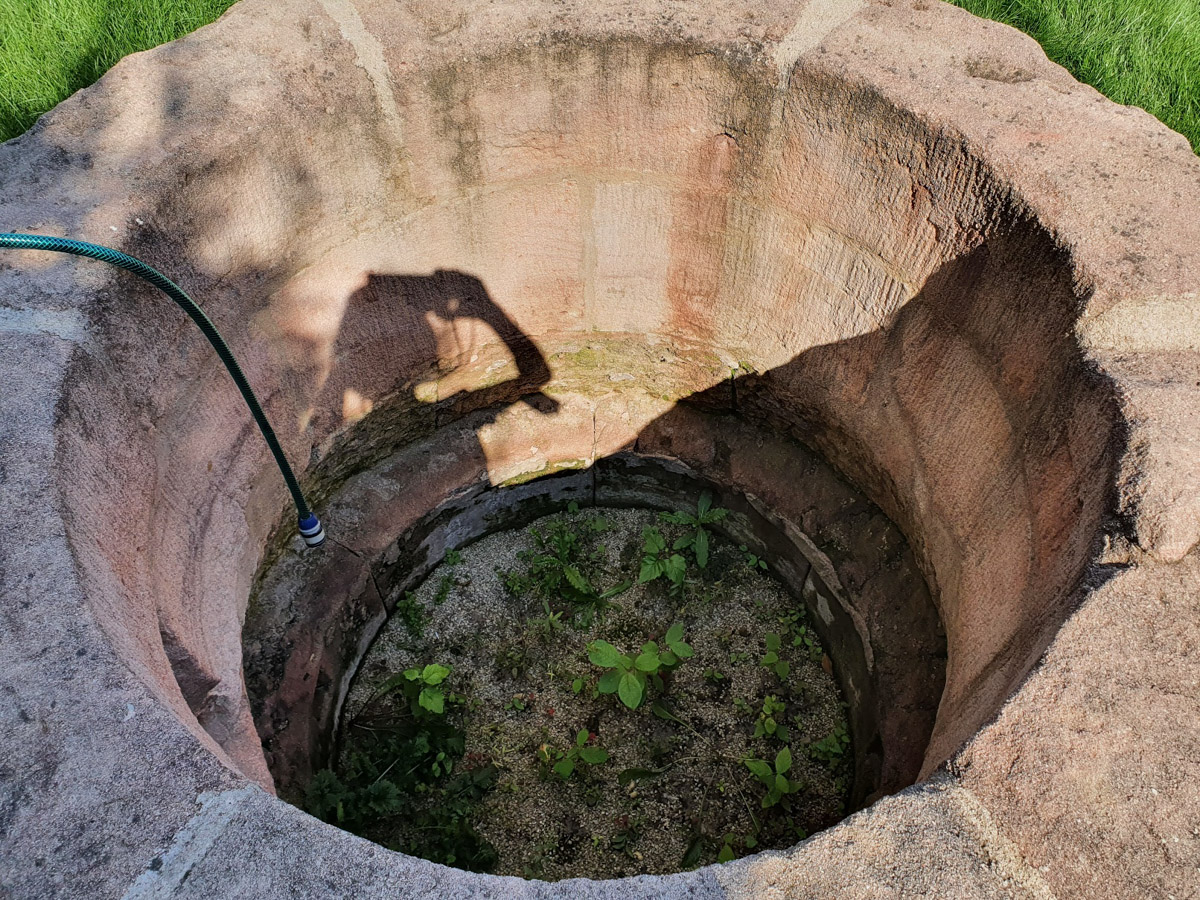
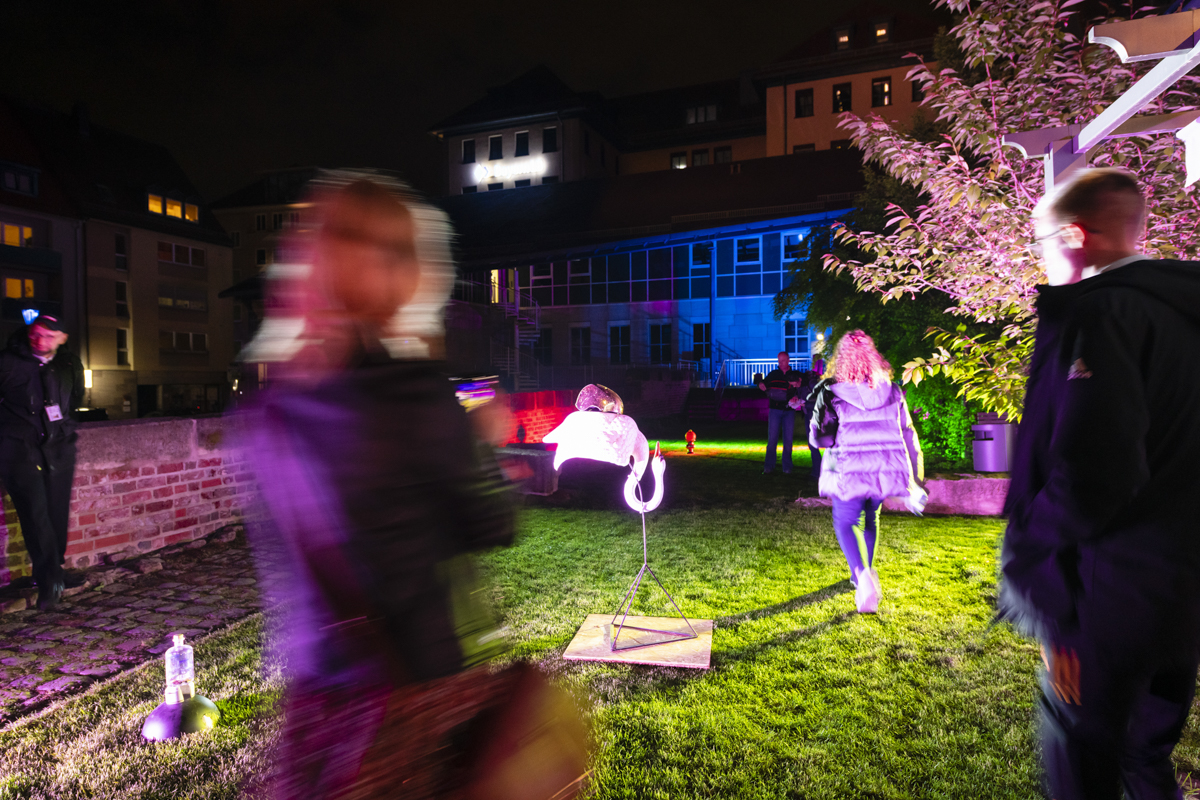
The garden, which is not normally open to the public but is available as an event site, is managed by BayernLB. Between 2017 and 2018, the area underwent extensive restoration, during which sections of the late medieval city wall and a well were uncovered. The garden rises from Oberer Bergauerplatz towards Lorenzer Platz.
Power supply: Schuko connection
Access during Blaue Nacht: via the courtyard gate at Nonnengasse/corner of Marstallbrücke
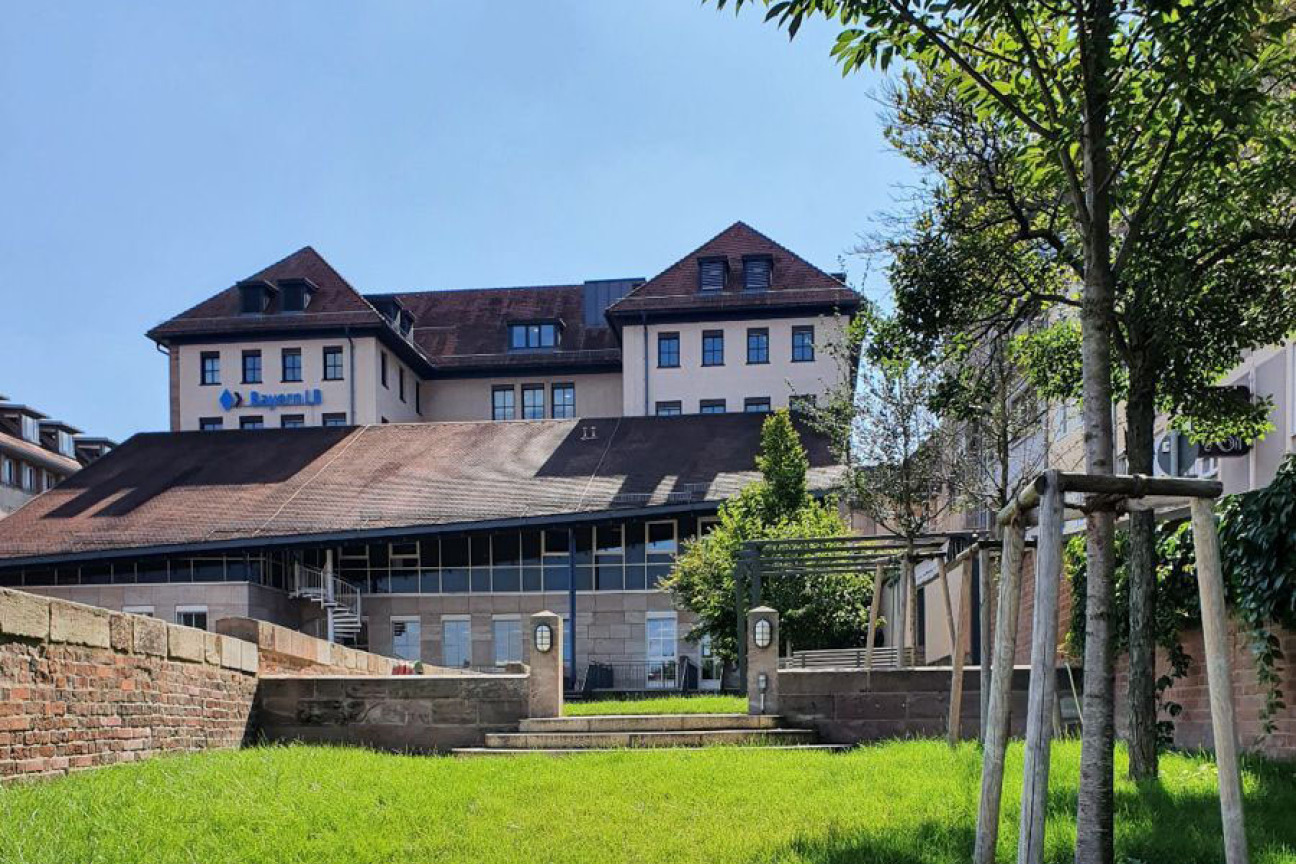
Garten Nonnengasse / Marstallbrücke

Ballroom, Künstlerhaus / KunstKulturQuartier
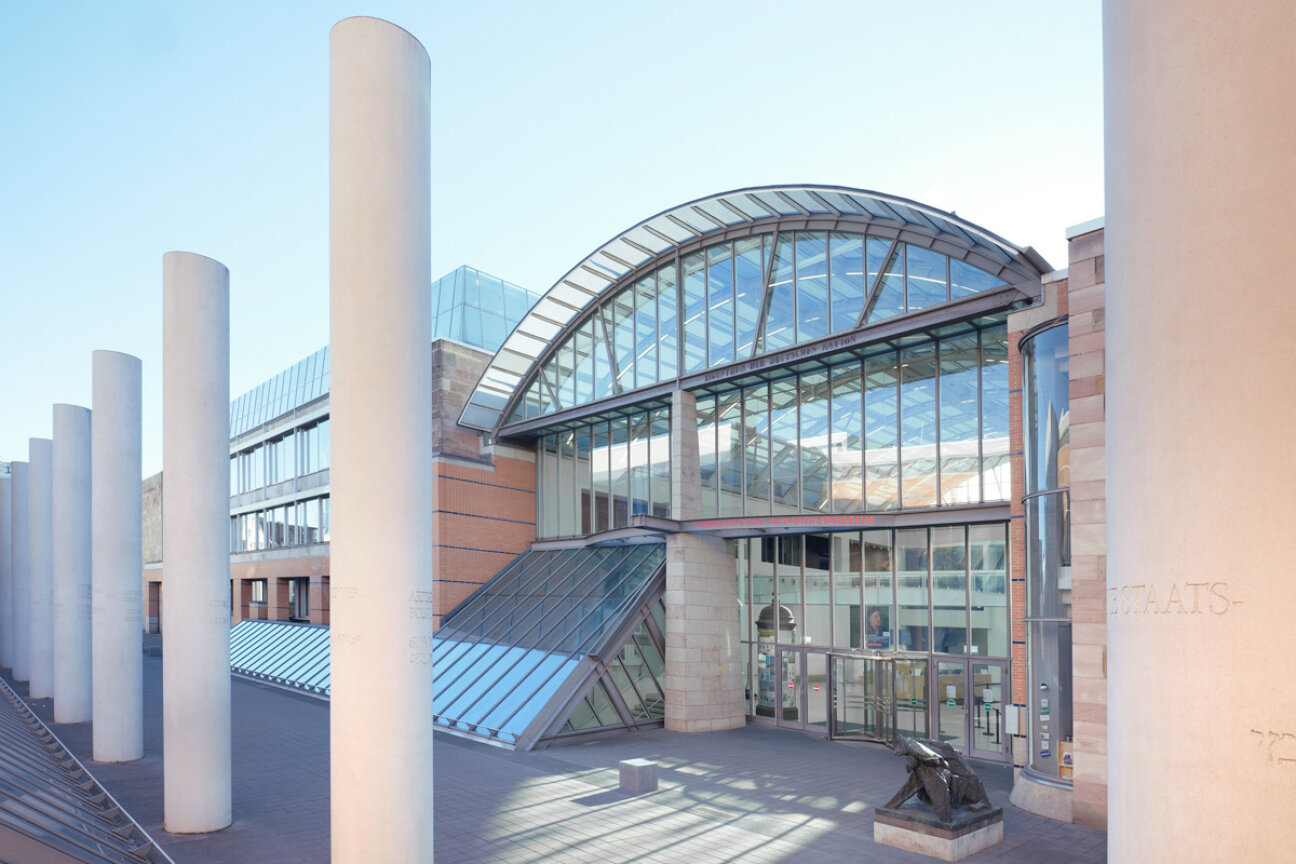
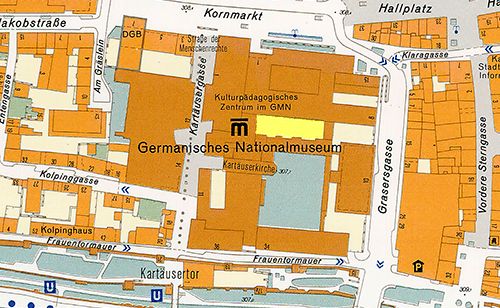
Germanisches Nationalmuseum
Germanisches Nationalmuseum
Kartäusergasse / Straße der Menschenrechte
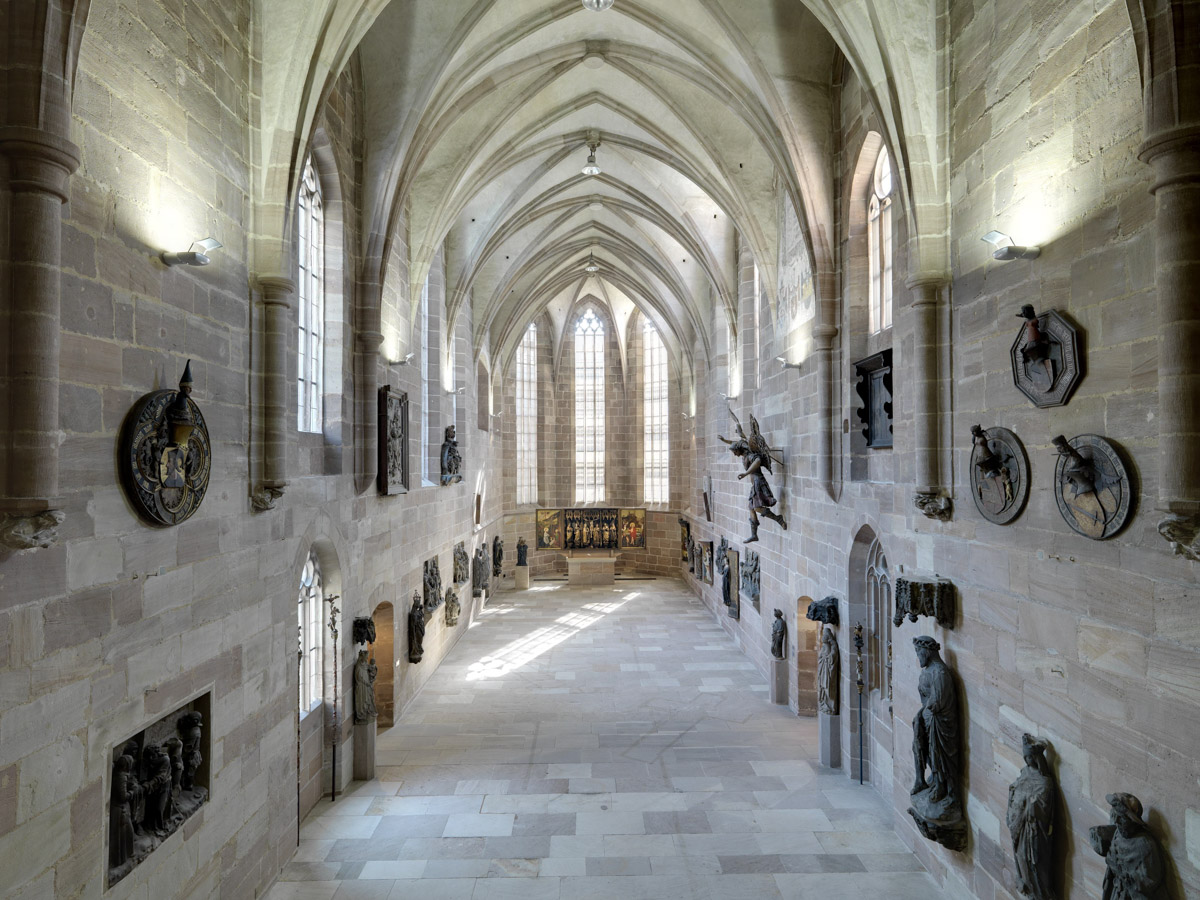
Kartäuserkirche
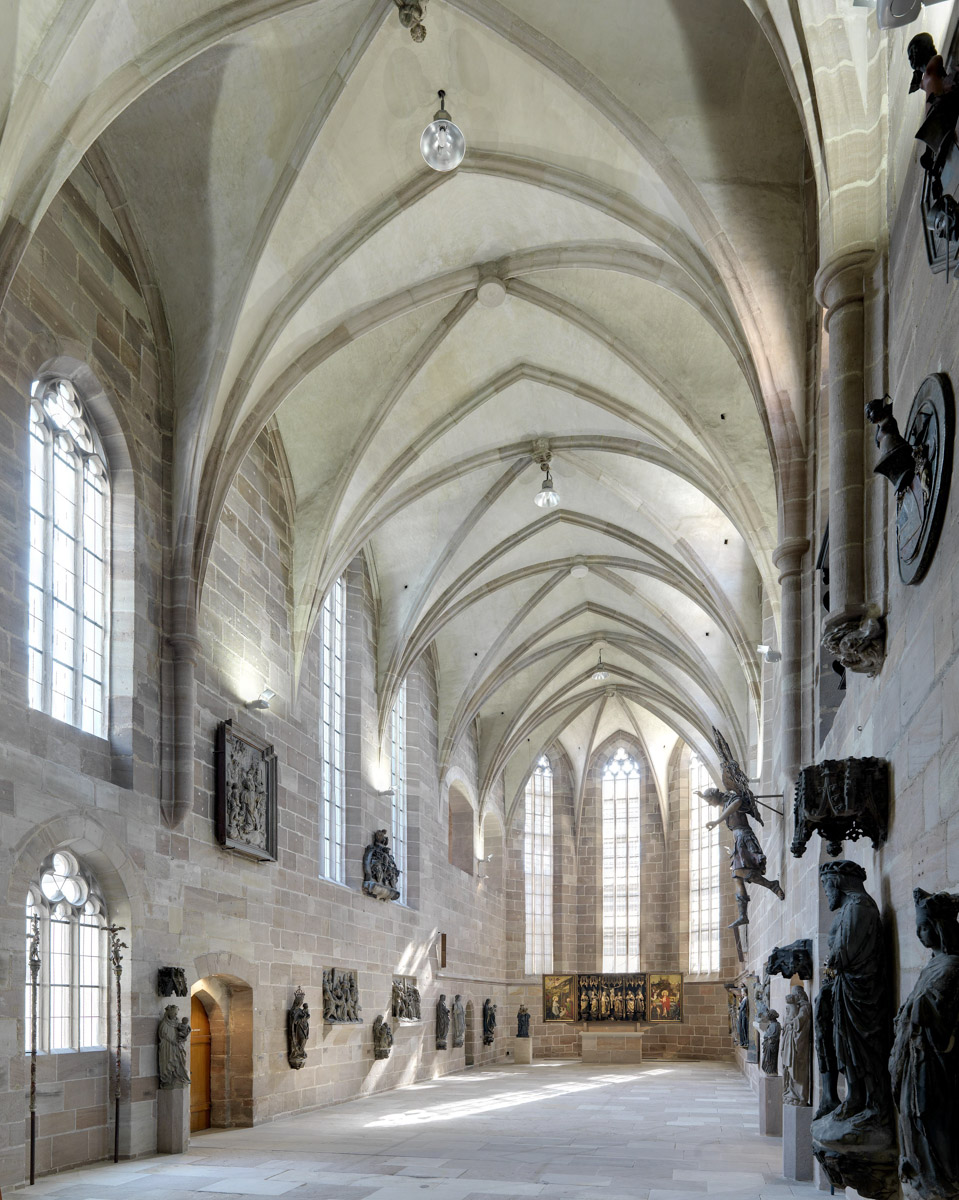
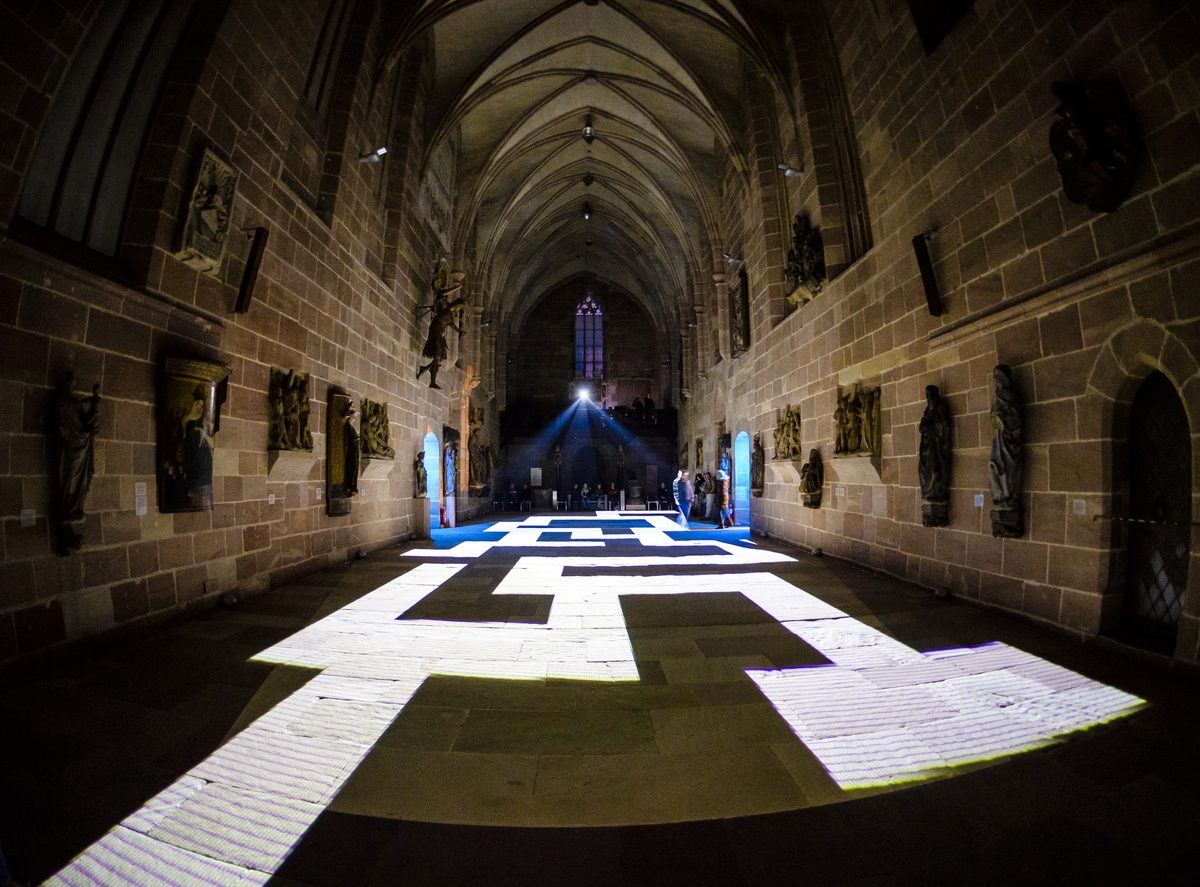
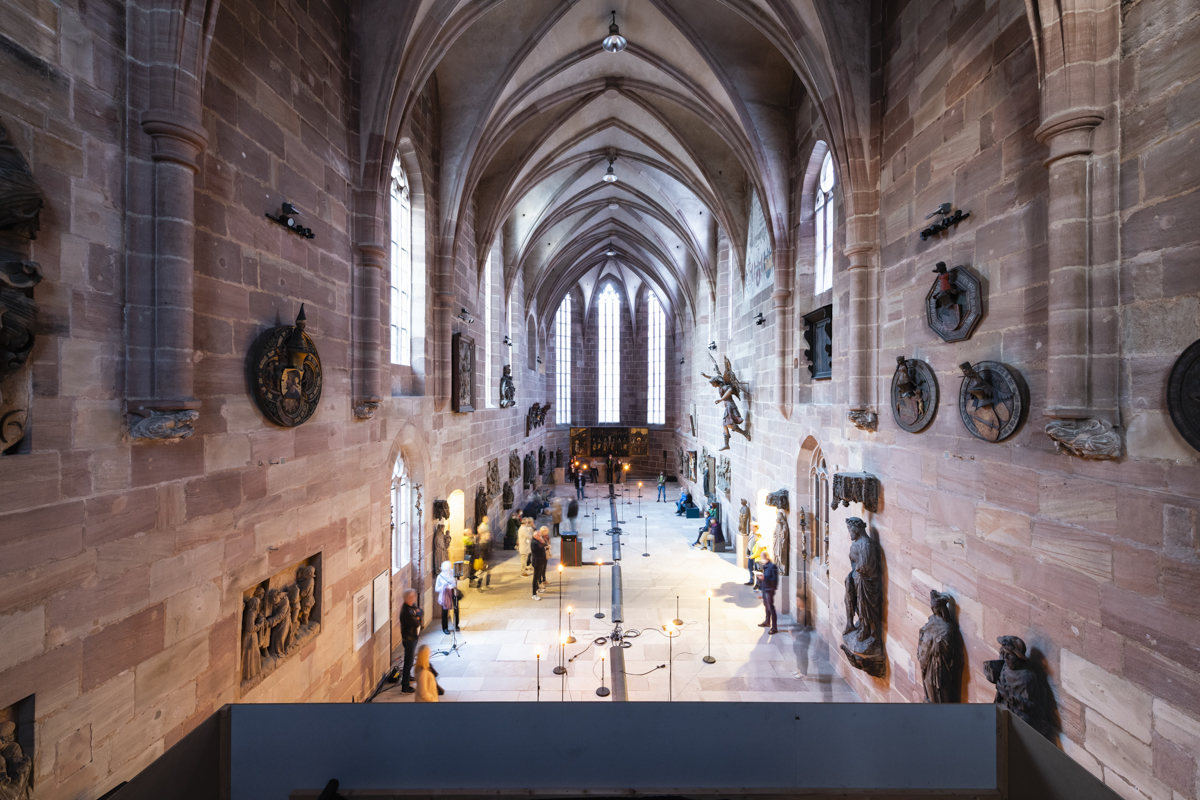
The heart of the Germanisches Nationalmuseum is formed by the Charterhouse Church dating from the 14th century. The church is part of the monastic complex of the Carthusian monastery, which was founded through a donation in 1380. The foundation stone was laid in 1381, with the overall construction of the complex continuing until 1459. From 1525 onwards, following the Reformation and the abandonment of the monastic life, the buildings were put to secular use. Since 1857, the Carthusian monastery and its church have been part of the Germanisches Nationalmuseum and are used as exhibition spaces. Severely damaged by bombing during the Second World War, the Charterhouse Church was restored in the post-war period.
It is a single-nave Gothic sandstone church with rib vaulting, currently housing late medieval artworks. Almost all of the original medieval furnishings have been lost. Within the Germanisches Nationalmuseum, the Charterhouse Church can be reached quickly through the entrance hall via the cloister.
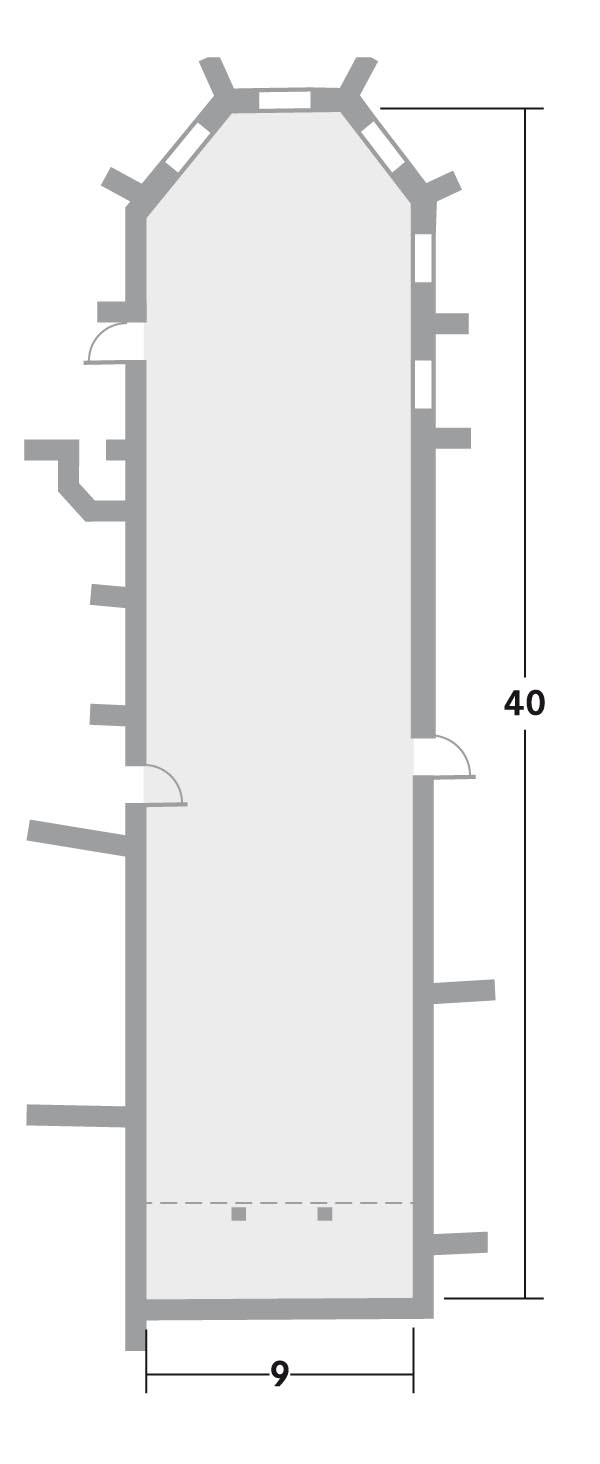
Dimensions: 320 m², approx. 40 m long and 9 m wide
Power supply: 16 A Schuko socket, 32 A CEE socket optional
Access during Die Blaue Nacht | The Blue Night: Via the museum entrance, Kartäusergasse / Straße der Menschenrechte
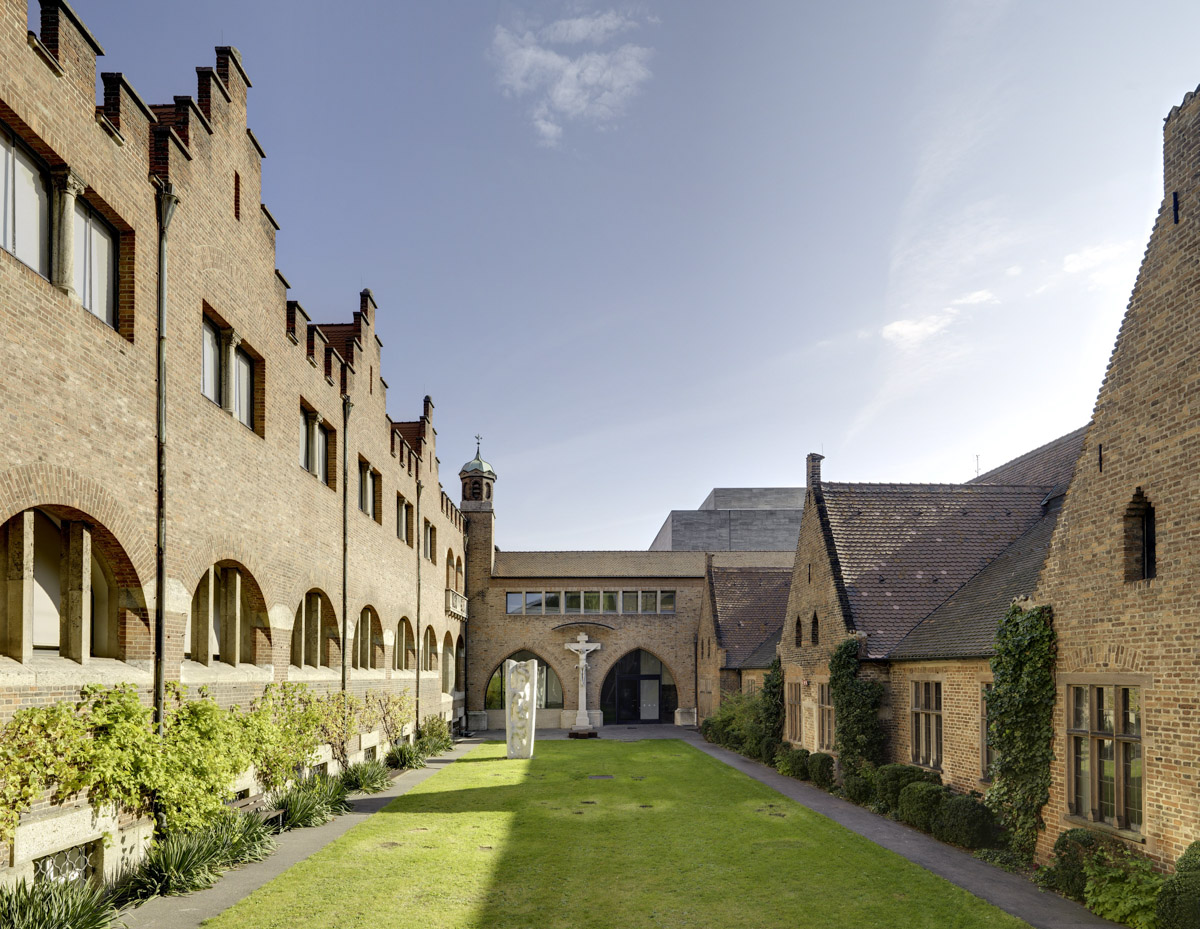
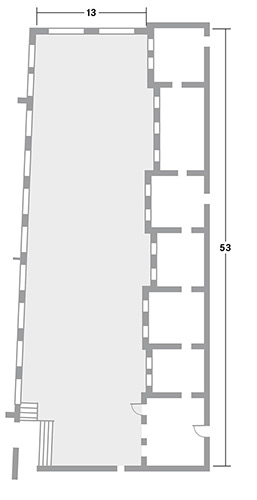
Small monastery courtyard
The small monastery courtyard is enclosed on all four sides, situated between the buildings of the Germanisches Nationalmuseum. In the south along the longitudinal sides, the ivy-covered monk’s cells are located, and opposite them a two-storey gallery building. On the narrower western side are a historic stone fountain (no longer in use) and the rear of the museum entrance hall. Access to the courtyard via the museum, along the cloister of the former Carthusian monastery, through a large glass door on the eastern side of the courtyard. With its trees and contemporary artworks, the courtyard offers a quiet seclusion in the middle of the city.
Dimensions: 13 x 53 m
Power supply: 16A schuko socket, 32A CEE socket optional
Mains power can be supplied to the courtyard.
There is no lighting; it could be installed if required.
Access during Die Blaue Nacht | The Blue Night: Via the museum entrance, Kartäusergasse / Straße der Menschenrechte
Germanisches Nationalmuseum
Parkhaus Sterntor | Sterntor Car Park
Parkhaus Sterntor
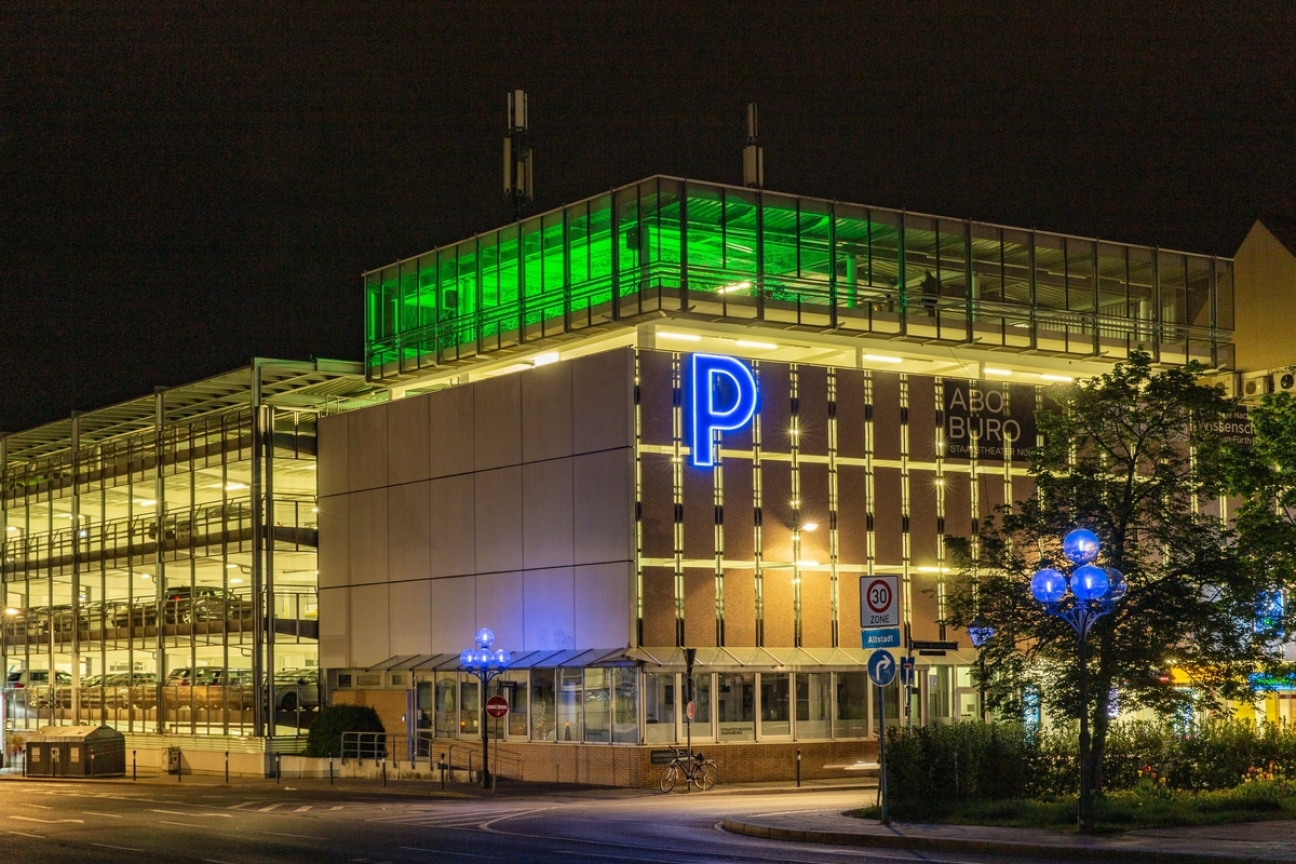
Grasersgasse 25/27 bzw. Am Sterntor
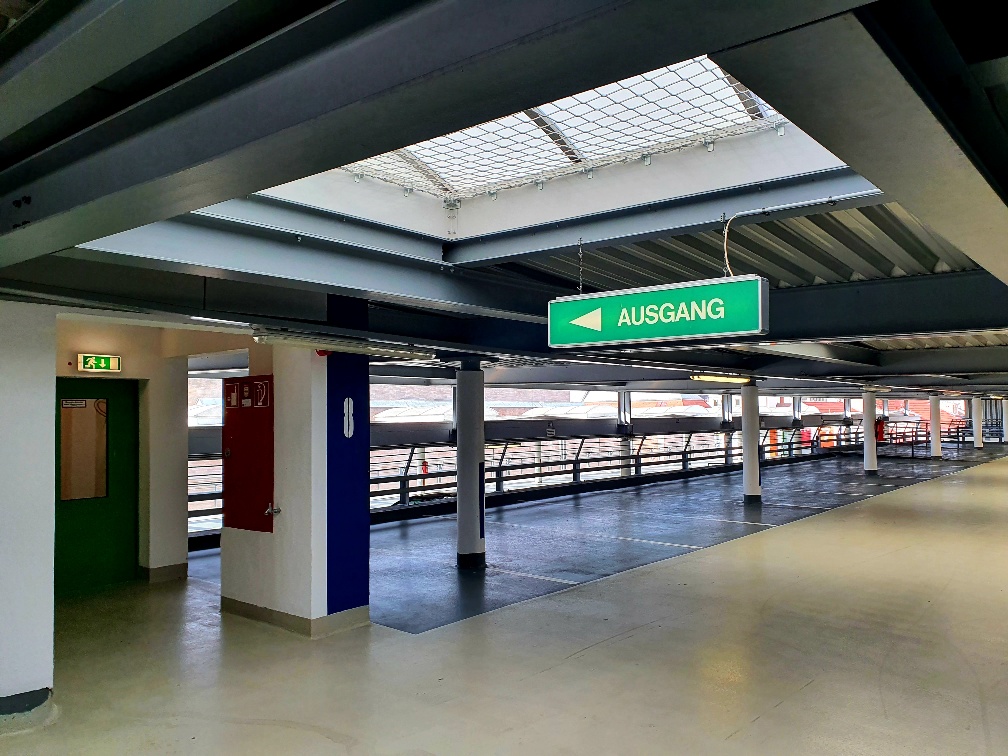
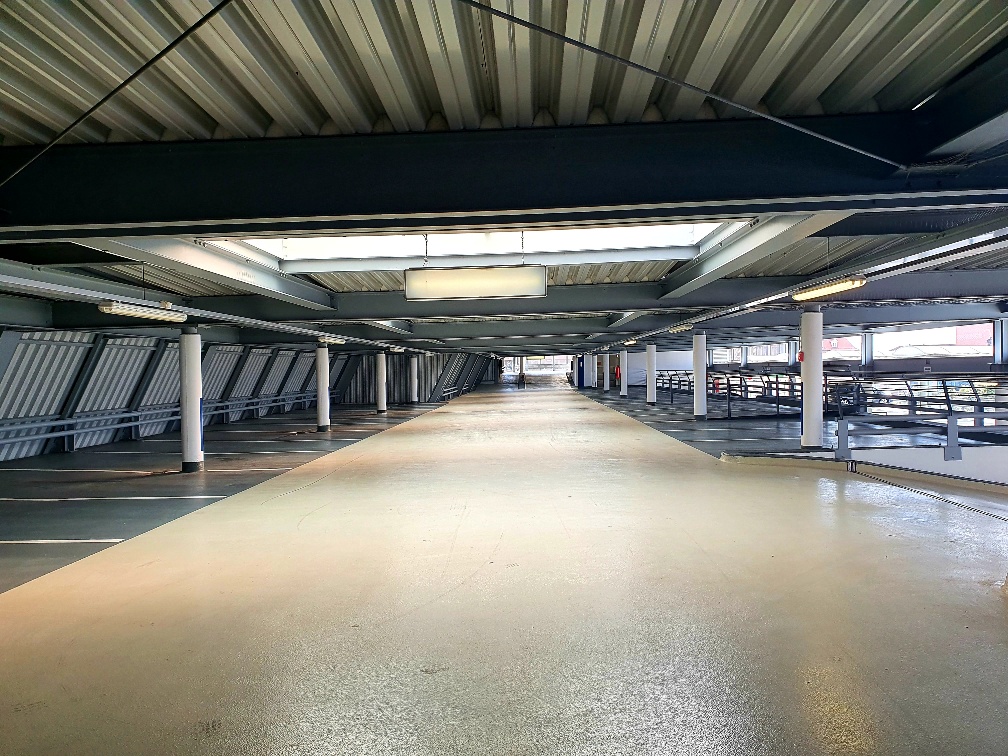
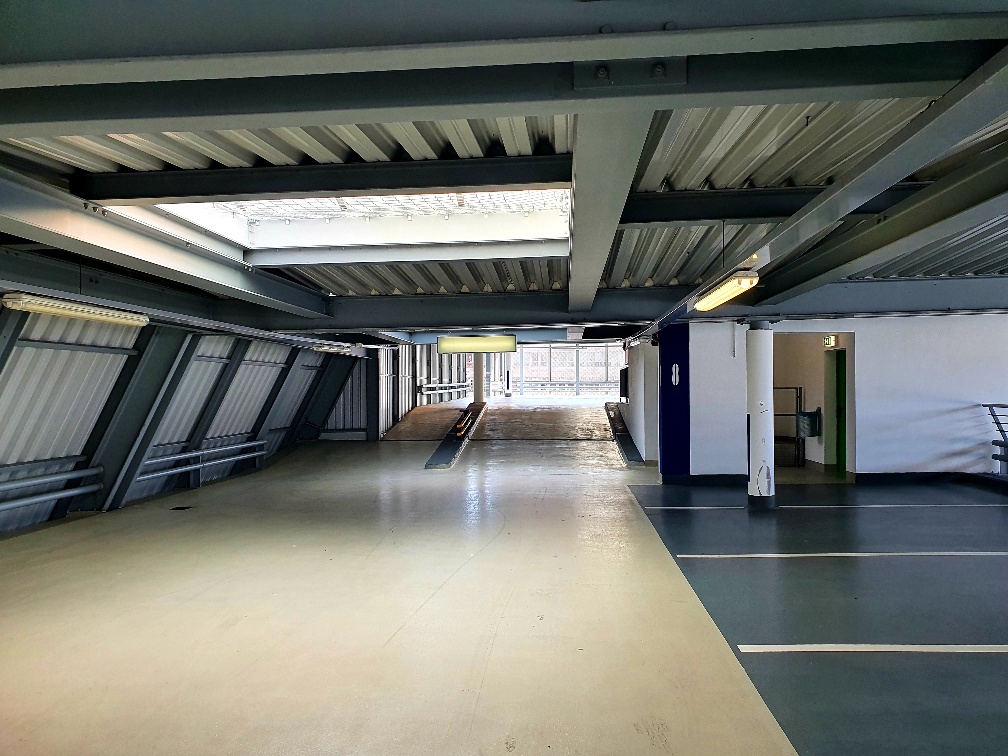
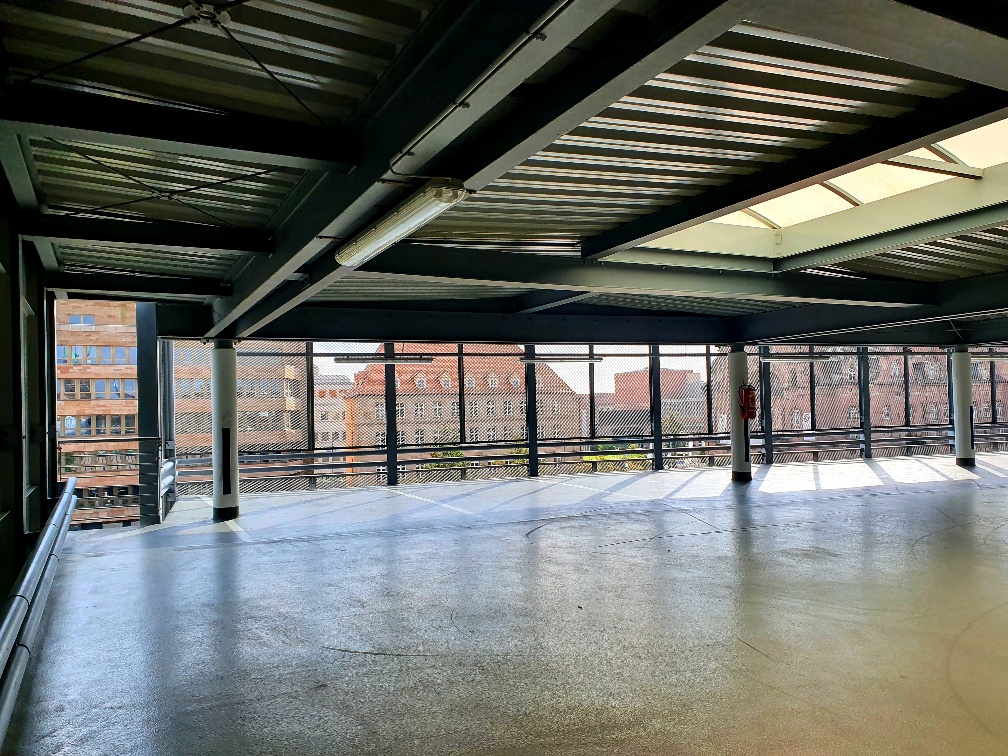
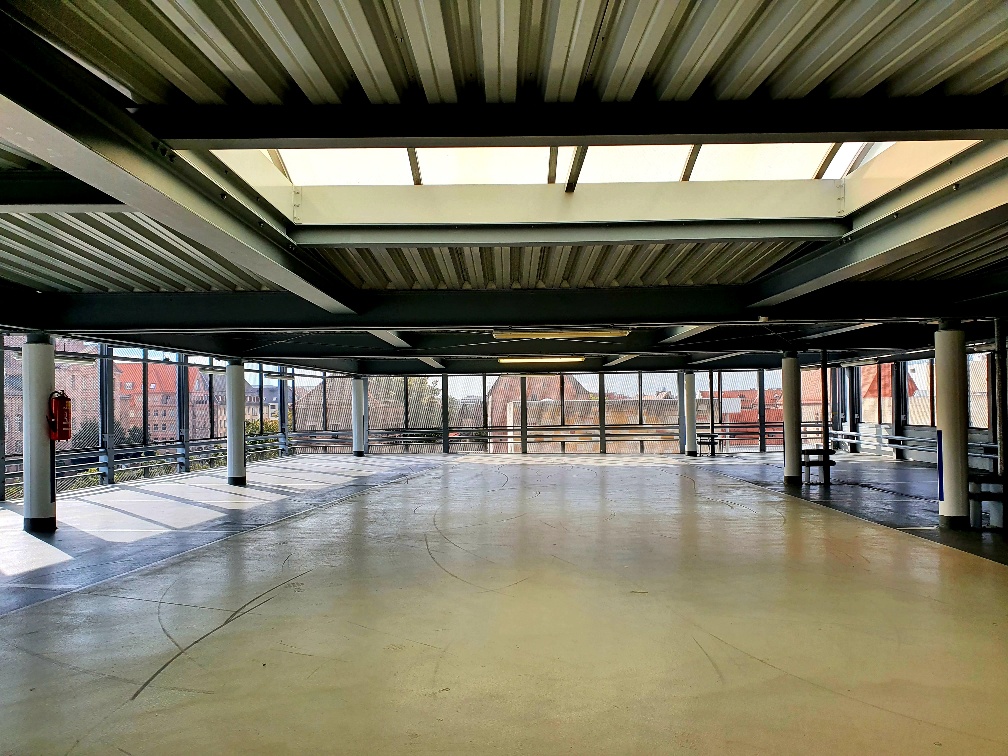
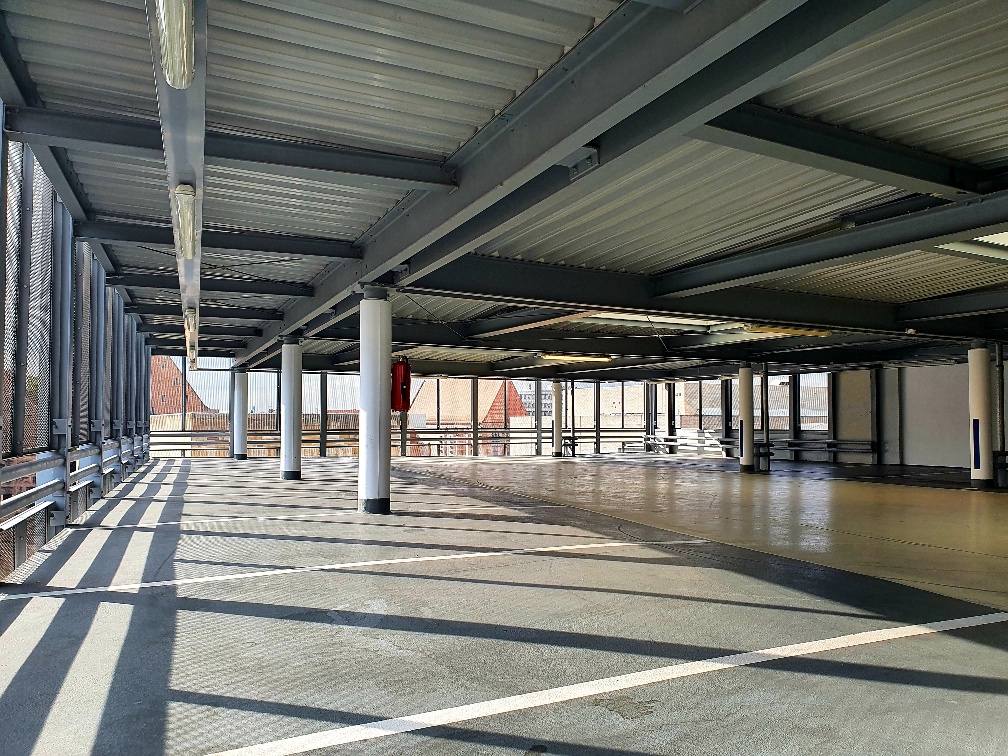
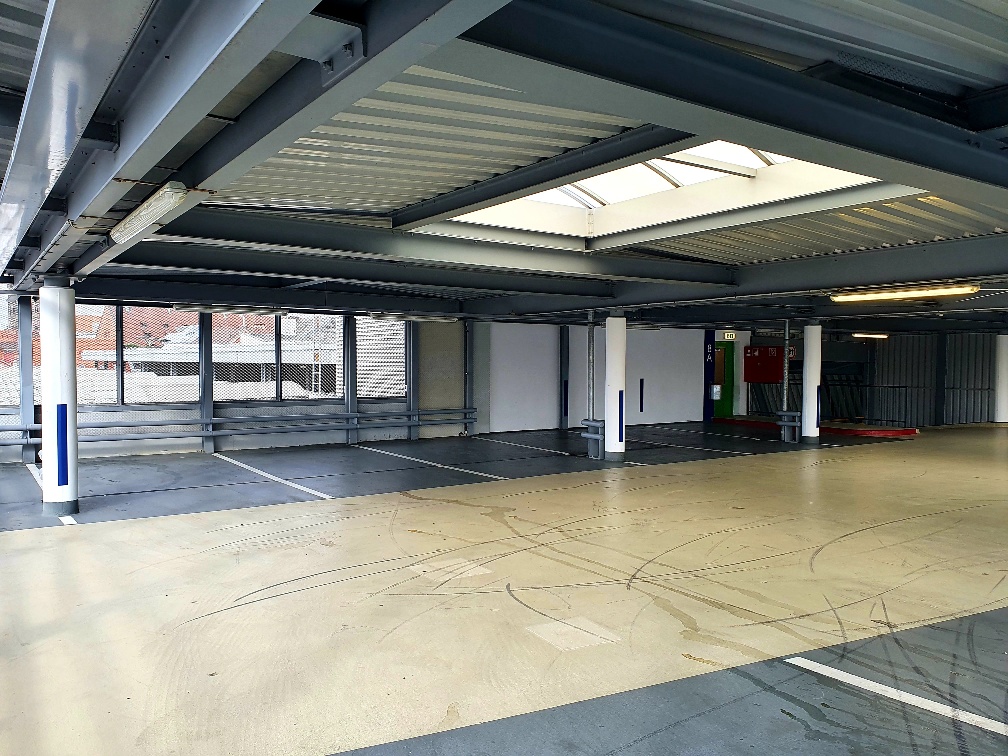
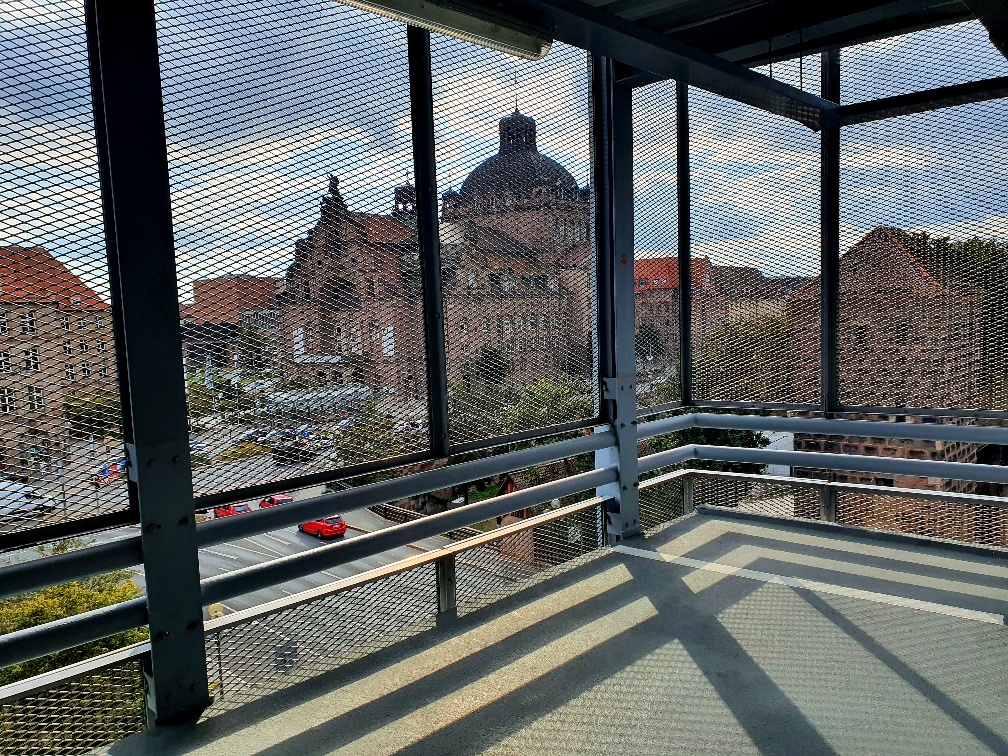
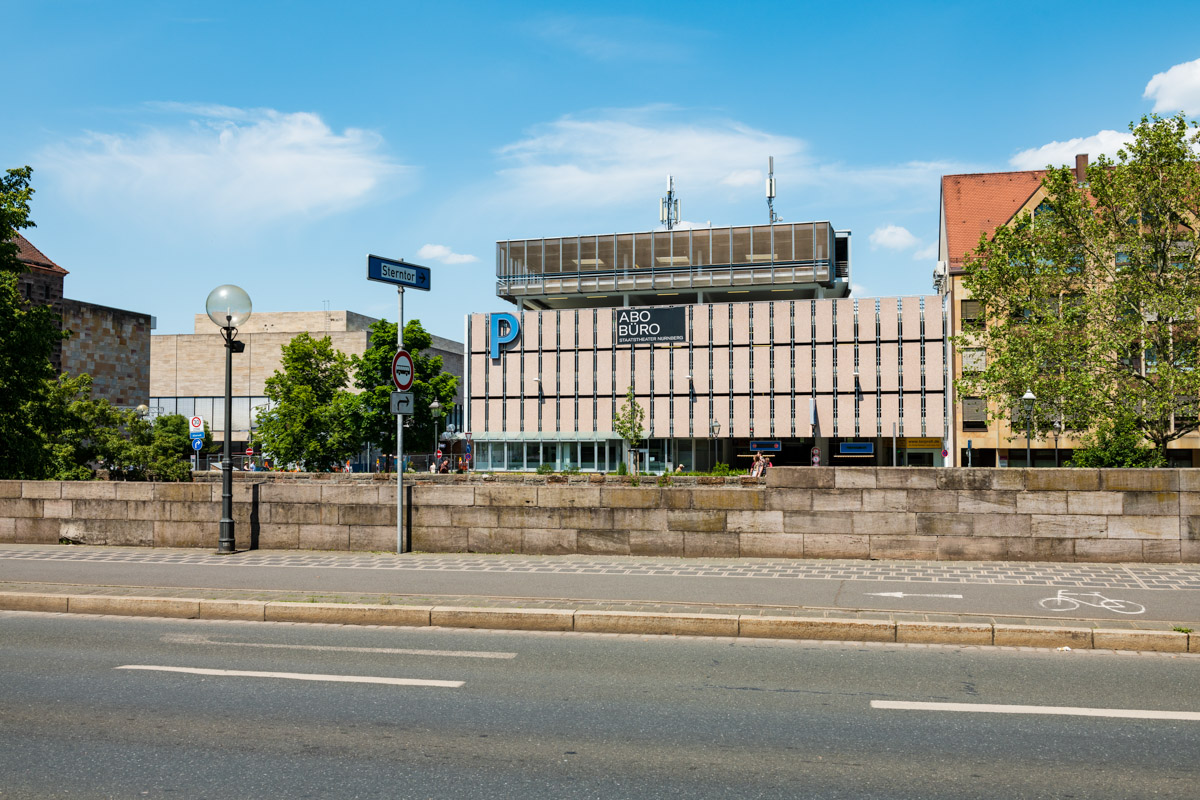
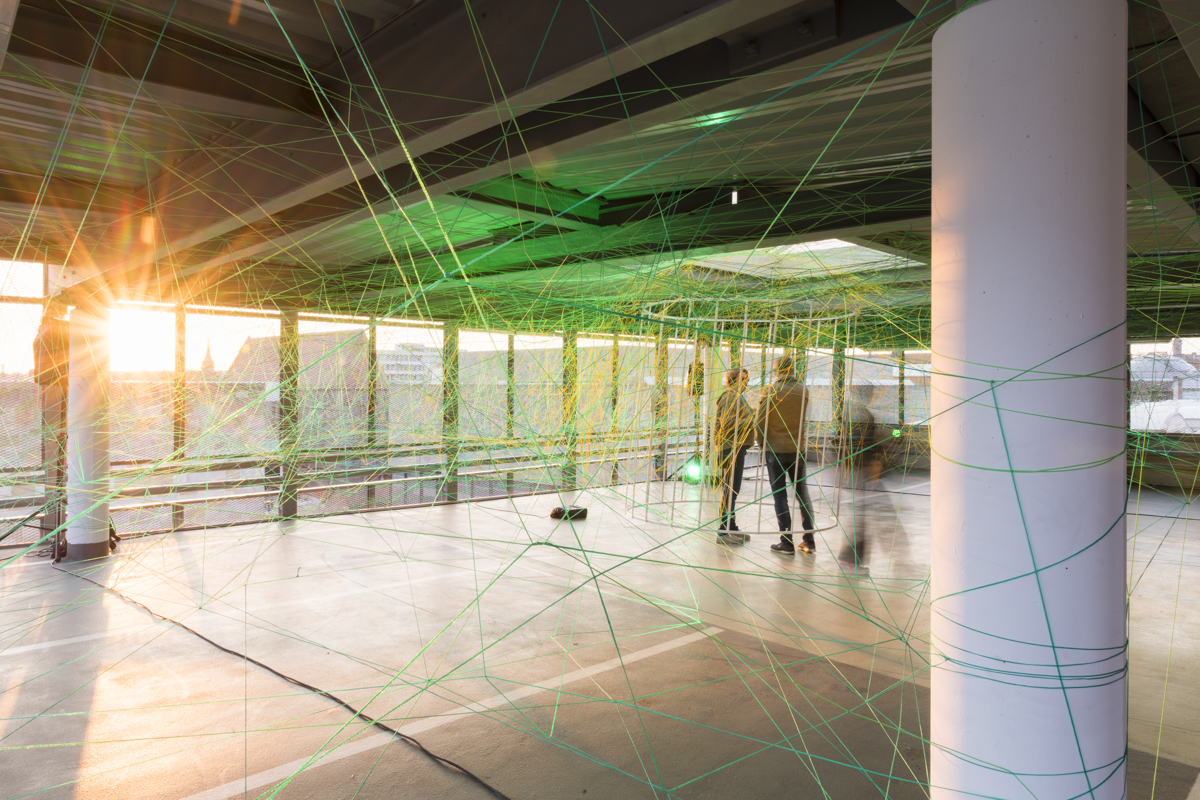
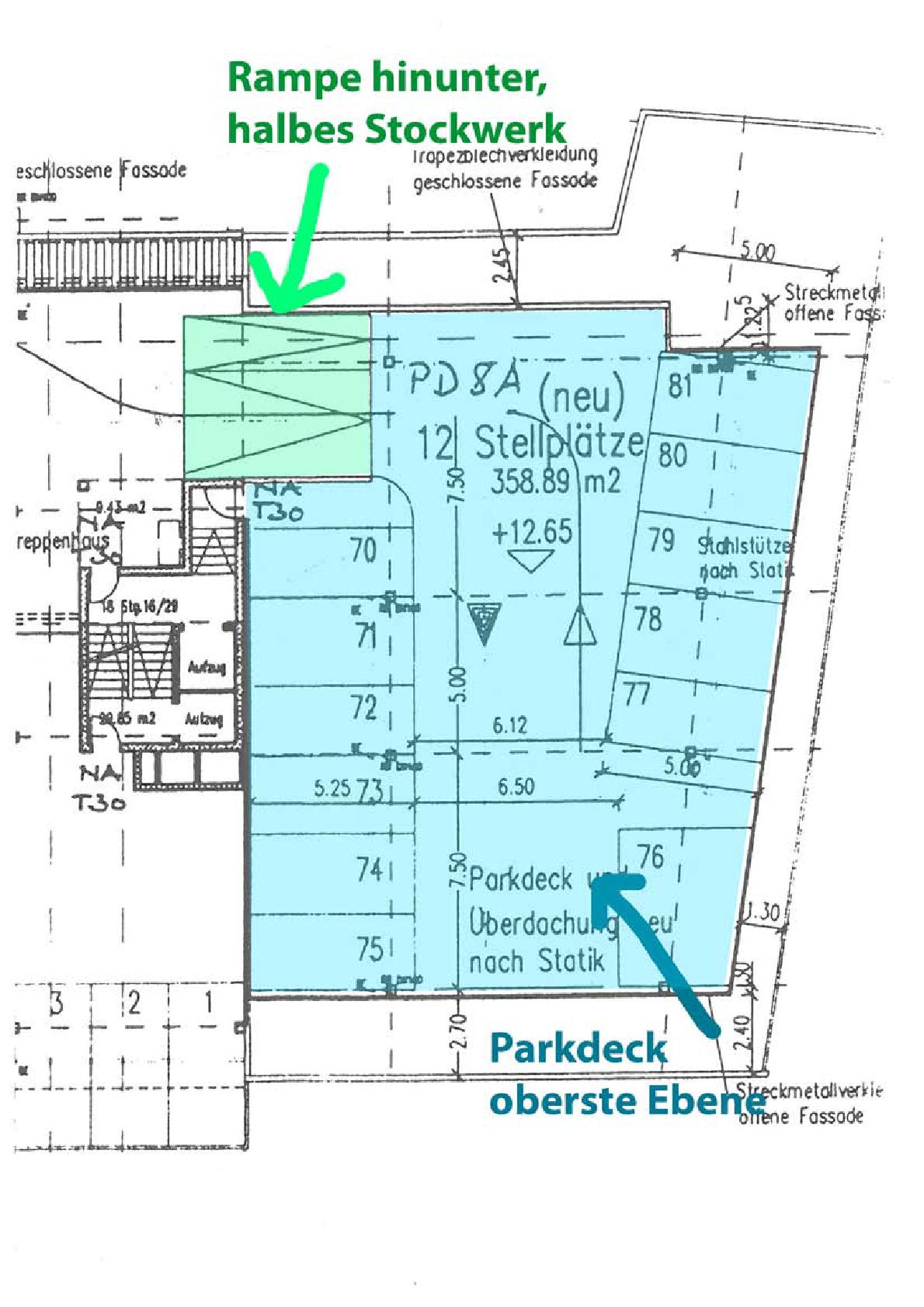
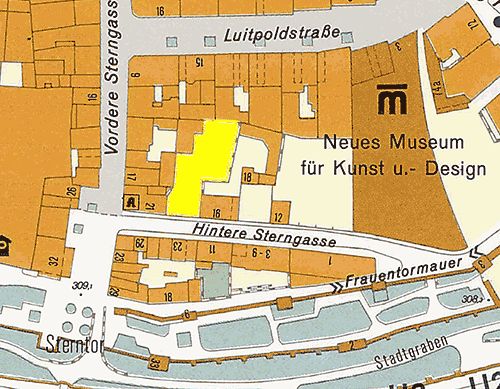
The Sterntor car park, operated by PS Parkhaus Service Nürnberg GmbH, is located next to the Frauentormauer, a defensive city wall with a well-preserved walkway. Within sight are the Germanisches Nationalmuseum and the Opera House/Staatstheater. The top level, Deck 8A (covered), is enclosed with metal grating on the sides (not glass), but allows outward views over the ring road, the opera house, the main station, and towards the west.
The lower levels feature a half-height concrete balustrade. Access via a stairwell and lift. Each deck measures approximately 30 × 10 metres. Ceiling height ranges between around 2.5 and 3 metres.
Please note: the upper deck is exposed to direct sunlight until sunset. Traffic noise from the surrounding streets should be taken into account. The car park remains in operation throughout The Blue Night | Die Blaue Nacht and the preview.
Power supply: CEE 16 A, Schuko sockets
Access during Blaue Nacht: Grasersgasse 25/27 or Am Sterntor
Parkhaus Sterntor

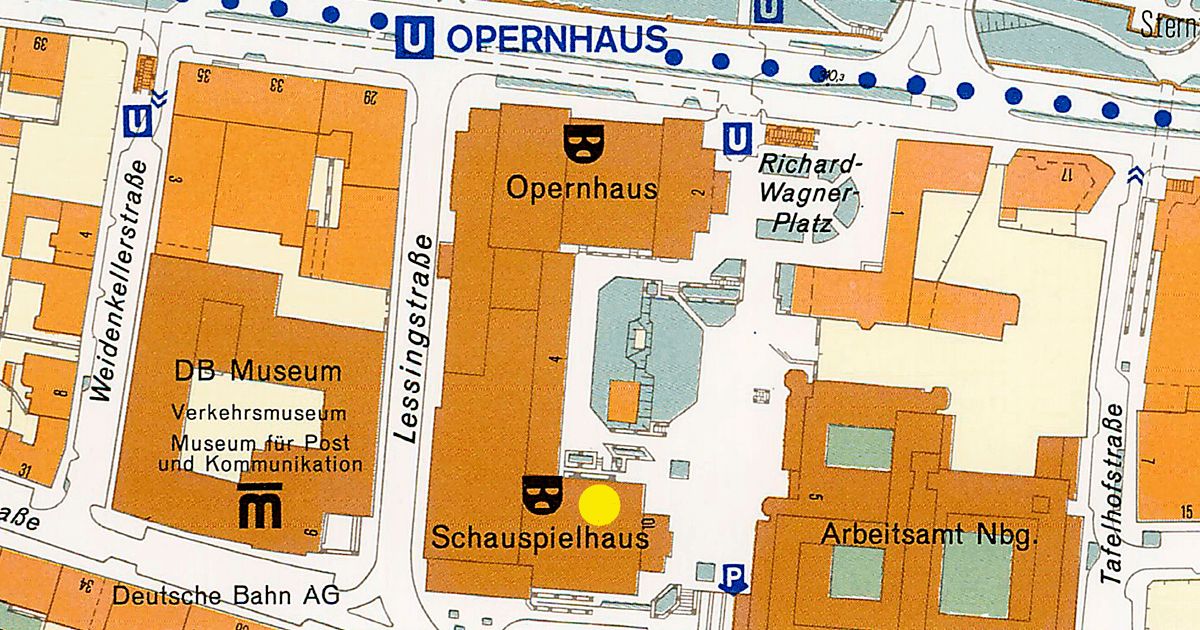
Staatstheater Nürnberg, 3. Etage | Staatstheater Nürnberg, 3rd floor
Staatstheater Nürnberg / 3rd floor
Richard-Wagner-Platz 2-10
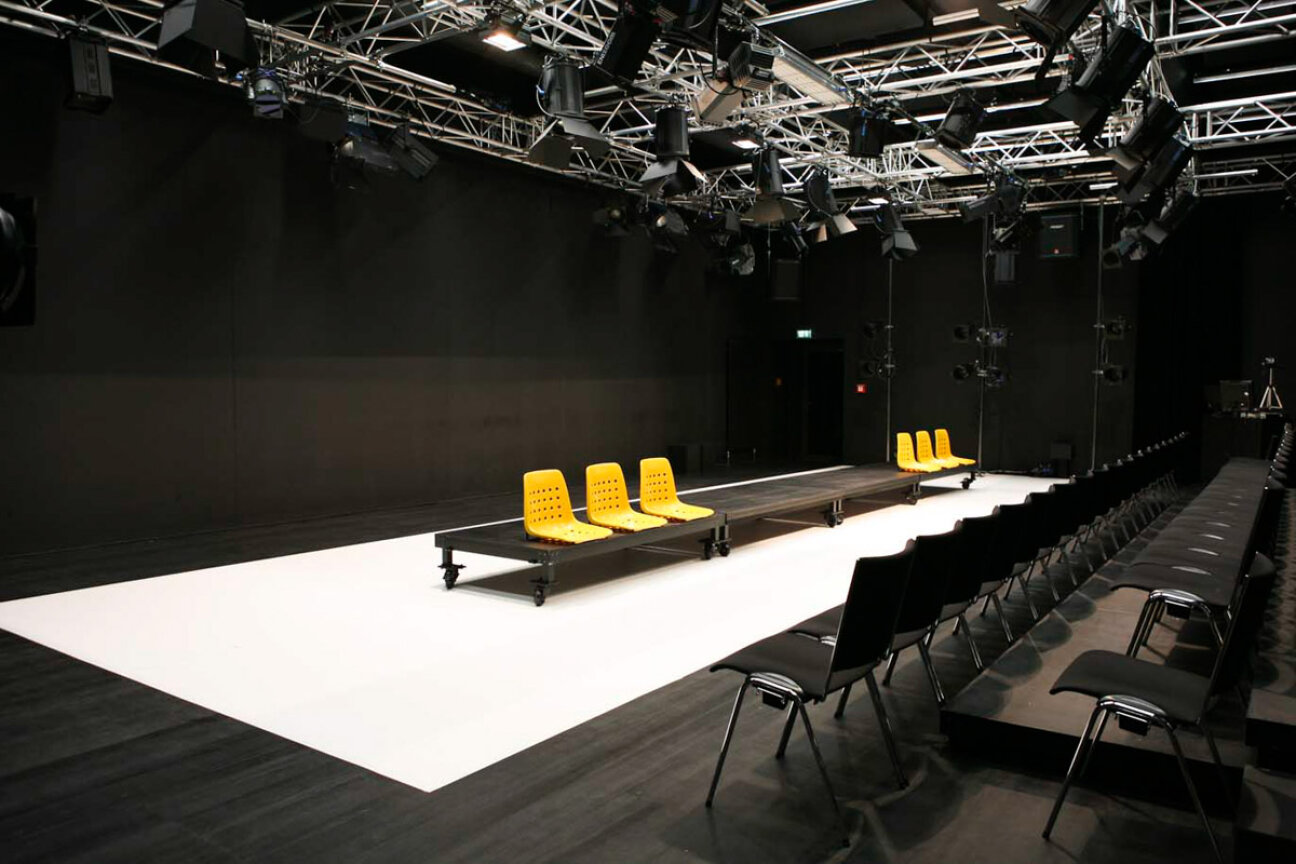
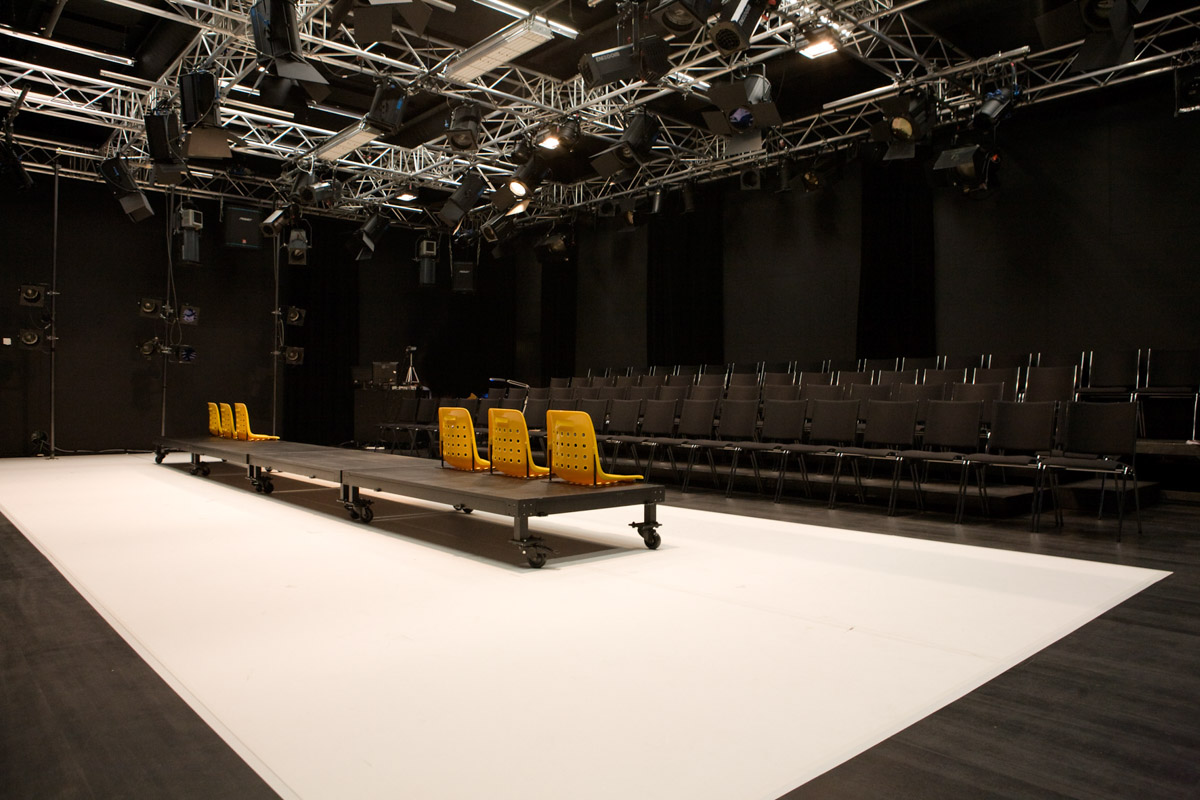
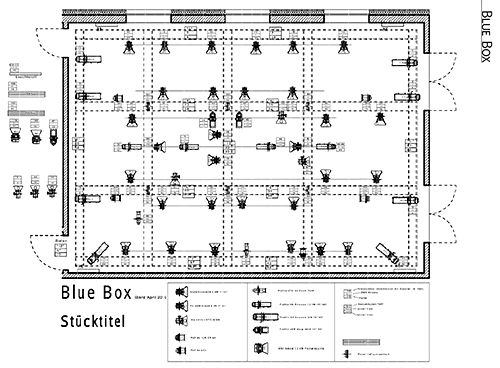
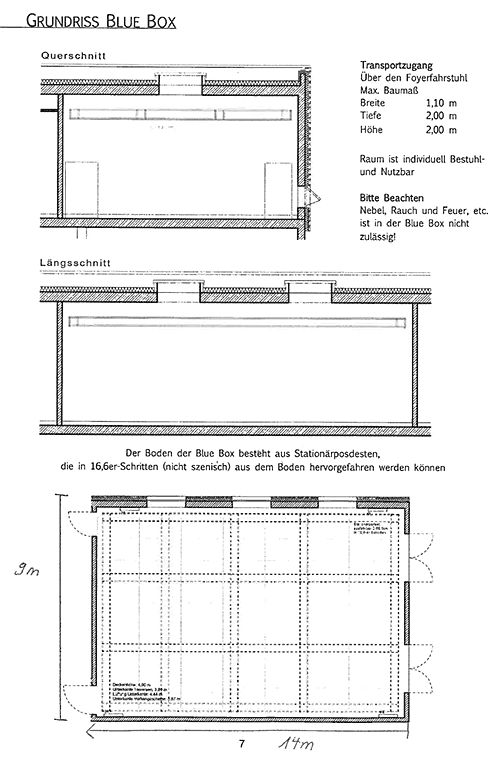
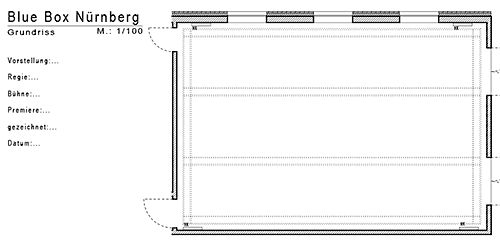
The third floor is the smallest performance space at the Staatstheater Nürnberg. It measures 9 x 14 metres with a ceiling height of 4.8 metres (bottom edge of the trusses 3.88 metres, bottom edge of the ventilation system 4.44 metres, bottom edge of the curtain rail 3.87 metres). The space can also be used and configured in a variety of settings.
Transport access is available via the foyer lift, with a maximum load size of 1.1 × 2 × 2 m. The use of fog, smoke, or fire is not permitted.
At the rear side, there are two single-leaf doors located in the corners; at the front side, there are two double-leaf doors that can be used as access points. The floor of the third level consists of fixed platforms that can be extended in 16.6 cm increments (non-scenic).
Lighting and sound equipment are available.
Power supply: CEE 16 A, Schuko socket
Access during Die Blaue Nacht | The Blue Night: Schauspielhaus
Staatstheater - 3. Etage | Staatstheater - 3rd floor


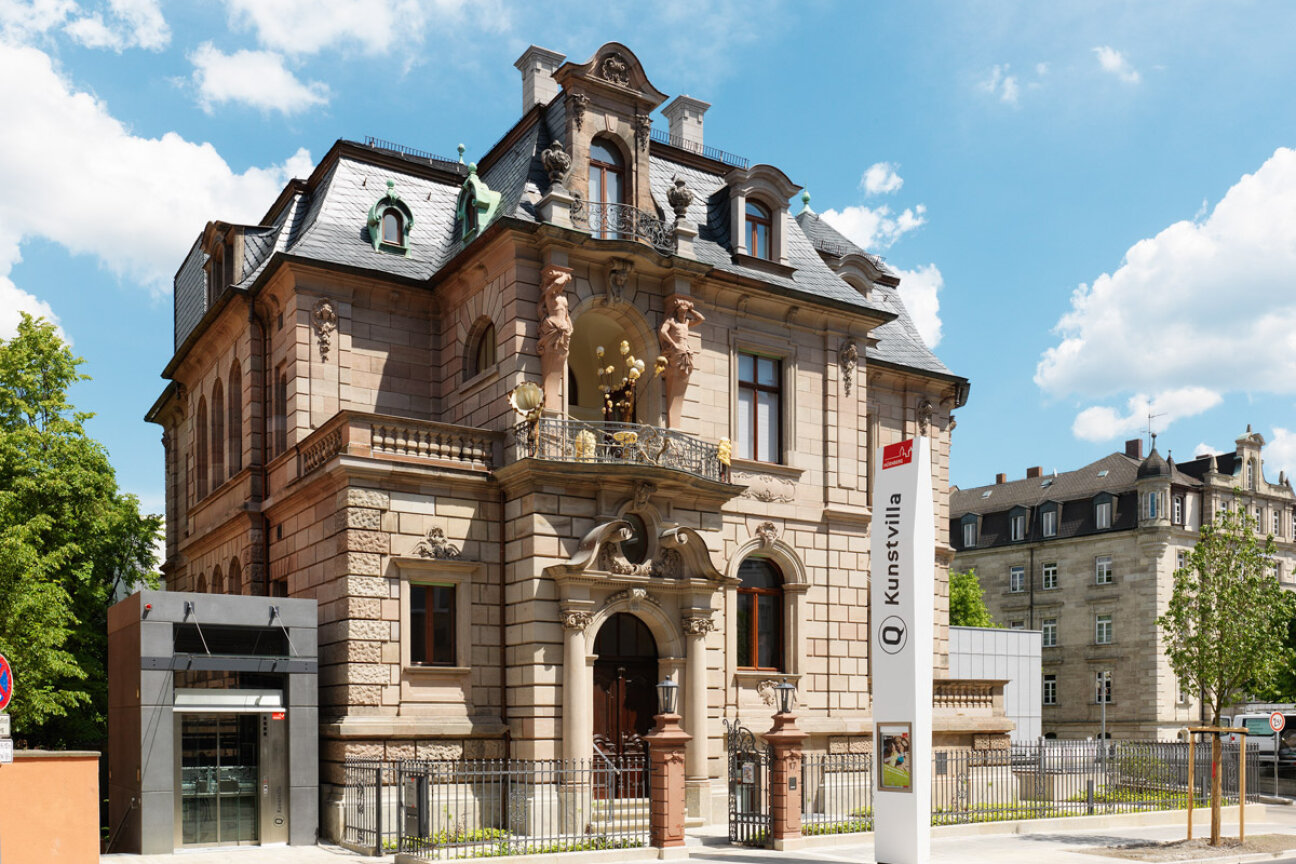
Kunstvilla im KunstKulturQuartier | Kunstvilla, part of KunstKulturQuartier
Kunstvilla, part of KunstKulturQuartier
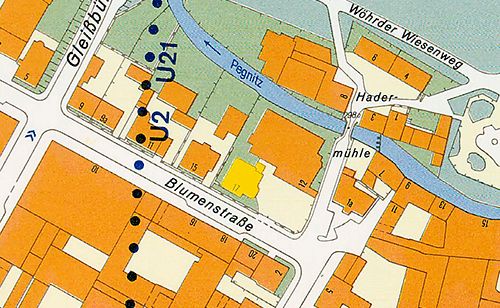
Blumenstraße 17
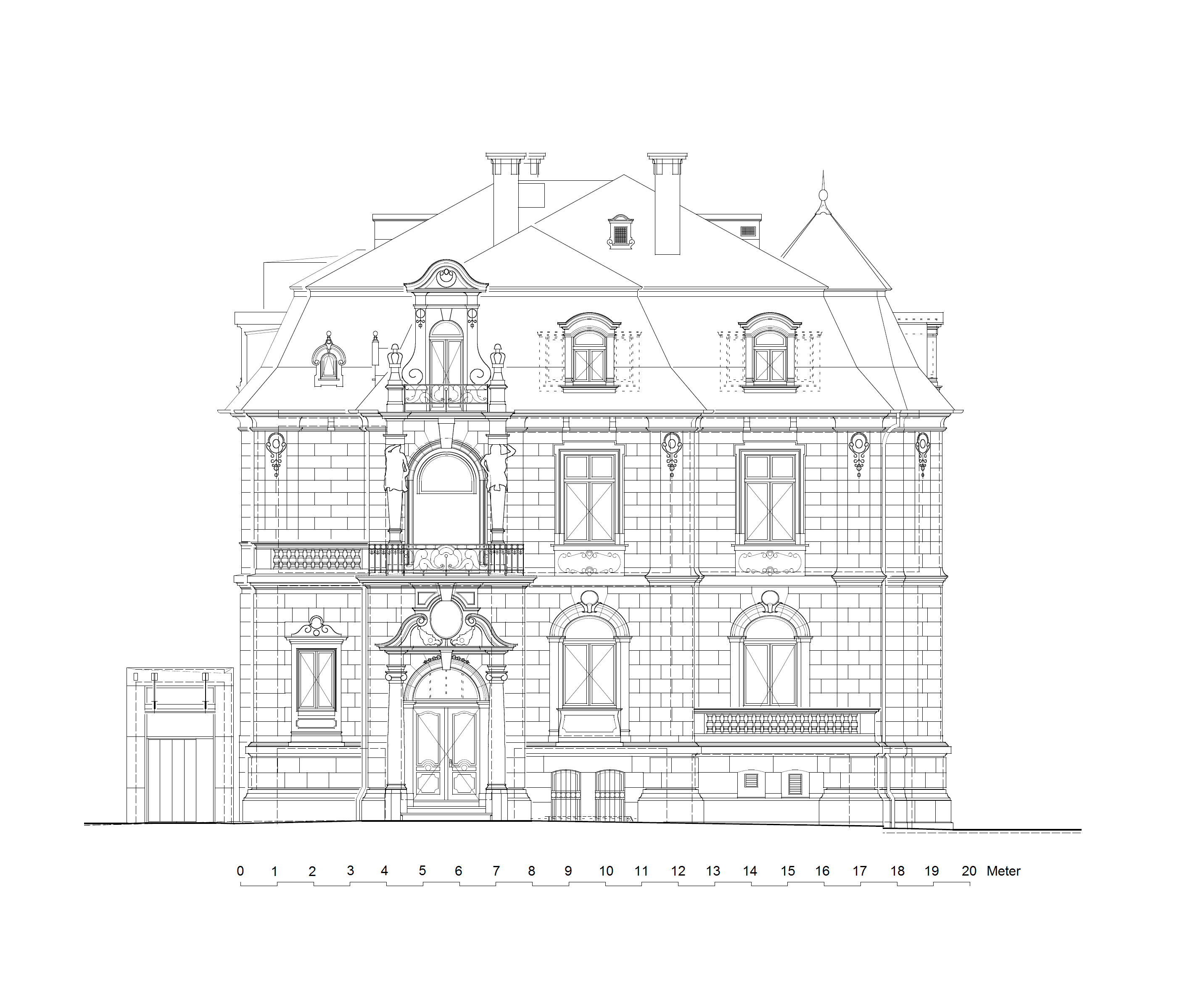
The Kunstvilla is a unique historicist architectural landmark. Built in 1895 as the prestigious residence of the family of Jewish hop merchant and banker Emil Hopf (1860–1920), the building’s history also reflects the ruptures of the 20th century and offers a glimpse into Nuremberg’s past.
Donated to the City of Nuremberg by publisher Bruno Schnell, the villa underwent comprehensive restoration until 2014 and was converted into an art museum. The result is an architectural gem, offering around 600 sqm of exhibition space for a permanent collection as well as changing exhibitions focusing on art in and from Nuremberg. Owing to its architectural character, the Kunstvilla is considered one of the city’s most distinctive art venues.
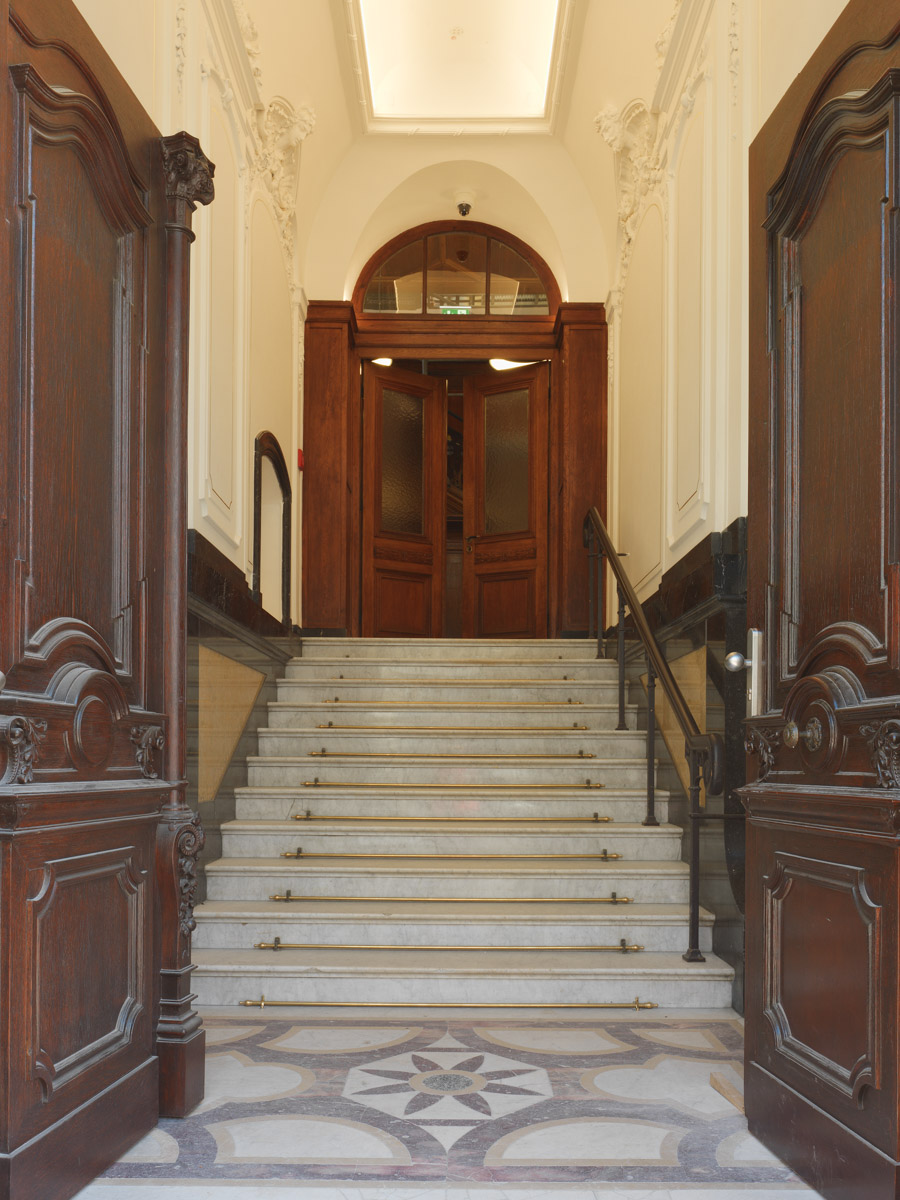
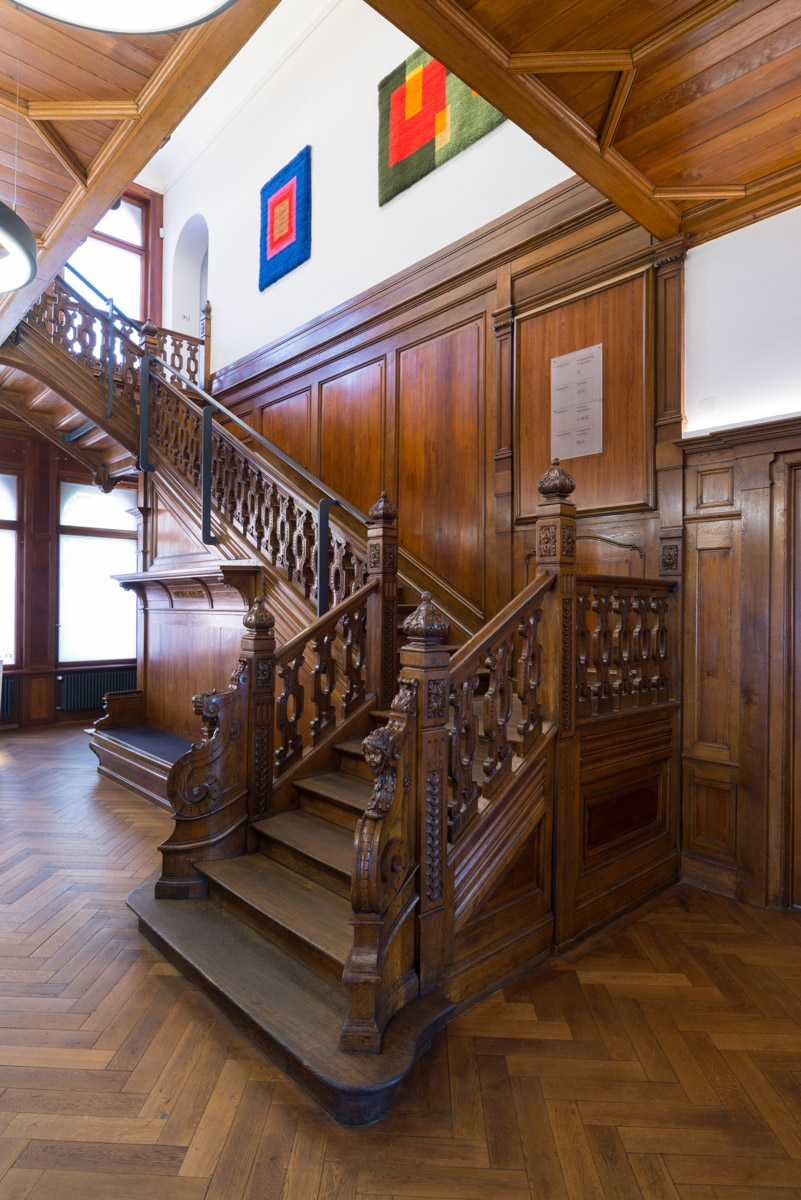
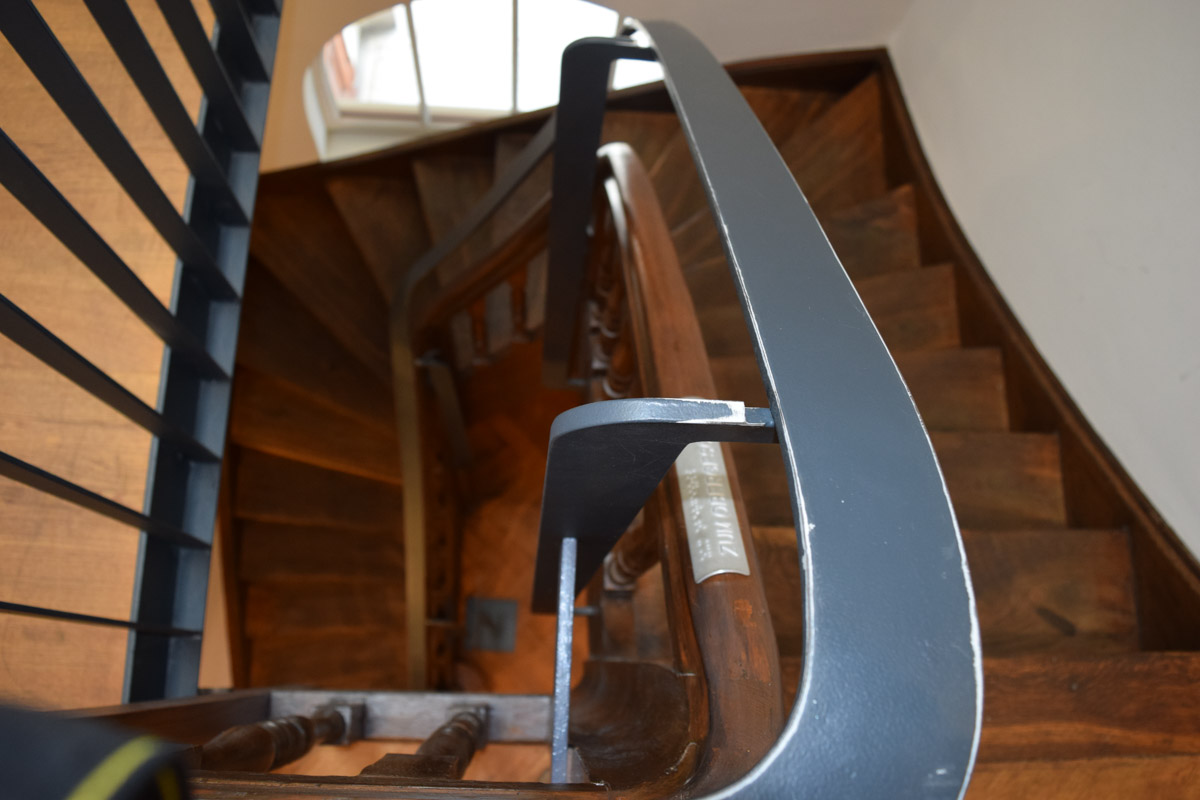
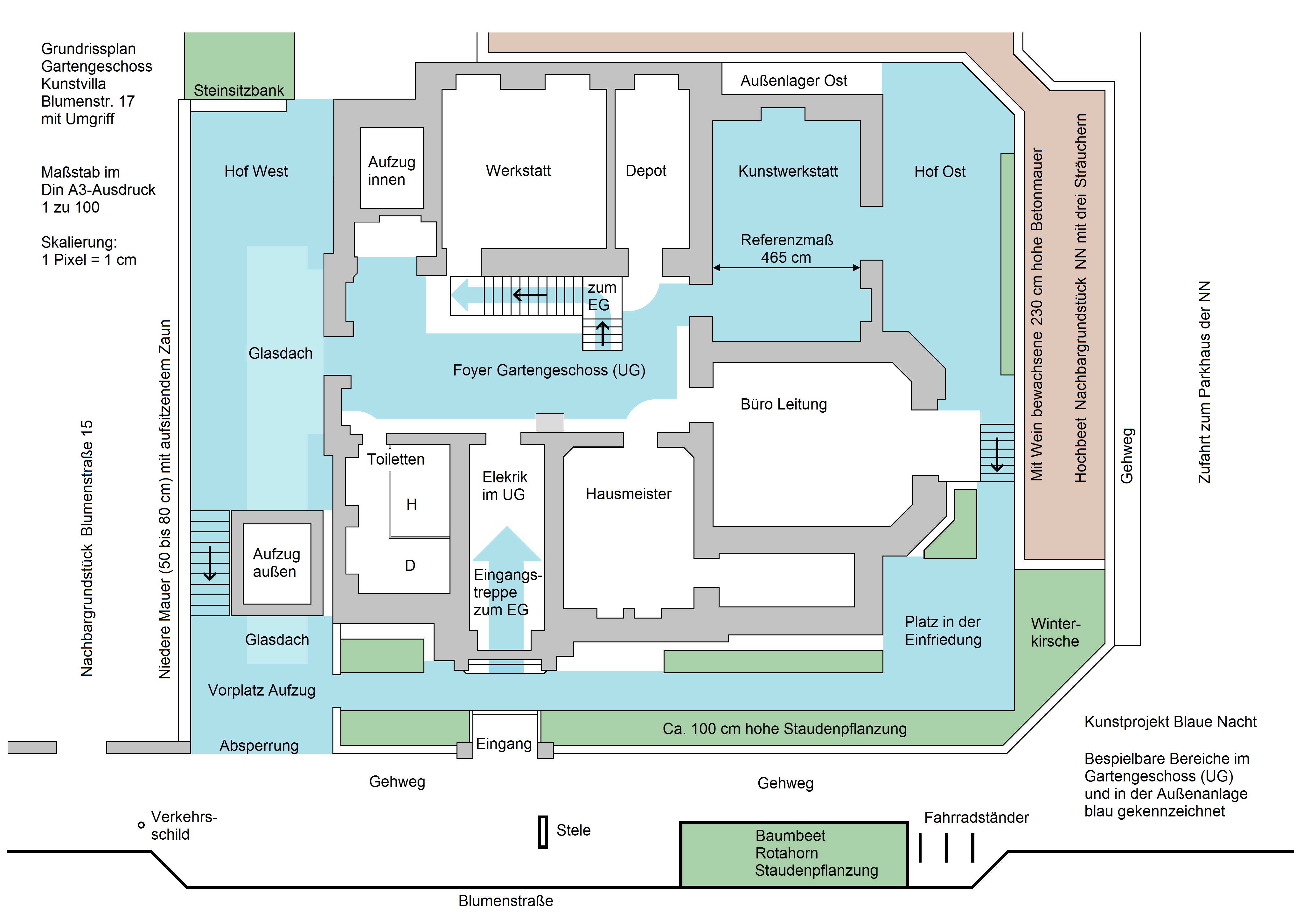
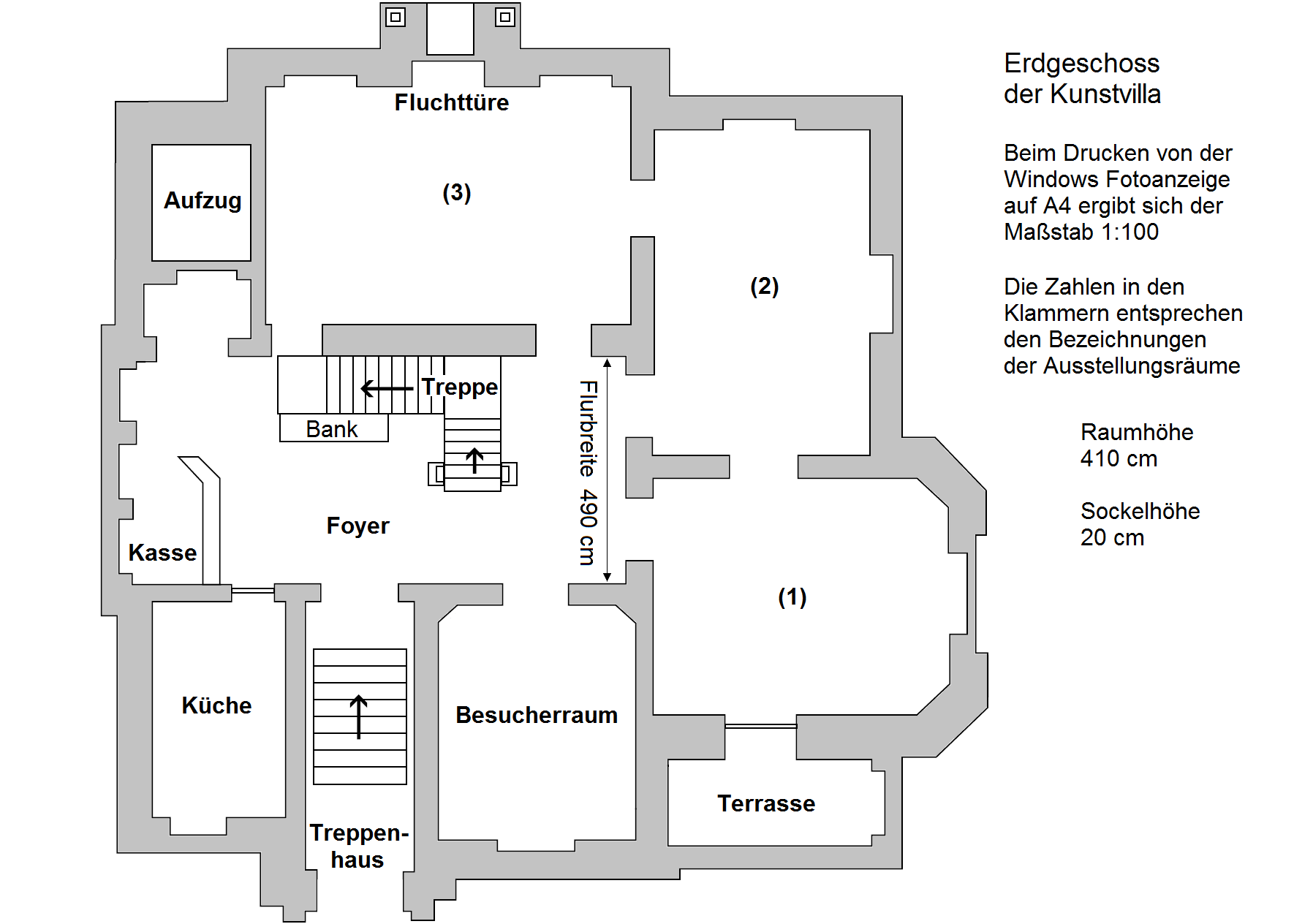
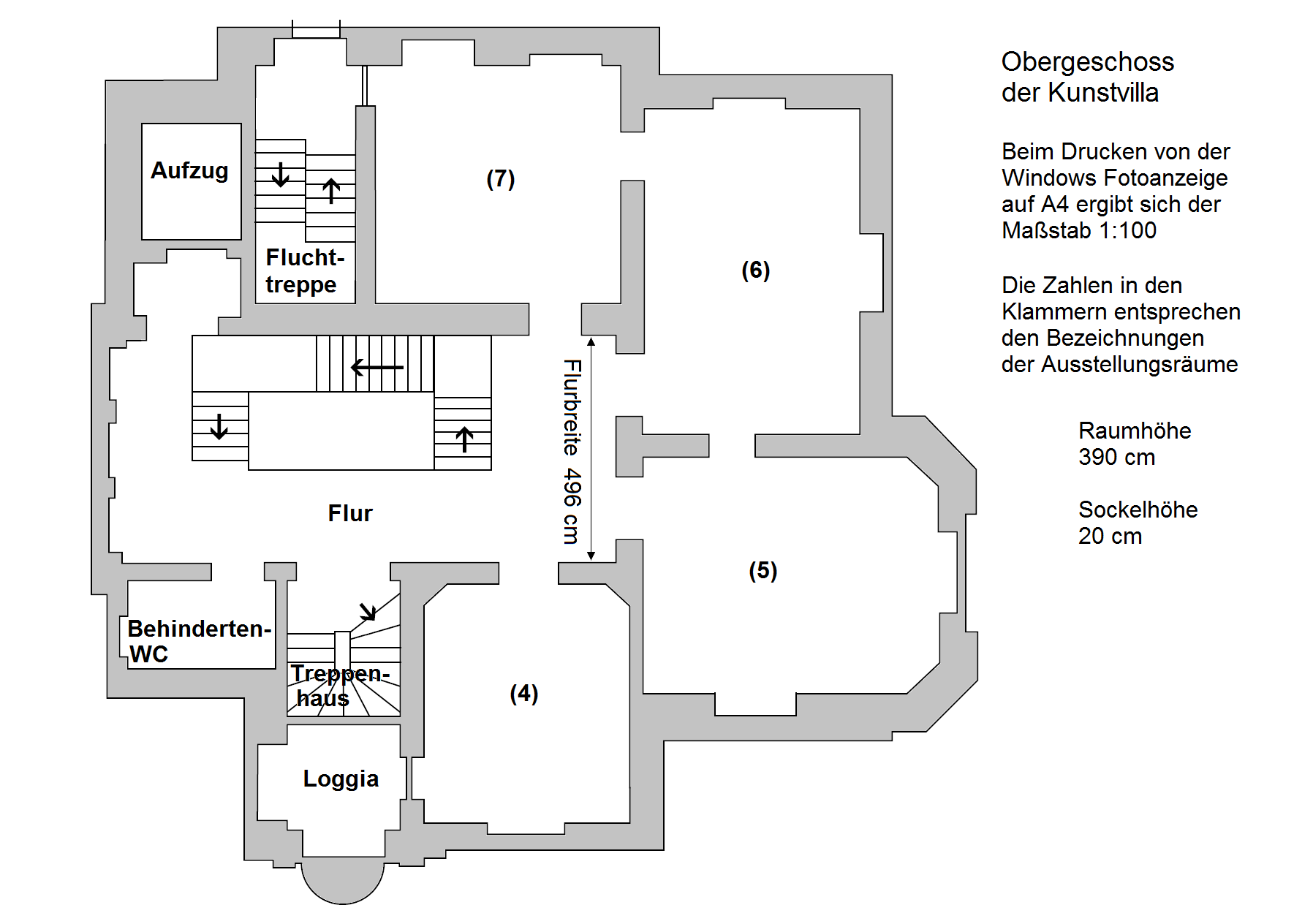
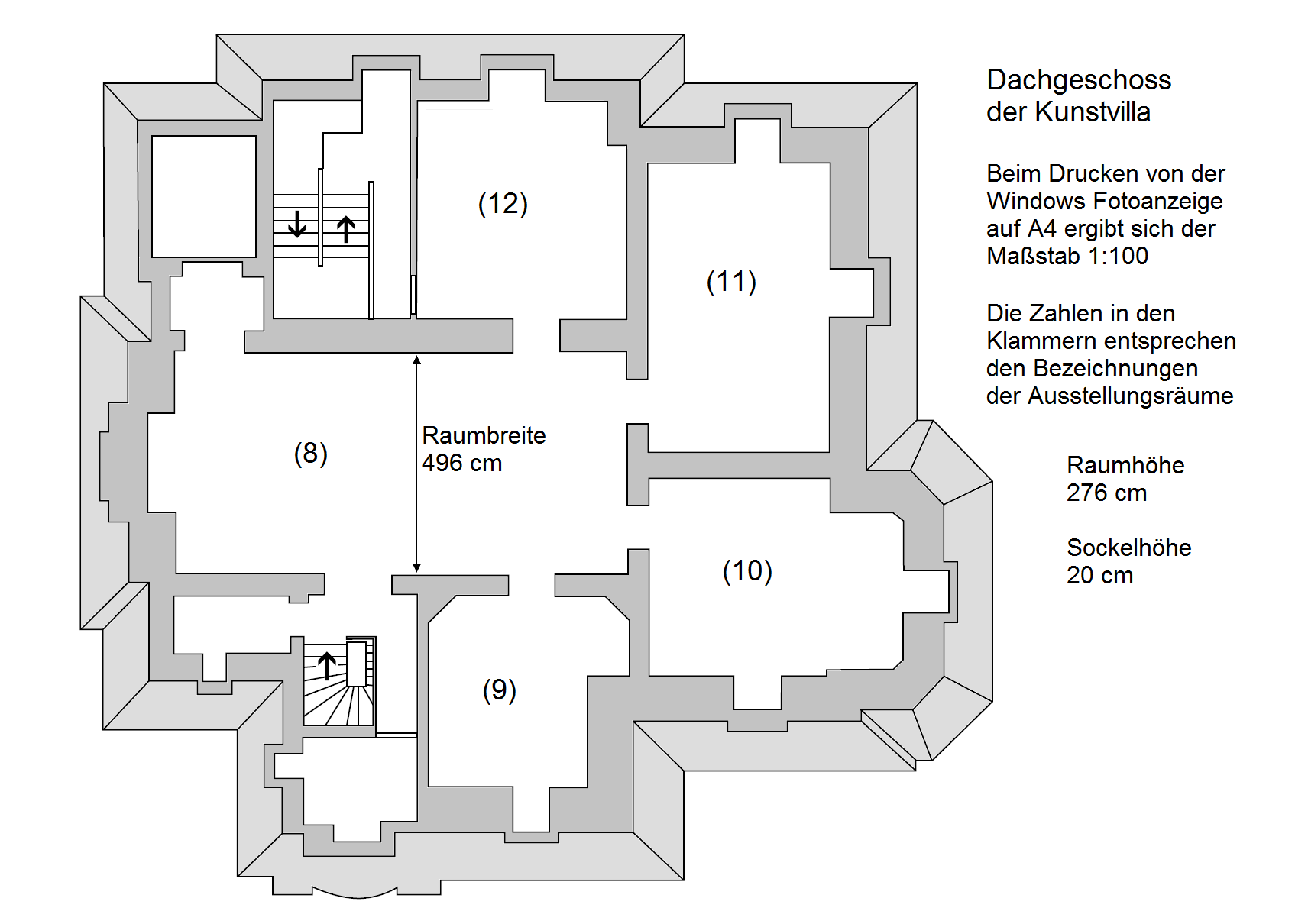
For artistic projects, the two courtyards, the hall on the garden level, the representative façade, and the striking staircases are available. These include the marble staircase (serving as the entrance), the foyer staircase connecting the ground and upper floors, and the secondary staircase leading from the upper floor to the attic.
Spaces and dimensions:
Marble staircase: 13.38 sqm
Foyer staircase: 54.16 sqm
Secondary staircase: 7 sqm
Hall (garden level): 40.71 sqm
East courtyard: 18.8 sqm (3.60 m width × 8 m length × 6 m height)
West courtyard: 52.92 sqm (4.20 m width × 12.60 m length × approx. 3 m height to glass roof)
Façade: 400 sqm (20 m width × 20 m height); projection possible from the opposite building at a distance of approx. 20 m upon request
Power supply:
CEE 16 A and Schuko connections available in both courtyards
Kunstvilla

Pocket Park Marientorzwinger
Pocket Park at the Northern Marientorzwinger
Katharinengasse / Marientormauer 15
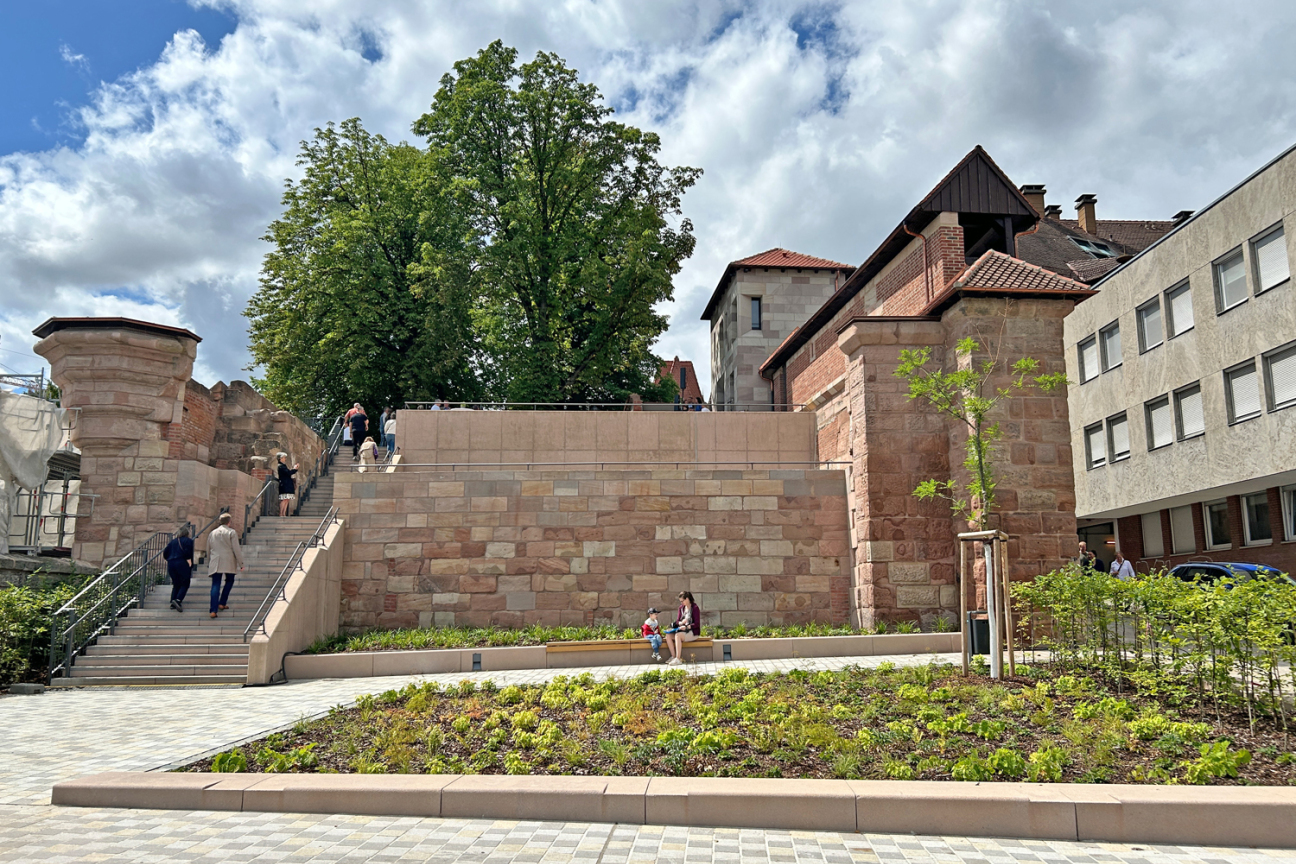
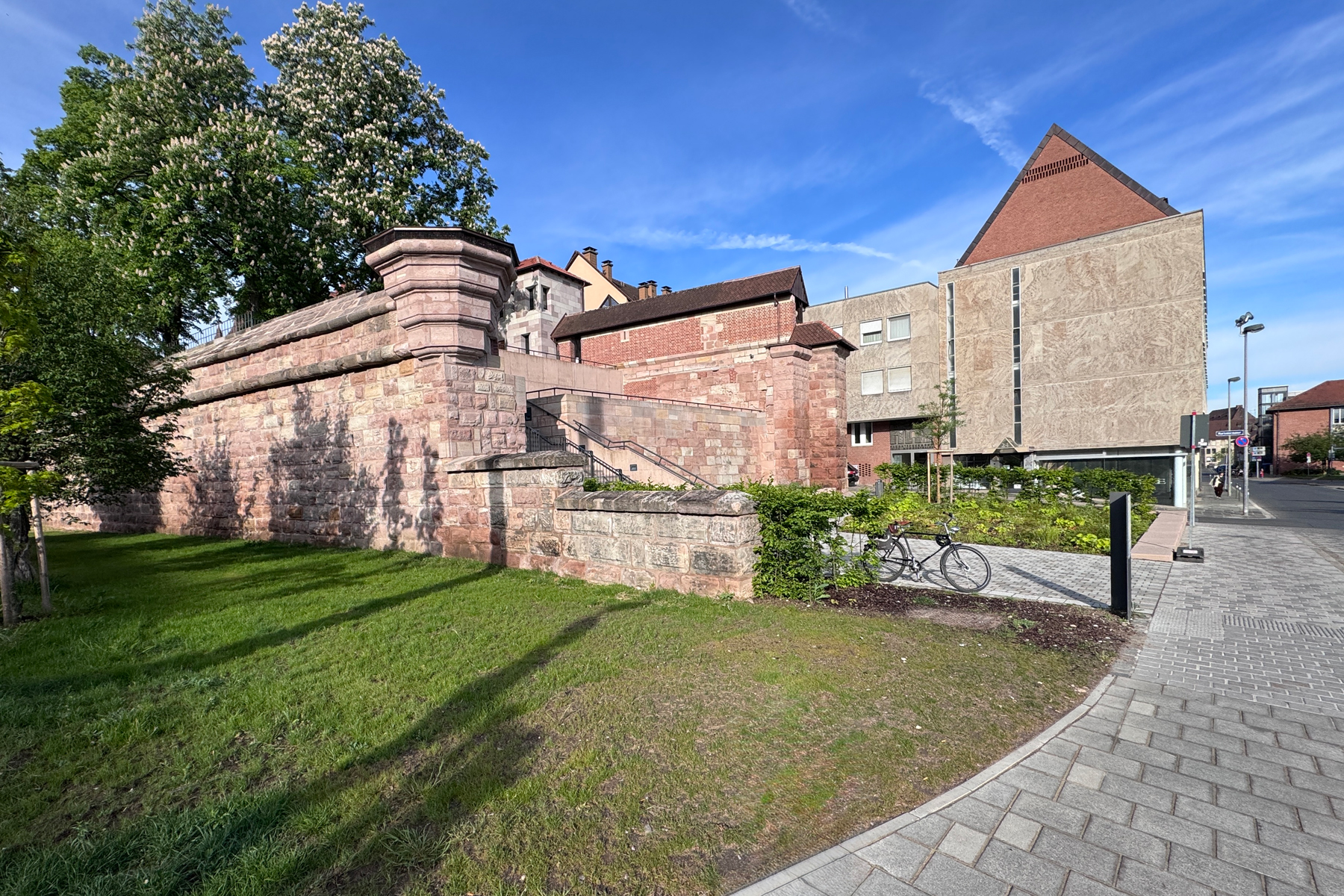
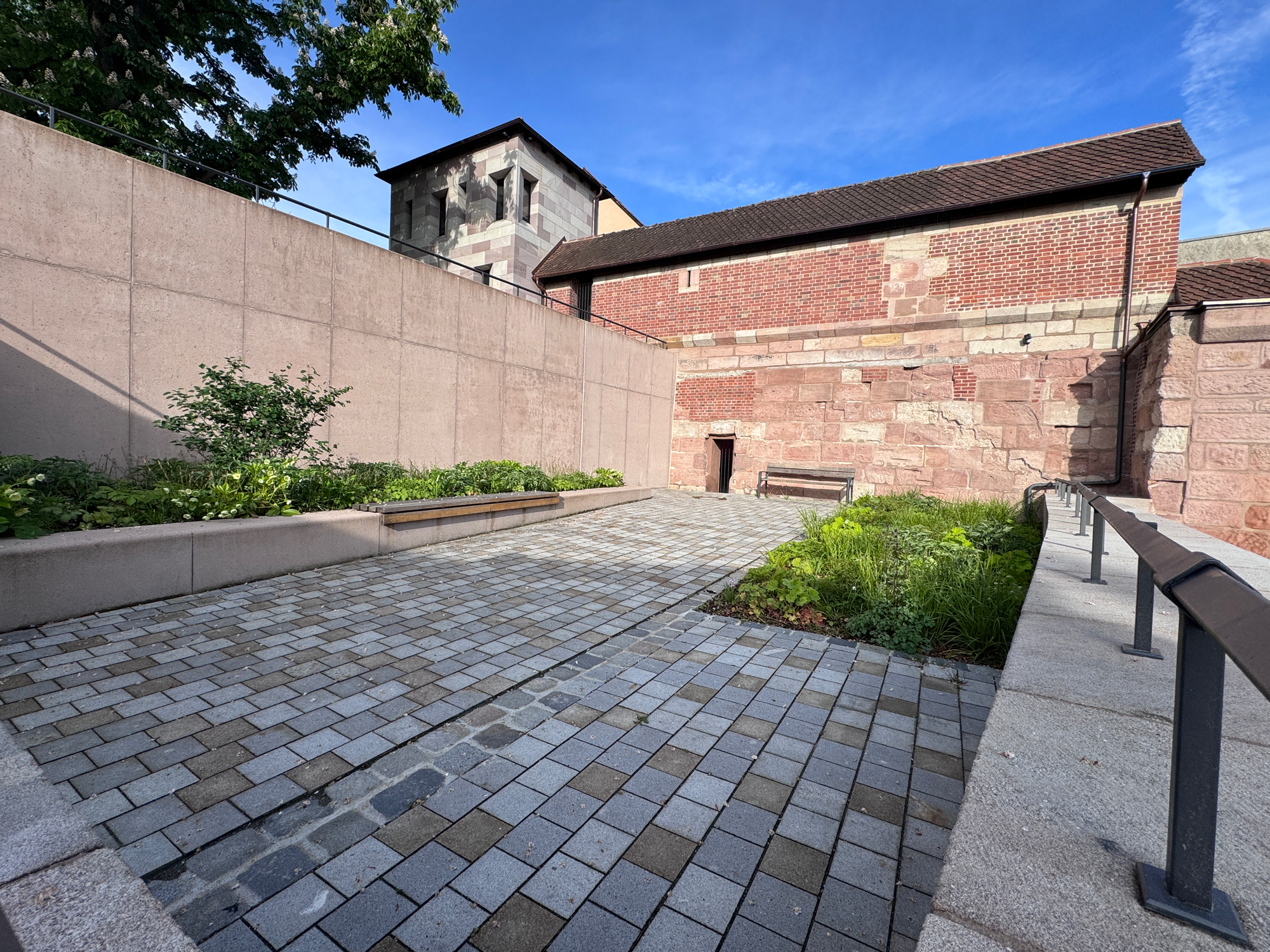
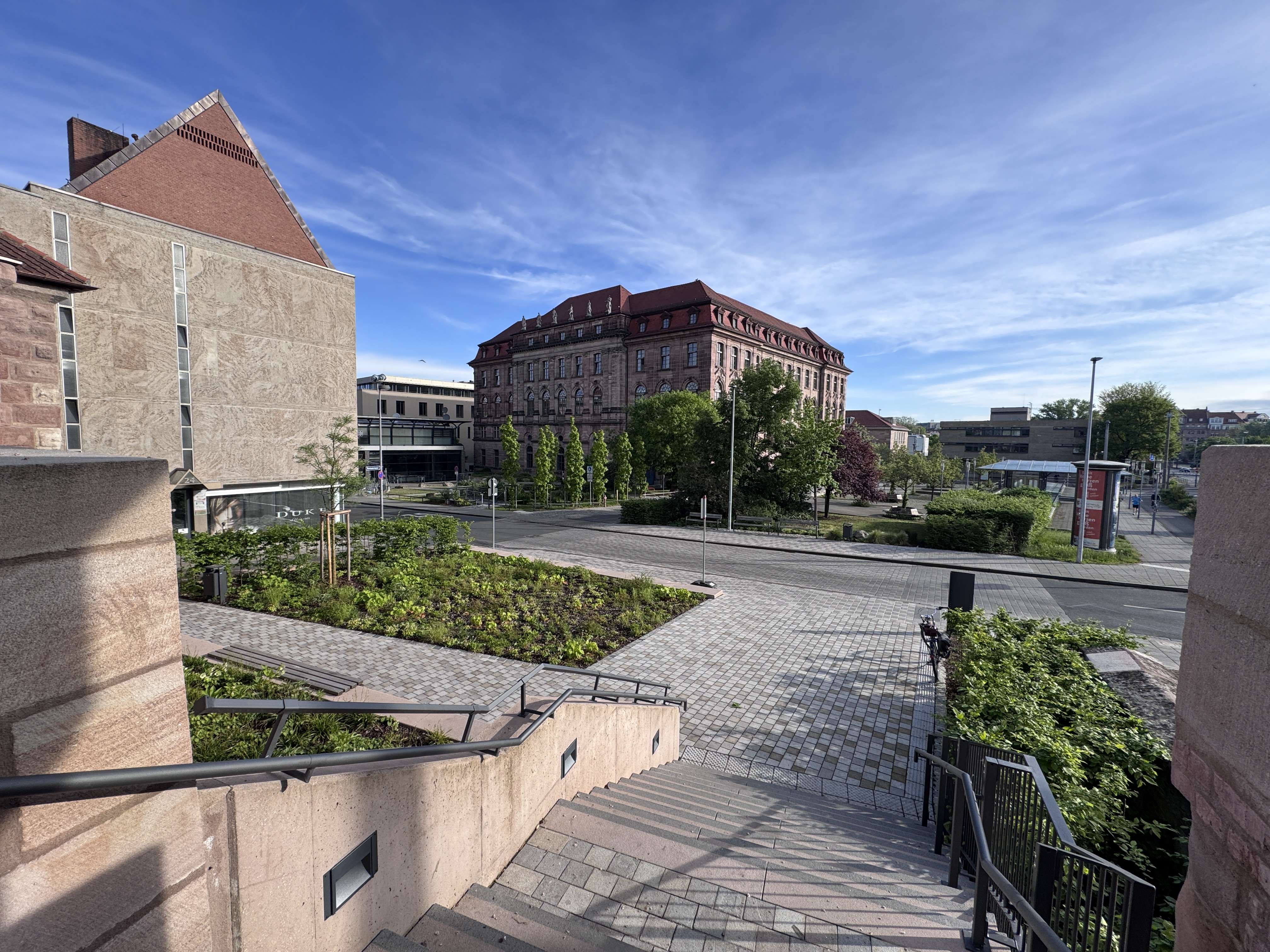
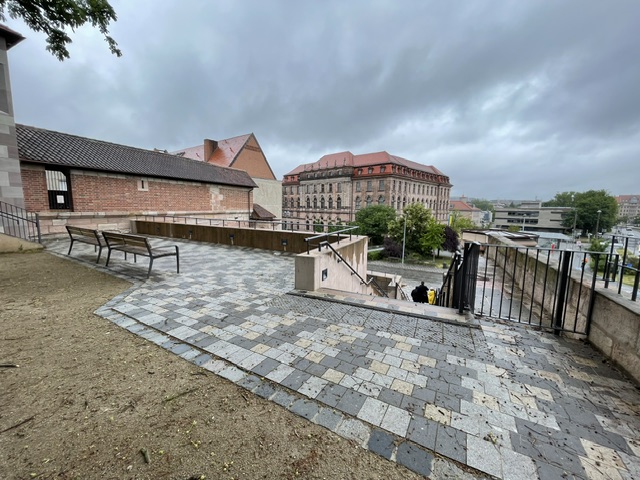
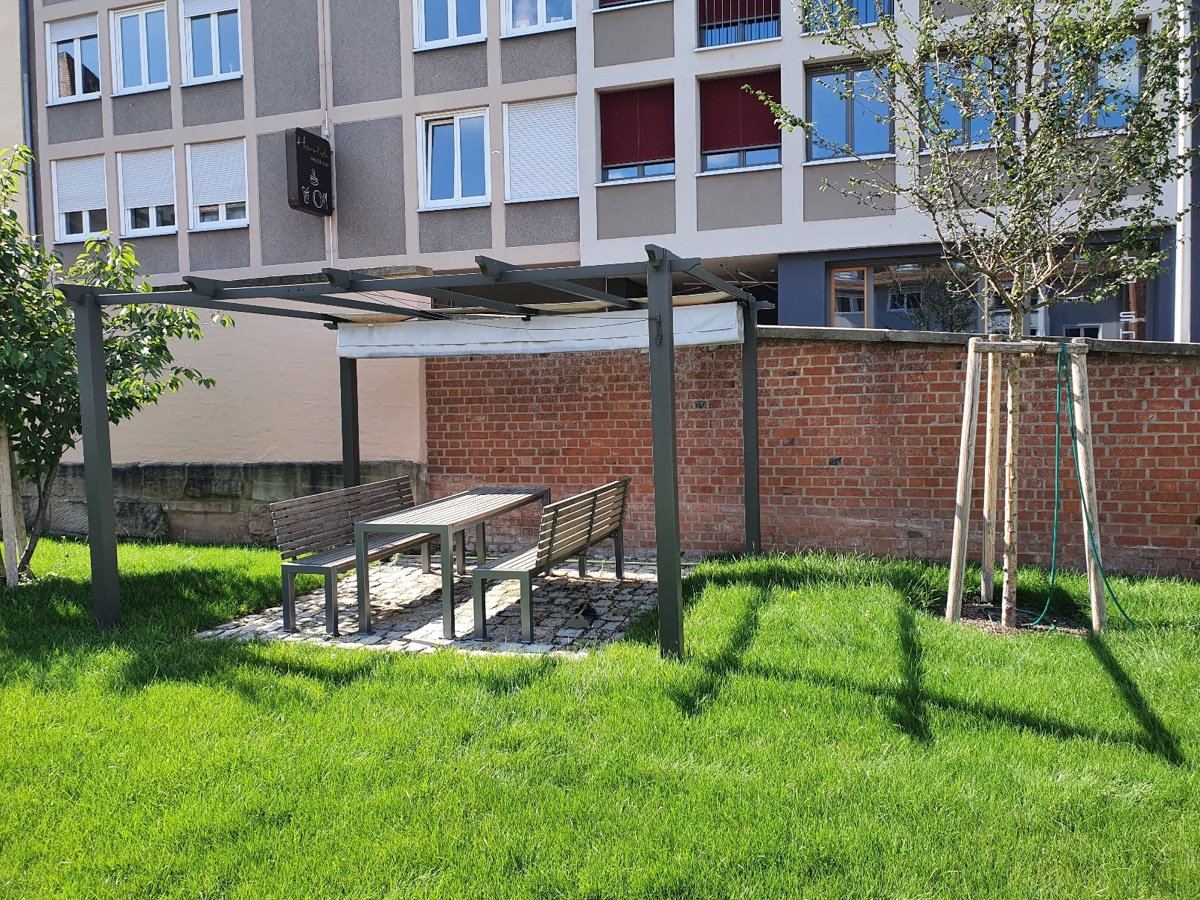
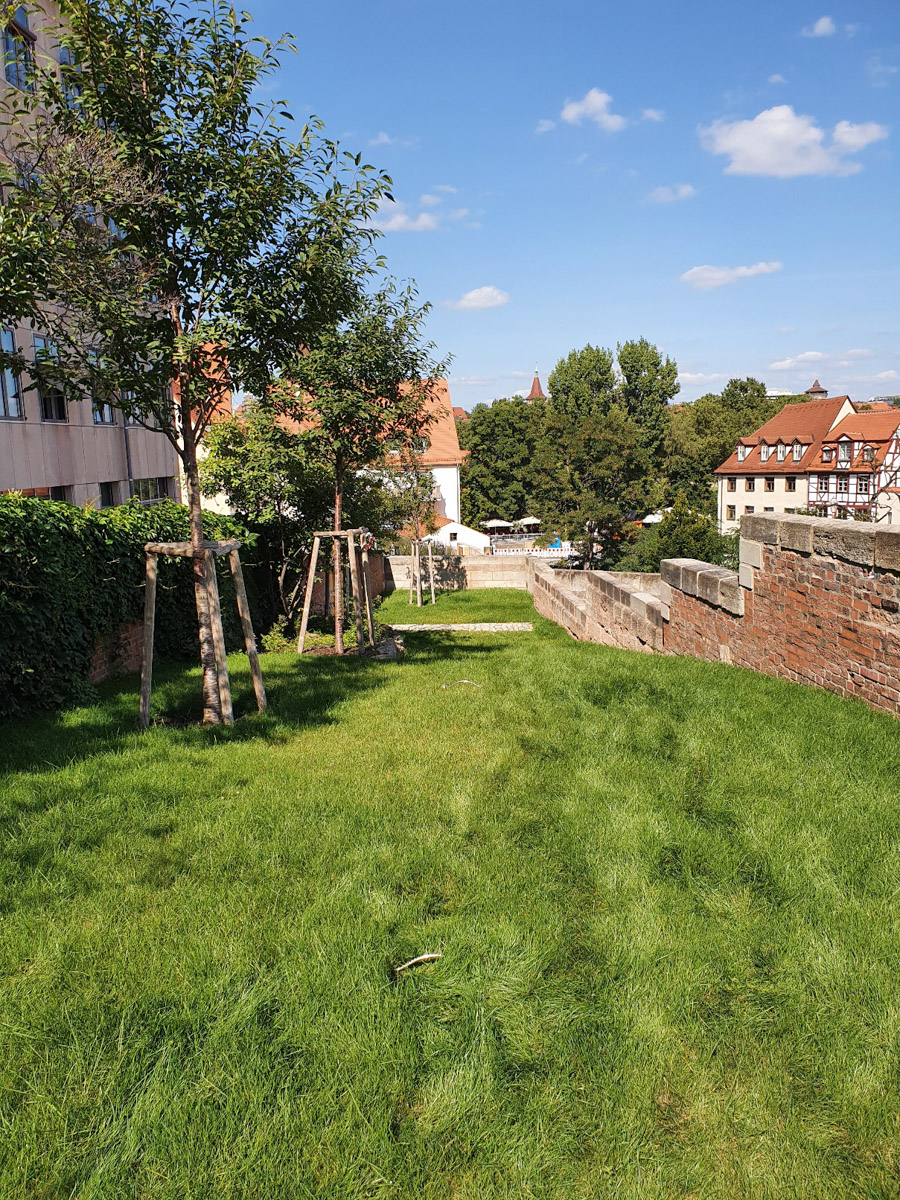
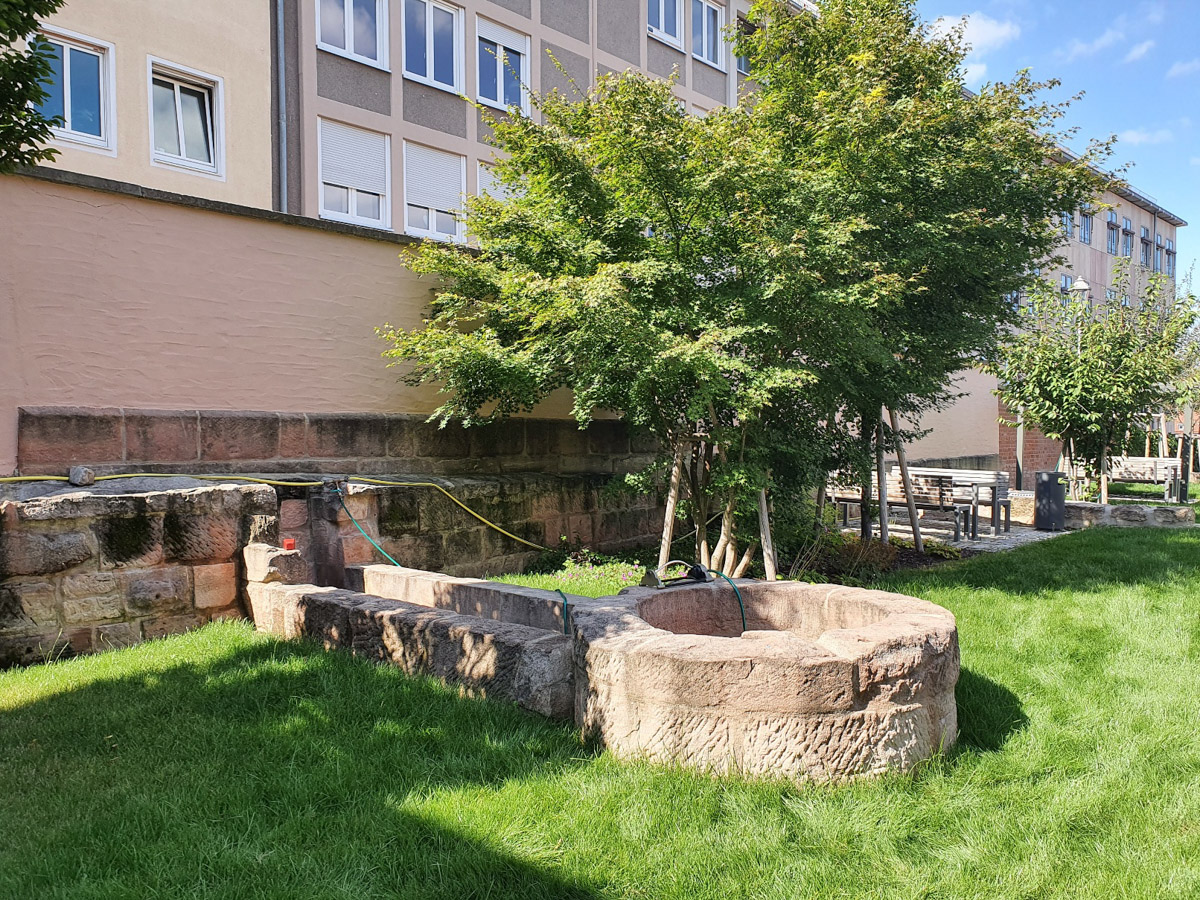
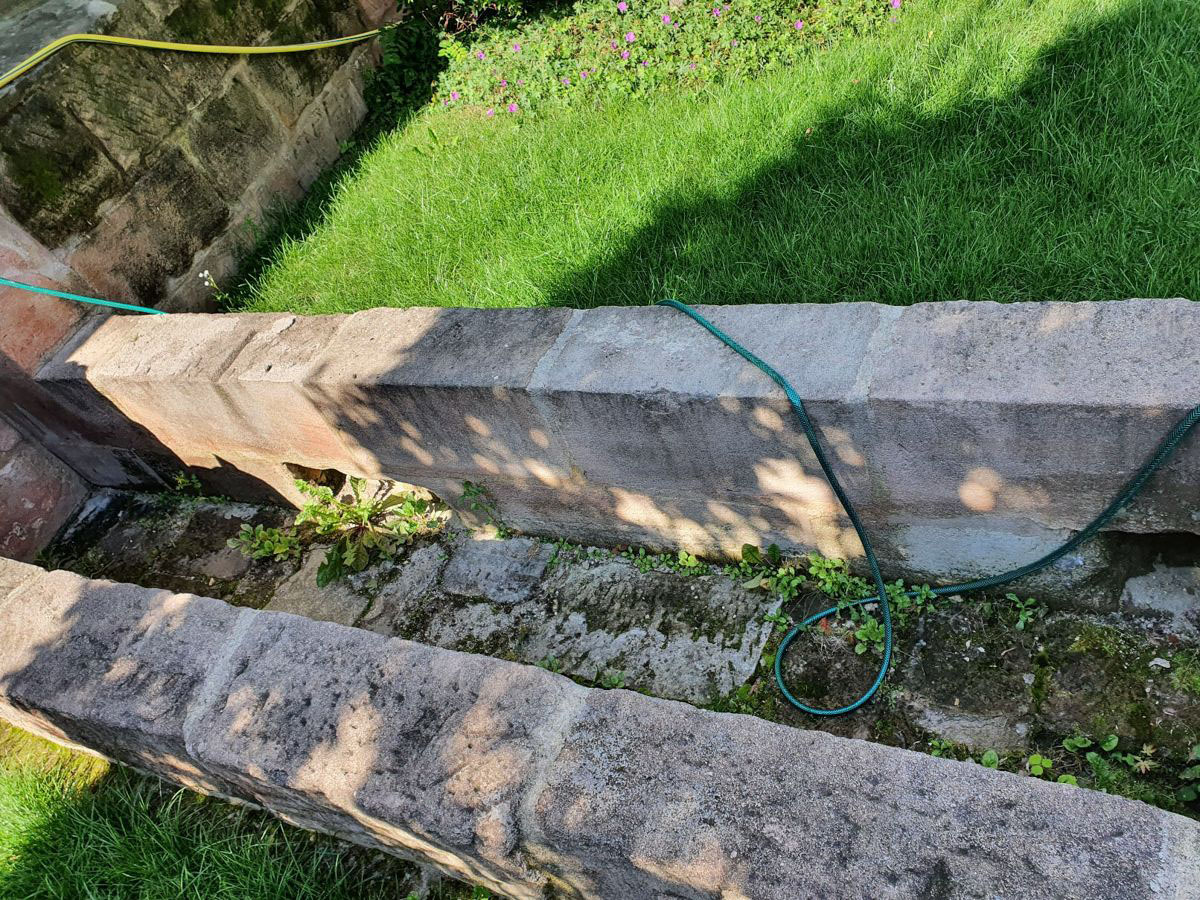
The newly designed Pocket Park at the Marientorzwinger opened in 2025. The result is a green space that allows visitors to experience the historic city walls directly. The small park, with its seating areas, extends across three levels spanning a height difference of seven metres and is accessible via a staircase. The lower and middle levels each have standstone walls to the rear, creating a stepped arrangement of usable areas.
The ensemble includes the reconstructed city wall tower known as the "Blaues G", where the association Geschichte für alle e.V. presents the history of Nuremberg's city walls.
Any intervention into the city wall — including drill holes or similar alterations — is not permitted. The planted areas must not be walked on and, like the trees, may not be fitted with or used to support artworks. No paint of any kind, including washable paint, may be applied to walls or surfaces.
Power supply: Schuko sockets, mains power
Installation: from Wednesday, 21 April 2027 / deinstall: Sunday, 25 April 2027
Access during The Blue Night | Die Blaue Nacht: via the staircase at Katharinengasse — not step-free